24/7 Emergency Water Damage Response Near Me
Starting price: Call for pricing
Water does not wait, and neither do we. Capital Restoration Services keeps emergency crews ready around the clock for burst pipes, appliance failures, storm intrusion, and every other sudden water loss. Fast extraction and drying in the first hours is what separates a cleanup from a rebuild.
What this service is
Emergency water damage response is the immediate answer to an active water event. A crew arrives, stops the spread, pulls out standing water, maps how far moisture traveled, and sets drying equipment running. Everything about this visit is about momentum: the faster water leaves the building, the less damage it leaves behind.
This is not the same as a scheduled drying appointment. Emergency response happens on the water's schedule, day or night, because the chemistry of damage does not pause for business hours. What begins as clean water from a supply line becomes contaminated gray water within about a day, and sewage or flood water is already a health hazard on arrival.
The 24-hour window nobody talks about
Water wicks. It climbs drywall at a measurable pace, runs under baseboards, and soaks carpet pad from beneath while the surface still looks fine. Within the first day, hardwood floors begin cupping, particleboard swells irreversibly, and moisture trapped in wall cavities creates the warm, dark conditions mold needs.
Mold colonization typically begins within 24 to 48 hours on wet organic materials. That timeline is the whole argument for emergency service. A crew that arrives tonight can often dry drywall in place. A crew that arrives Thursday may have to cut it out.
The category of the water matters too. Category 1 clean water, from a broken supply line or an overflowing tub, can sometimes be extracted and dried with materials left intact. Category 2 gray water, from a dishwasher or washing machine discharge, carries enough contamination that porous materials usually have to go. Category 3 black water, sewage or storm flooding, always requires removal and disinfection. We classify the water on arrival per the IICRC S500 standard, and that classification drives every decision after.
What happens when you call
You speak with a live dispatcher who asks a short set of questions: where the water is coming from, how many rooms are affected, whether it is still flowing, and whether sewage is involved. That tells us which equipment to load and whether you need extraction specialists, a sewage crew, or both.
If the water is still flowing and you have not found your main shutoff, we talk you through locating it while the truck rolls. Shutting off the source is the single most valuable thing you can do before we arrive, and it costs you nothing.
When the crew reaches the property, the first walkthrough is safety and mapping. We check for electrical hazards in standing water, then use pin meters, thermo-hygrometers, and infrared cameras to trace how far the moisture actually traveled, which is almost always further than the eye can see.
How the emergency visit unfolds
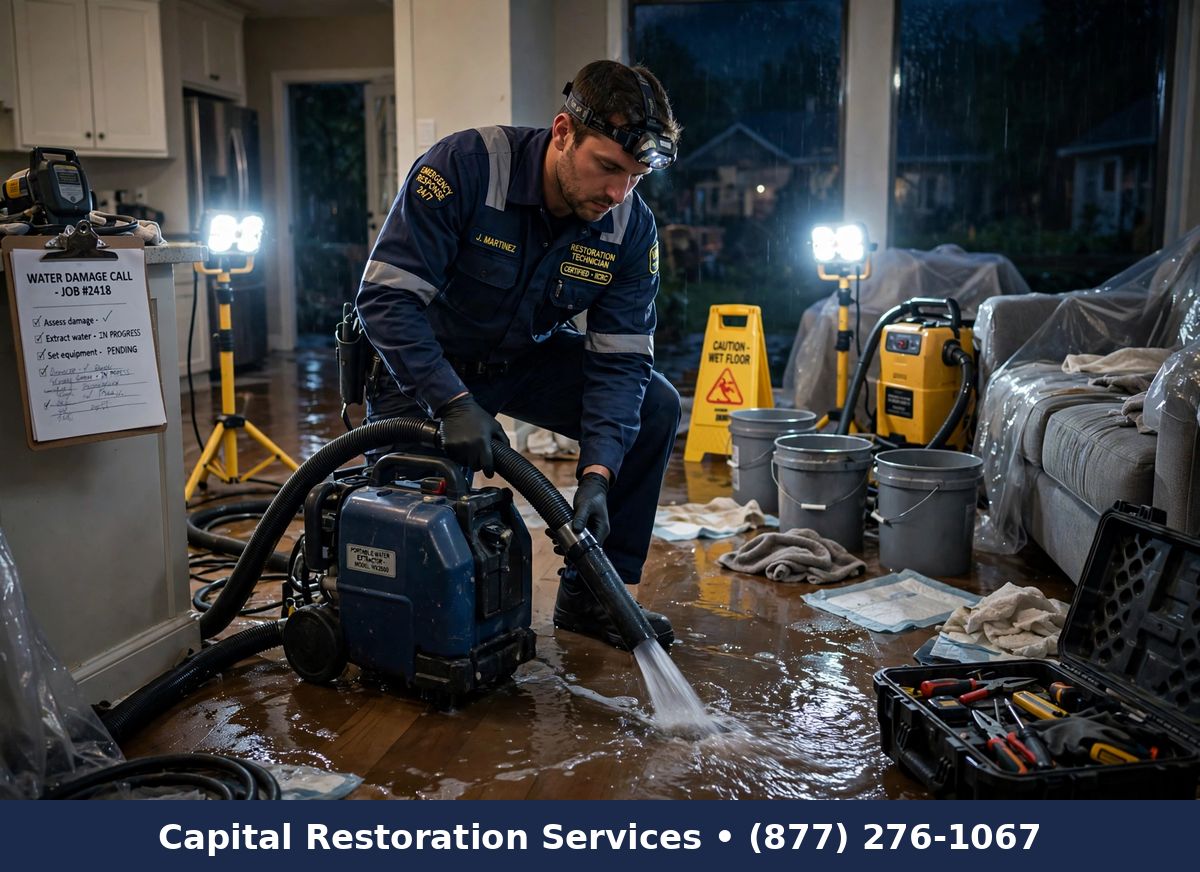
Extraction comes first. Truck-mounted or portable extractors pull standing water from floors, and weighted extraction tools squeeze water out of carpet and pad. Removing bulk water quickly is the highest-leverage step in the entire process.
Next is containment and equipment placement. Plastic sheeting seals wet rooms from dry ones so airborne moisture does not migrate. Air movers go along walls to drive evaporation, and low-grain refrigerant dehumidifiers pull that moisture out of the air. Placement follows the class of the loss, and every unit is logged.
Then monitoring begins. A technician returns daily to take moisture readings in walls, floors, and cavities, comparing them against dry standards for each material. Equipment stays until readings hold steady, and only then does the drying phase close out.
Materials that cannot be saved are handled honestly. Carpet pad soaked with gray water gets removed and replaced. Drywall that wicked water above the cut line gets cut at a clean flood line for efficient replacement. We remove what must go and dry what can stay.
What to do while the truck is on its way
Move what you can. Electronics, rugs, and valuables off wet floors save themselves; we cannot reverse water damage to a laptop, but we can keep it from happening. Lift furniture legs onto blocks or foil if you have them.
Do not run your HVAC fan, and do not plug in anything near standing water. Do vacuum with a household vacuum, and do not enter rooms where water meets electrical outlets. Common sense keeps you safe until we arrive.
Who we serve and how to reach us
Capital Restoration Services answers emergency water calls for homes, rentals, and businesses across the coverage area, from single-family houses to multi-unit buildings and offices. Whether it is a burst pipe at 2 a.m. or a dishwasher that flooded the kitchen at dinner, the response is the same: live dispatch, fast arrival, and documented drying. Call (877) 276-1067 now and we will be on our way.
Features
- Live 24/7 dispatch for floods, leaks, and pipe failures
- Rapid on-site water extraction with truck-mounted units
- Moisture mapping with meters and thermal imaging
- Emergency containment to stop water migrating to dry rooms
- Industrial dehumidifiers and air movers placed the same visit
- Category assessment per the IICRC S500 standard
- Photo and moisture documentation for insurance claims
Benefits
- Limits how far water wicks into walls, floors, and belongings
- Keeps a clean-water leak from degrading into contaminated gray or black water
- Reduces the chance of mold colonies taking hold in the first 48 hours
- Protects hardwood, drywall, and insulation that can sometimes be dried in place
- Creates the moisture documentation insurers ask for
- Gets drying equipment running the same day instead of next week
Frequently asked questions
What counts as a water damage emergency?
Any sudden, uncontrolled water: burst pipes, appliance failures, roof leaks, storm intrusion, sewage backups, sump pump failures. If water is actively spreading, that is an emergency.
How quickly can a crew reach me?
Usually within the hour for most of our coverage area. We confirm an arrival window when you call so you are never left guessing.
Should I shut off the water before you arrive?
If you can reach the main shutoff valve safely, turn it off first. It will not hurt anything, and it stops the most common sources like supply lines and appliance hoses.
Will you have to tear out my floors and walls?
Sometimes. Clean water caught fast can often be extracted and dried in place. Sewage or long-standing water usually requires removal of carpet pad, baseboards, and the lower sections of drywall. We assess before we cut anything.
How much does emergency water response cost?
It scales with how many rooms are wet, how long the water sat, the contamination category, and what materials need to go. We scope everything on site and walk you through it before work starts.