Basement Mold Remediation Near Me
Starting price: Call for pricing
Basements are where moisture goes to hide, and mold knows it. Below-grade walls, cool concrete, and poor airflow create the perfect conditions for hidden colonies. Capital Restoration Services remediates basement mold with full containment, then tackles the groundwater and humidity problems that invited it in.
Why basements grow mold differently
A basement lives below grade, surrounded by damp soil on three sides. Hydrostatic pressure pushes groundwater against the foundation constantly, and any crack, failed seal, or overwhelmed drain becomes an entry point. Add cool concrete surfaces that condense humid summer air, and you have a space that stays damp even when nothing is visibly leaking.
The mold that results hides well. It grows behind finished walls, under carpet, on the paper backing of drywall, and on the wooden bottom plates sitting on the slab. Homeowners usually discover it by smell: that unmistakable musty basement odor is microbial volatile organic compounds, the gases mold releases as it digests material. If your basement smells musty, something is growing somewhere.
Finished basements complicate everything. Drywall, insulation, and carpet turn a concrete box into rooms, but they also give mold a buffet of food and hide it from view. A finished basement with a moisture problem is almost always worse underneath than it looks on the surface.
What the inspection covers
We start by finding the water. Moisture meters check walls at multiple heights, because the pattern tells the story: moisture low on the wall suggests groundwater or the cove joint; moisture high suggests a plumbing leak or exterior grading issue; moisture everywhere suggests chronic humidity. Infrared cameras find the cold, damp spots the eye misses.
Then we look at the systems that are supposed to keep the basement dry. Is the sump pump working, and is there a backup for power outages? Does exterior grading slope away from the foundation? Are gutters discharging at the foundation or piped away? Do window wells drain? Most basement mold jobs trace back to one of these, and fixing it is part of the permanent solution.
We also distinguish mold from its lookalikes. White efflorescence on block walls is mineral salt, not mold, and it calls for waterproofing assessment rather than remediation. We test ambiguous growth rather than guessing, because the wrong diagnosis wastes your money.
How the remediation works
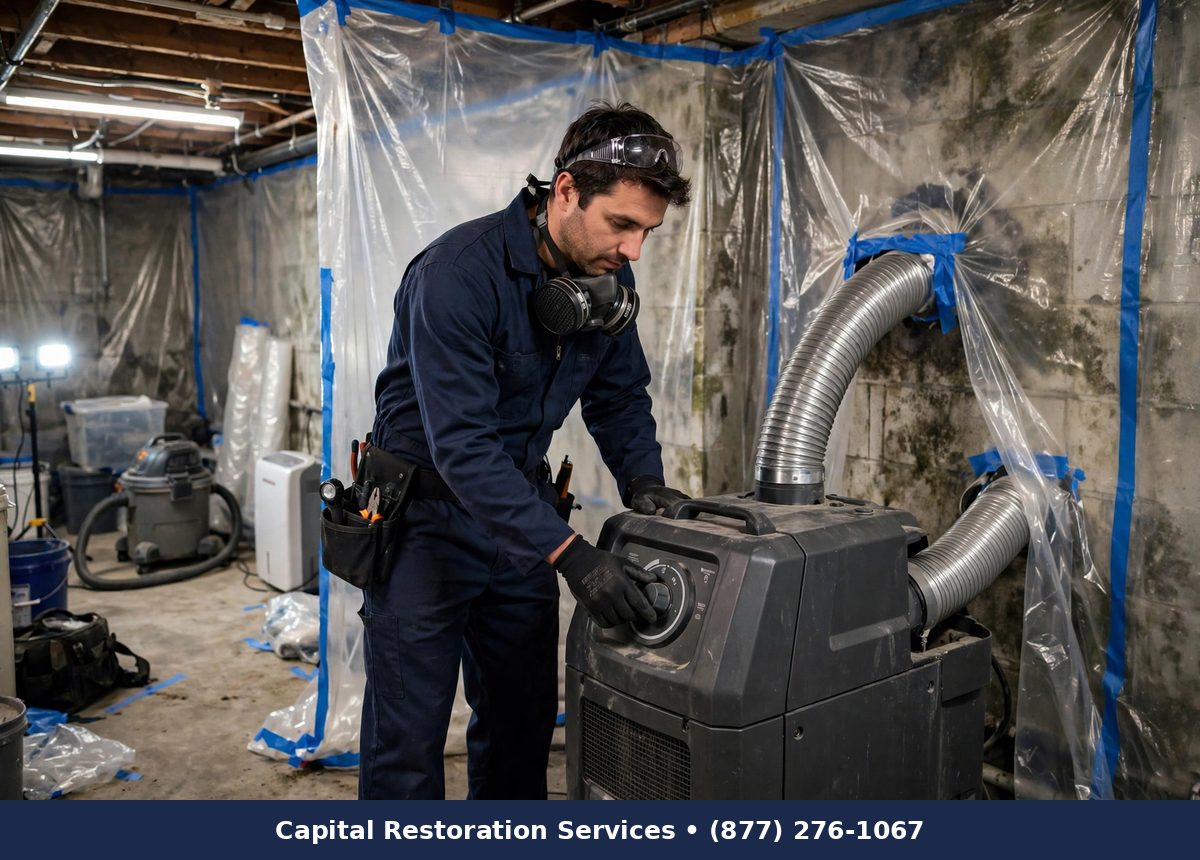
Containment goes up first. Polyethylene barriers seal the basement from the upstairs, and HEPA-filtered negative air keeps the work zone under negative pressure. Basement remediation disturbs a lot of material, and without containment the spores ride the stack effect straight into your living room.
Finished materials that are mold-damaged come out: drywall that wicked moisture, insulation behind it, carpet and pad that stayed damp. These are bagged and removed. Structural surfaces, block walls, poured concrete, and framing that is still sound, get HEPA vacuuming, cleaning, and antimicrobial treatment.
Contents get triaged honestly. Cardboard boxes that sat on a damp floor are usually a loss. Plastic bins, metal shelving, and sealed items typically clean up fine. We help you sort rather than billing you to clean trash.
Fixing what invited the mold
Remediation without moisture correction is temporary. Our report includes specific recommendations: regrade soil away from the foundation, extend downspouts, service or replace the sump pump, add a battery backup, seal the cove joint, or improve dehumidification. We handle the remediation; some corrections are our work and some belong to waterproofing or plumbing contractors, and we tell you which is which.
Dehumidification deserves emphasis. Even a basement with no active leak can sit at 70 percent relative humidity in summer, which is plenty for mold. A properly sized dehumidifier with a drain to the sump keeps the space below the threshold where mold thrives, and it is the cheapest long-term protection a basement can have.
Cost factors
Affected square footage leads, followed by how much finished material must be removed. A small colony on one unfinished wall is contained work. A finished basement with growth behind every wall is a larger project. The moisture correction, sump work, and dehumidification are scoped separately so you see exactly where the investment goes.
Serving homes across the coverage area
Capital Restoration Services remediates basement mold in single-family homes, duplexes, and commercial lower levels throughout the coverage area, and every job ends with verification that the space is dry and clean. If your basement smells musty or an inspection found growth, call (877) 276-1067 for a diagnosis that finds the water, not just the mold.
Features
- Full basement inspection with moisture source diagnosis
- Containment barriers and negative-air pressure setup
- HEPA vacuuming of all affected surfaces and contents
- Removal of mold-damaged drywall, insulation, and carpet
- Cleaning and antimicrobial treatment of masonry and framing
- Sump, grading, and drainage assessment with recommendations
- Post-remediation verification and moisture documentation
Benefits
- Removes the colony from the lowest, dampest level of your home
- Addresses the below-grade moisture drivers other rooms never face
- Stops musty basement air from rising into the living spaces
- Protects stored belongings, finished walls, and mechanical systems
- Identifies grading, drainage, and sump issues feeding the problem
- Leaves the basement dry, documented, and ready to finish or use
Frequently asked questions
Why is mold so common in basements?
Hydrostatic pressure pushing groundwater through walls and floors, poor exterior grading, failed or missing sump pumps, plumbing leaks, and chronic high humidity. Basements sit in the dampest part of the building envelope, so moisture finds them first.
Can mold grow on concrete?
Concrete itself does not feed mold, but the dust, paint, drywall, wood framing, and stored cardboard against it do. Mold grows on the organic materials touching the concrete, not the concrete itself.
Will you have to tear out my basement walls?
Often yes, if the block or poured walls are sound and the moisture source is fixed. Finished basement drywall that wicked water usually has to go, but the structural walls themselves are cleaned and treated, not demolished.
How do I tell mold from efflorescence?
White, powdery efflorescence is mineral salt left by water moving through masonry, not mold. It wipes off and does not smear. Mold smears and often has a musty smell. We test when it is ambiguous.
How much does basement mold remediation cost?
It depends on the affected area, whether finished walls must be removed, the moisture source that needs correcting, and the basement's size and access. We inspect first and scope the work before anything begins.