Basement Water Damage Restoration Near Me
Starting price: Call for pricing
Basement flooding is a race against the slab. Groundwater, sump failures, and storm intrusion pool on concrete and wick into everything touching it. Capital Restoration Services restores flooded basements with fast extraction, structural drying, and honest decisions about what can be saved.
How basements flood
Most basement floods are groundwater events. Heavy rain saturates the soil, hydrostatic pressure builds against the foundation, and water finds the weak points: the cove joint where wall meets floor, hairline foundation cracks, window wells without drainage, or a sump pit whose pump quit at the worst possible moment. The water that comes in is rarely clean, and it keeps coming until the rain stops or the pump is replaced.
Sump pump failure deserves its own mention because it is the most common single cause we see. Pumps die from age, from float switches sticking, from discharge lines freezing or clogging, and from power outages during the exact storms that need them most. A basement that has never leaked can take on inches of water in one night when the pump fails.
Plumbing breaks are the other category. A burst supply line, a failed water heater, or a washing machine hose on an upper floor sends clean water down through the house to the lowest point. The basement collects everyone else's leak.
The first hours
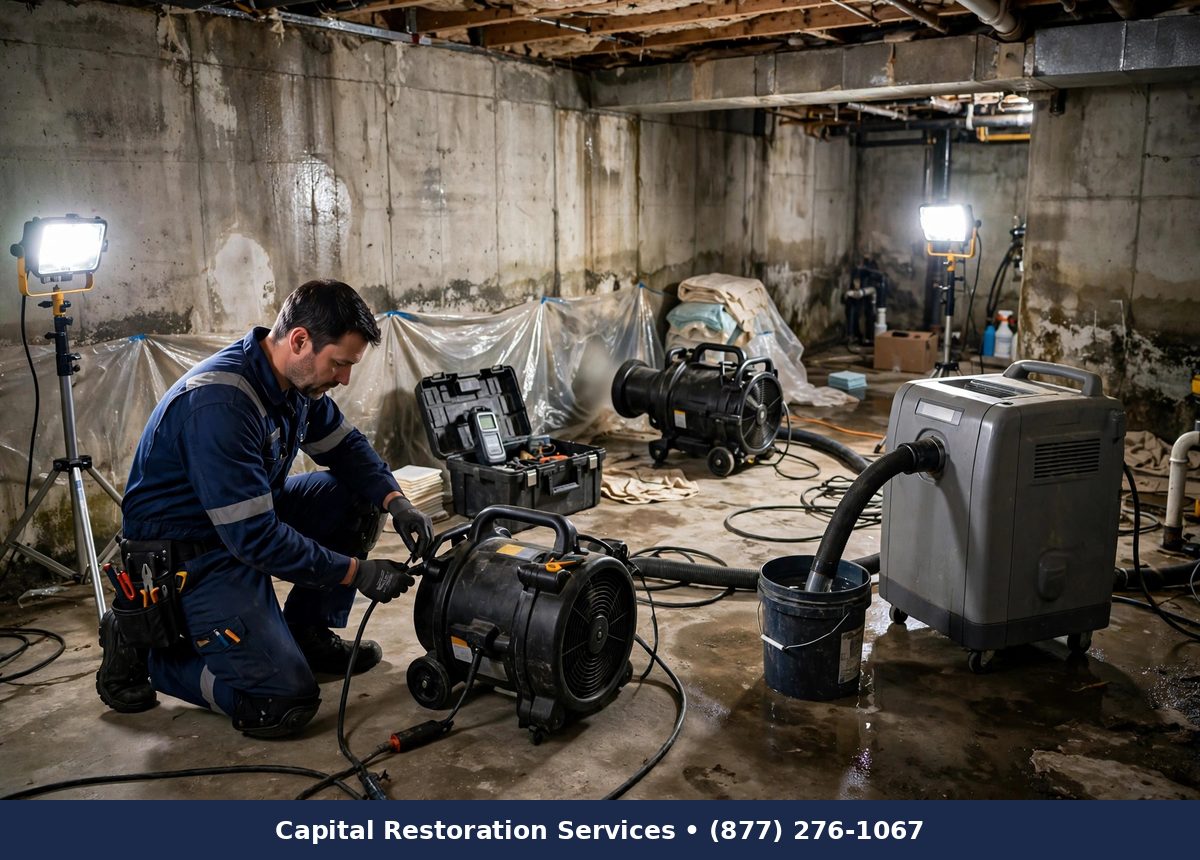
Extraction is everything. Pumps and truck-mounted extractors pull standing water off the slab as fast as it can be moved, because every hour of standing water is an hour of wicking into drywall, framing, and stored belongings. If the water is still rising, we work the extraction while the source is addressed, sump replaced or rain subsiding.
Safety comes with the water. Electricity and standing water are a dangerous pair, so the crew checks panels, outlets, and appliances before wading in. Furnaces and water heaters sitting in water get assessed before anyone restarts them. We do not guess with utilities.
Then the mapping. Moisture meters check how high water wicked into drywall, infrared finds the damp areas behind finished walls, and the slab itself gets tested. The map decides the whole plan: what dries, what gets cut, and where equipment goes.
Drying a basement properly
Basements dry slowly. Cool concrete, minimal airflow, and high ambient humidity fight every step of the process, which is why basement jobs get the heavy equipment: low-grain refrigerant dehumidifiers sized to the space and air movers positioned to drive air across wet walls and floors. A residential dehumidifier from the hardware store is not in the same league.
Finished materials get honest triage. Drywall that wicked water gets a flood cut, typically a clean horizontal line above the damage, so replacement is efficient and the remaining wall dries fully. Carpet pad comes out in every flood; it is a sponge that cannot be reliably dried or disinfected. Carpet itself is evaluated by water category: clean water caught fast can sometimes be dried and cleaned, while gray or black water means replacement.
Unfinished basements are more forgiving. Bare block walls and concrete slabs dry well with equipment and time, and contents on shelving often survive untouched. The drying goal is the same everywhere: verified dry readings on every material, not just surfaces that feel dry to the touch.
The contamination question
Groundwater intrusion and storm water count as contaminated. That changes the protocol: porous materials that touched the water get removed rather than dried, and remaining surfaces get disinfected after drying. It is more demolition than a clean-water loss, but it is the only safe approach.
Sewage backup is the extreme case, handled with full PPE, containment, removal of all porous materials in the affected area, and thorough disinfection. If your basement flood smells like sewage, say so when you call, because it changes the crew and equipment we send.
What shapes the cost
Water depth and spread are the headline factors, followed by contamination category and how much finished material must go. A few inches of clean water on an unfinished slab is a contained job. A finished basement under a foot of storm water is a major project. Drying duration, equipment count, and any mold remediation needed afterward all factor into the final scope.
Who we help
Capital Restoration Services restores flooded basements in homes, rentals, and commercial buildings across the coverage area, from emergency pumping at midnight to the final verified dry-out. If water is in your basement now, call (877) 276-1067. Every hour it sits, the job gets bigger.
Features
- Emergency pumping and extraction of standing water
- Moisture mapping of walls, slab, and finished materials
- Targeted drying with air movers and LGR dehumidifiers
- Removal of saturated carpet pad and unsalvageable drywall
- Flood cuts at clean lines for efficient drywall replacement
- Antimicrobial treatment of affected surfaces after drying
- Daily moisture monitoring until verified dry
Benefits
- Gets standing water out before it wicks into walls and framing
- Dries the slab and structure to verified dry standards
- Removes unsalvageable pad, carpet, and drywall cleanly
- Stops the mold timeline that starts within 48 hours
- Protects furnaces, water heaters, and electrical panels from corrosion
- Creates insurance-ready documentation of the entire loss
Frequently asked questions
What causes basement flooding?
Sump pump failure during heavy rain, hydrostatic pressure through cracks and the cove joint, window well overflow, plumbing breaks, and storm water entering through doors or stairwells. Most basement floods trace to one of these.
My sump pump just died and water is coming in. What now?
Call immediately. A failed sump during a storm means water is still rising, and every hour adds to the damage. We dispatch for active flooding around the clock.
Can everything in a flooded basement be saved?
Bare concrete and block walls usually yes. Carpet pad almost never. Finished drywall that wicked water usually gets cut at a flood line. We assess each material against what can actually be dried.
Should I move my stored belongings first?
It can be, carefully. Electronics and valuables go upstairs first. We handle the rest during extraction and triage, and we photograph everything for your claim.
How much does basement water restoration cost?
It depends on the water depth and spread, the contamination category, how much finished material must be removed, and the drying time required. We scope it on site before work begins.