Black Mold Removal Near Me
Starting price: Call for pricing
Black mold has a frightening reputation, and finding it in your home is genuinely alarming. Capital Restoration Services handles black mold removal with the seriousness it deserves: full containment, complete physical removal, moisture source correction, and verification that the job is truly done.
What black mold is, without the hype
The mold people call black mold is most often Stachybotrys chartarum, a greenish-black species that colonizes cellulose-rich materials, drywall, wood, paper, ceiling tiles, after they stay wet for an extended period. It needs constant moisture, far more than most molds, which is why it shows up after floods, long-term leaks, and chronic condensation rather than a single damp weekend.
Here is what the CDC actually says, and it matters: there is no test proving a link between Stachybotrys and specific health symptoms, and all indoor molds should be treated the same for health risks and removal. The color does not change the protocol. What changes the protocol is the extent of growth and the moisture feeding it.
That said, black mold deserves respect for practical reasons. Its colonies are often extensive by the time they are visible, because the constant moisture they need usually means a serious, long-running water problem. Finding Stachybotrys is finding a leak that has been active for weeks or months, and the remediation has to address both.
Why you should not handle it yourself
Disturbing a colony releases spores in large numbers, especially as the growth dries. A homeowner scrubbing black mold off a wall without containment sends those spores through the HVAC system and into every room. Painting over it seals in the moisture and the colony, which continues growing behind the paint.
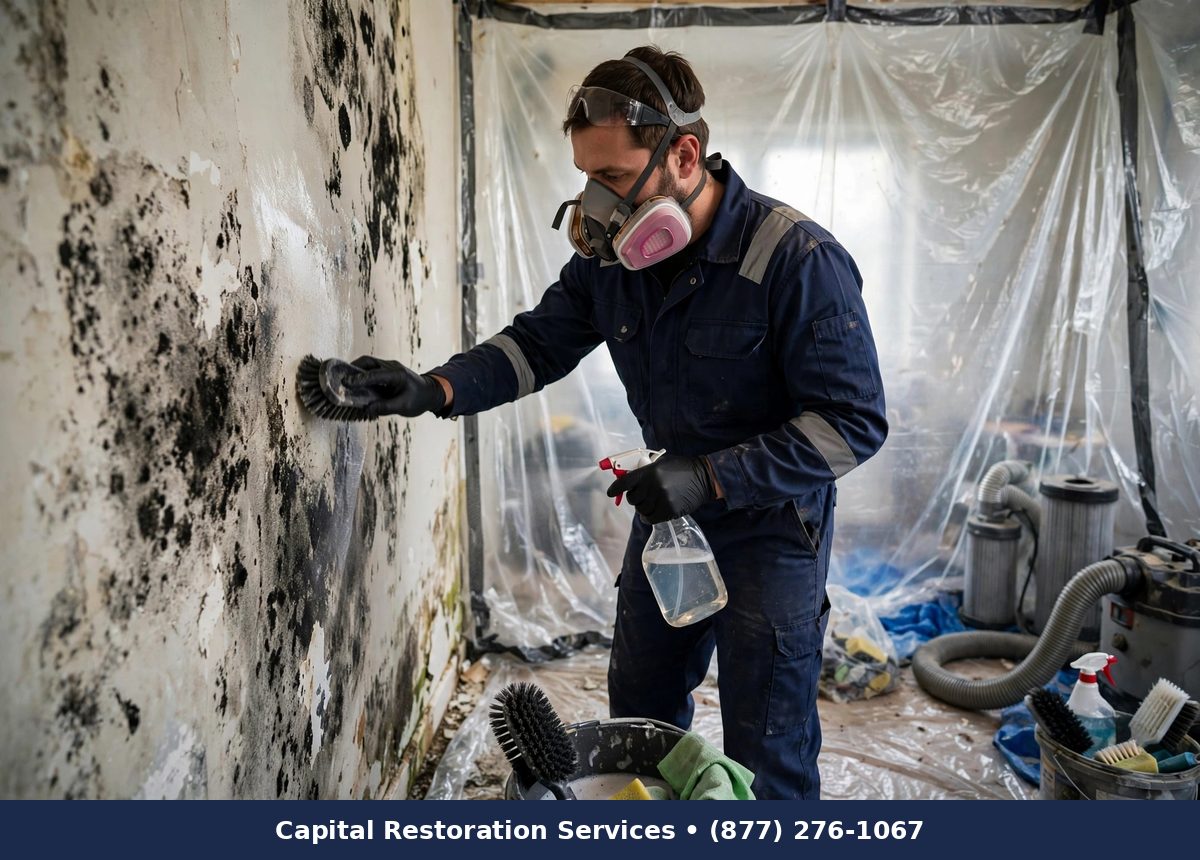
Professional removal exists precisely because of this. Containment barriers, negative-air pressure, HEPA filtration, and proper PPE keep the spores in the work zone while the colony comes out. It is the difference between removing the problem and redistributing it.
There is also the moisture source. Black mold cannot exist without sustained water, so every legitimate remediation includes finding and fixing the leak, the condensation, or the flooding that allowed it. A company that offers to spray the mold and leave has not understood the assignment.
How professional removal works
It starts with investigation, not demolition. We map the visible growth, then use moisture meters and sometimes thermal imaging to find how far the water traveled behind and beneath it. The moisture map defines the removal boundaries, because cutting too little leaves colony behind and cutting too much wastes your money.
Containment goes up before anything is disturbed. Polyethylene sheeting seals the work area, a HEPA-filtered negative-air machine keeps it under negative pressure, and HVAC vents in the zone get sealed. Then contaminated materials come out: drywall, insulation, carpet, and any other porous materials the colony has penetrated. Non-porous surfaces that can be cleaned get HEPA vacuuming and detailed cleaning.
Structural wood that is sound but affected gets cleaned and treated rather than replaced. Framing with surface growth cleans up well in most cases; framing that has rotted does not, and we mark it for repair. Every decision is documented with photos.
Verification and the moisture fix
After removal and cleaning, the work area gets a detailed visual inspection: no visible growth, no mold-damaged materials, no musty odor. The EPA's own success criteria center on exactly these points, plus the critical requirement that the moisture problem is completely fixed. We verify dry readings on all remaining materials before containment comes down.
Post-remediation verification testing is available when you want independent confirmation, and it is often worth it for real estate transactions, landlord-tenant situations, and anyone who wants third-party peace of mind. We coordinate with qualified independent testers rather than testing our own work.
The moisture source gets fixed as part of the project plan. Roof leak, plumbing failure, grading problem, condensation issue, whatever fed the colony gets addressed before we call the job complete, because black mold in a still-wet building is a countdown to the next remediation.
Cost factors
The affected area is the primary driver, along with how many materials must be removed versus cleaned. A contained colony on one wall section is straightforward. Growth spread through wall cavities across multiple rooms, with the plumbing or roofing work needed to stop the moisture, is a larger project. Verification testing is scoped as its own line item so you can decide.
How we serve your area
Capital Restoration Services removes black mold from homes, rentals, and commercial properties across the coverage area with full containment and documented verification. If you have found dark growth and a musty smell that will not go away, call (877) 276-1067. We will find the water feeding it and remove both.
Features
- Professional identification and moisture source investigation
- Full containment with negative-air pressure during removal
- Complete physical removal of contaminated materials
- HEPA vacuuming and detailed cleaning of the work area
- Antimicrobial treatment of remaining structural surfaces
- Moisture source repair coordination and verification
- Post-remediation inspection with testing options
Benefits
- Removes the colony completely instead of just bleaching the surface
- Identifies the chronic moisture source black mold requires
- Protects your household during removal with full containment
- Prevents spores from spreading to clean rooms during the work
- Verifies the job with post-remediation inspection and testing options
- Gives you clear documentation for buyers, landlords, and insurers
Frequently asked questions
What exactly is black mold?
It is usually Stachybotrys chartarum, a greenish-black mold that grows on cellulose materials like drywall and wood after prolonged moisture. The CDC notes it needs constant moisture to grow, which means finding it always means finding a water problem too.
How do I know if my mold is the dangerous kind?
You cannot, reliably. Many molds look black, and color alone does not identify the species. The CDC's position is that all indoor mold should be treated the same for health and removal purposes, regardless of color. We remediate what we find without waiting on lab results.
Is it safe to disturb black mold?
It can release a large burst of spores when disturbed or dried out, which is why containment and negative air matter so much. This is also why scrubbing it yourself or painting over it usually makes things worse.
Will a mold spray from the store fix it?
Surface products cannot reach growth inside drywall, wood, or insulation, and dead mold left in place still causes the same concerns. Physical removal of contaminated materials is the only reliable approach.
How much does black mold removal cost?
It depends on the size of the affected area, how many materials must be removed, the moisture source that needs fixing, and whether verification testing is included. We inspect first and scope the work before anything begins.