Burst Pipe Water Damage Repair Near Me
Starting price: Call for pricing
A burst pipe can release hundreds of gallons before anyone notices, soaking walls, floors, and ceilings in minutes. Capital Restoration Services responds to burst pipe emergencies with immediate shutoff guidance, rapid extraction, and complete structural drying, then repairs the water damage the burst left behind.
How a pipe bursts
The classic winter burst starts with ice. Water trapped in a pipe freezes and expands, and the expanding ice pushes liquid water toward the closed faucet. Pressure builds enormously in that trapped section until the pipe wall gives way, and the split often happens some distance from the frozen section itself. That is why a pipe can burst inside a finished wall while the exposed pipe in the crawlspace looks fine.
Thawing is when the flooding starts. The ice held the split closed; once it melts, pressurized water pours through the fracture. Many burst-pipe floods are discovered in the morning after a cold night, when the homeowner wakes to water running through the ceiling.
Not every burst involves ice. Older galvanized pipes corrode from the inside until the wall is paper-thin, then fail under normal pressure. Excessive municipal water pressure stresses every joint in the system. Water hammer, the shock wave from a valve slamming shut, can split a weakened section. Each cause leaves a different signature, and the plumber's repair depends on knowing which one it was.
The damage a burst pipe does
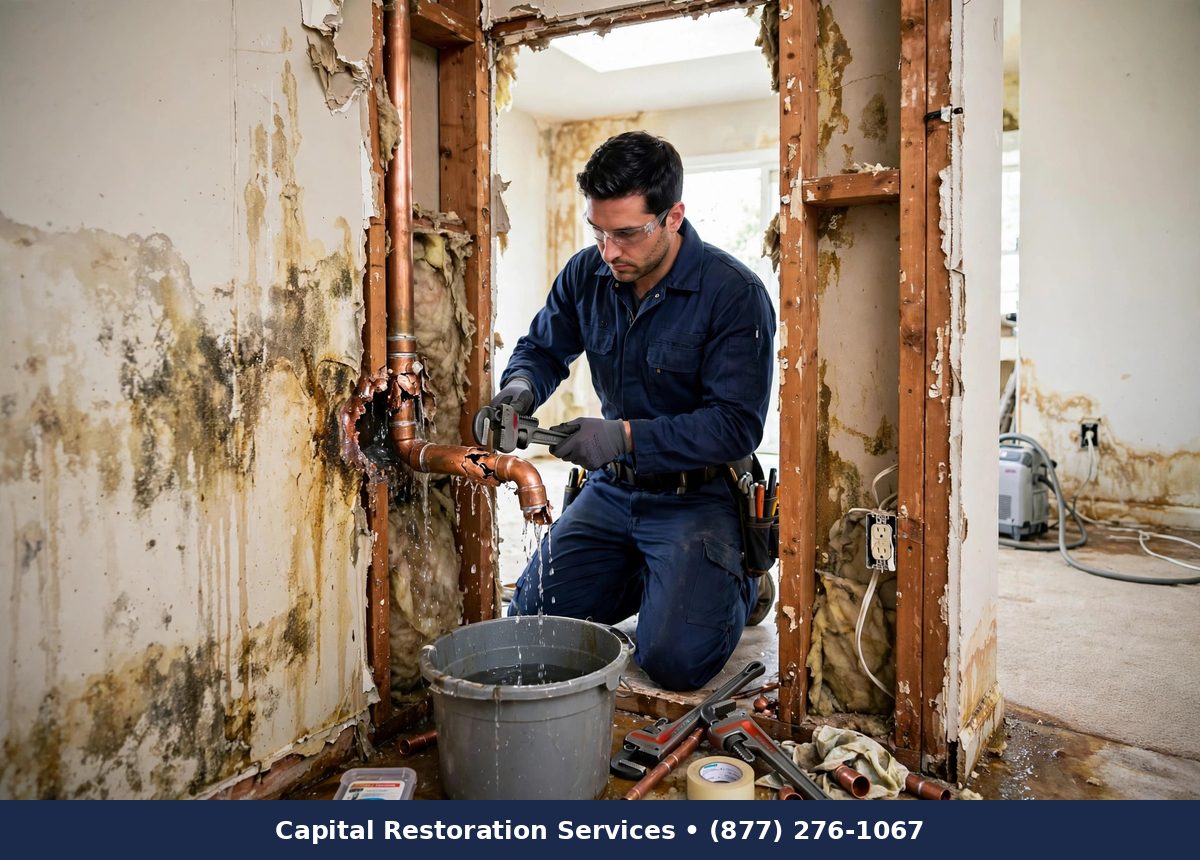
A supply line under full pressure moves an enormous volume of water fast. Within minutes it soaks drywall, insulation, subfloor, and framing across multiple rooms, and on upper floors it rains down through ceilings to the levels below. What looks like a kitchen flood is often a two-story loss by the time anyone sees it.
Water follows gravity and the path of least resistance: down inside wall cavities, along the top of ceilings, under flooring, into ductwork chases. Our moisture mapping routinely finds wet areas two rooms away from the burst, in places with no visible sign at all. That hidden migration is why professional drying matters more here than in almost any other water loss.
The materials tell their own story. Drywall wicks water upward and loses structural integrity. Insulation saturates and holds moisture against framing. Hardwood cups and buckles. Particleboard subfloor swells permanently. Each material gets assessed against whether it can truly be dried or must be replaced.
How we handle the emergency
Your first call reaches a live dispatcher who asks where the water is coming from and whether you have shut off the main valve. If you have not found it, we guide you to it while the truck rolls, because stopping the flow is worth more than anything we do after arrival.
On site, the crew extracts standing water first with truck-mounted or portable units, then maps the full extent of migration with meters and infrared cameras. Drying equipment goes in the same visit: air movers along wet walls, dehumidifiers sized to the loss, and sometimes injection drying for trapped wall cavities.
Demolition is surgical. We remove what cannot be dried, baseboards to dry behind them, lower drywall sections that wicked beyond saving, saturated insulation, and nothing more. Every cut is photographed before and after, which is exactly the documentation adjusters want.
The pipe repair itself is plumber's work, and we coordinate with yours or help you find one. Our lane is the water damage: extraction, drying, demolition of unsalvageable materials, and preparing the space for the rebuild.
Preventing the next one
After the emergency, prevention is worth a conversation. Pipes in unheated spaces, attics, crawlspaces, garages, and exterior walls, need insulation and, in severe cold, supplemental heat. Letting faucets drip during extreme cold can relieve pressure, and keeping cabinet doors open lets warm room air reach supply lines.
Know your main shutoff location before you need it. In a burst-pipe emergency, the minutes spent searching for the valve are the most expensive minutes of the whole event. A quarter-turn ball valve, clearly labeled and accessible, is one of the cheapest insurance policies a home can have.
Cost factors
Volume and spread dominate: how long the water ran and how many rooms and levels it reached. Material types, contamination is not usually a factor with supply-line bursts, access to wall cavities, and the drying duration all shape the scope. The plumbing repair is a separate trade with its own cost, and we keep the two scopes clearly distinct.
How we serve your area
Capital Restoration Services answers burst pipe emergencies across the coverage area around the clock, because pipes do not respect business hours. If water is flowing now, call (877) 276-1067 and we will talk you through the shutoff while the crew is already rolling.
Features
- Emergency shutoff guidance while the crew is en route
- Rapid extraction with truck-mounted and portable units
- Moisture mapping through walls, ceilings, and floors
- Structural drying with air movers and dehumidifiers
- Targeted demolition only where materials cannot be dried
- Coordination with your plumber for the pipe repair itself
- Full photo and moisture documentation for claims
Benefits
- Stops the active flow fast to limit the total water released
- Extracts water before it migrates through the whole structure
- Dries wall cavities, subfloors, and framing to verified standards
- Removes only what must go and dries everything that can be saved
- Prevents the mold growth that follows burst pipes within days
- Documents the loss thoroughly for your insurance claim
Frequently asked questions
What causes pipes to burst?
Freezing is the most common: ice forms, pressure builds between the ice and the closed faucet, and the pipe splits, often away from the frozen section. Corrosion in older pipes, excessive water pressure, and water hammer from sudden valve closures cause bursts the rest of the year.
What should I do first when a pipe bursts?
Turn off the main water valve if you can reach it safely, then call us. If you cannot find the valve, we will talk you through locating it while the crew rolls. Every minute of flow adds gallons to the loss.
Are some pipe materials safer than others?
Copper, PEX, PVC, and galvanized steel can all burst. PEX resists freezing a bit better because it can expand slightly, but no pipe material is burst-proof, and fittings can fail on any system.
How do I know a pipe is about to burst?
Warning signs of a frozen pipe include little or no water from a faucet, frost on exposed piping, and strange banging or whistling sounds. A pipe that froze and thawed without bursting may still be weakened, so have it checked.
What does burst pipe cleanup and repair cost?
It depends on how much water escaped, how many rooms and levels are affected, the materials involved, and how quickly drying begins. We scope everything on site and explain the plan before work starts.