Carpet Mold Removal Near Me
Starting price: Call for pricing
Mold in carpet rarely lives where you can see it. It colonizes the pad and backing underneath, where moisture lingers long after the surface feels dry. Capital Restoration Services removes carpet mold at the source: we pull the carpet, eliminate the contaminated pad, treat what remains, and make sure the moisture that fed it is gone.
The mold is under the carpet, not on it
Carpet is a sandwich: face fibers on top, backing in the middle, pad underneath, subfloor at the bottom. When water hits carpet, the fibers get wet first but dry fastest, because air moves across them. The pad underneath does the opposite. It absorbs water like a sponge and releases it slowly, staying damp for days after the surface feels dry to the touch.
That damp pad is where mold colonizes. It has everything mold needs: sustained moisture, darkness, warmth, and organic material in the form of dust, skin cells, and carpet fibers that have filtered down through the backing. The colony grows in the pad while the room looks completely normal from above.
This is why surface cleaning fails. Shampooing or steam-cleaning the face fibers does nothing to the colony in the pad. The musty smell returns within days, because the source was never touched.
How we find it
The nose usually finds it first. A musty odor in a carpeted room that never quite airs out is the classic sign, and it gets stronger in humid weather. Visible signs include discoloration, dark spots, or a carpet that feels damp in patches.
We confirm with inspection, not guesswork. Pulling back the carpet in a corner reveals the pad's condition immediately: staining, discoloration, and odor tell the story. Moisture meters check the pad and subfloor, because the extent of the wet area is almost always larger than the visible signs suggest.
The history matters too. A room that flooded last spring, a slab with no vapor barrier, a chronically humid basement, each points to the moisture source that must be fixed alongside the removal.
What removal actually involves
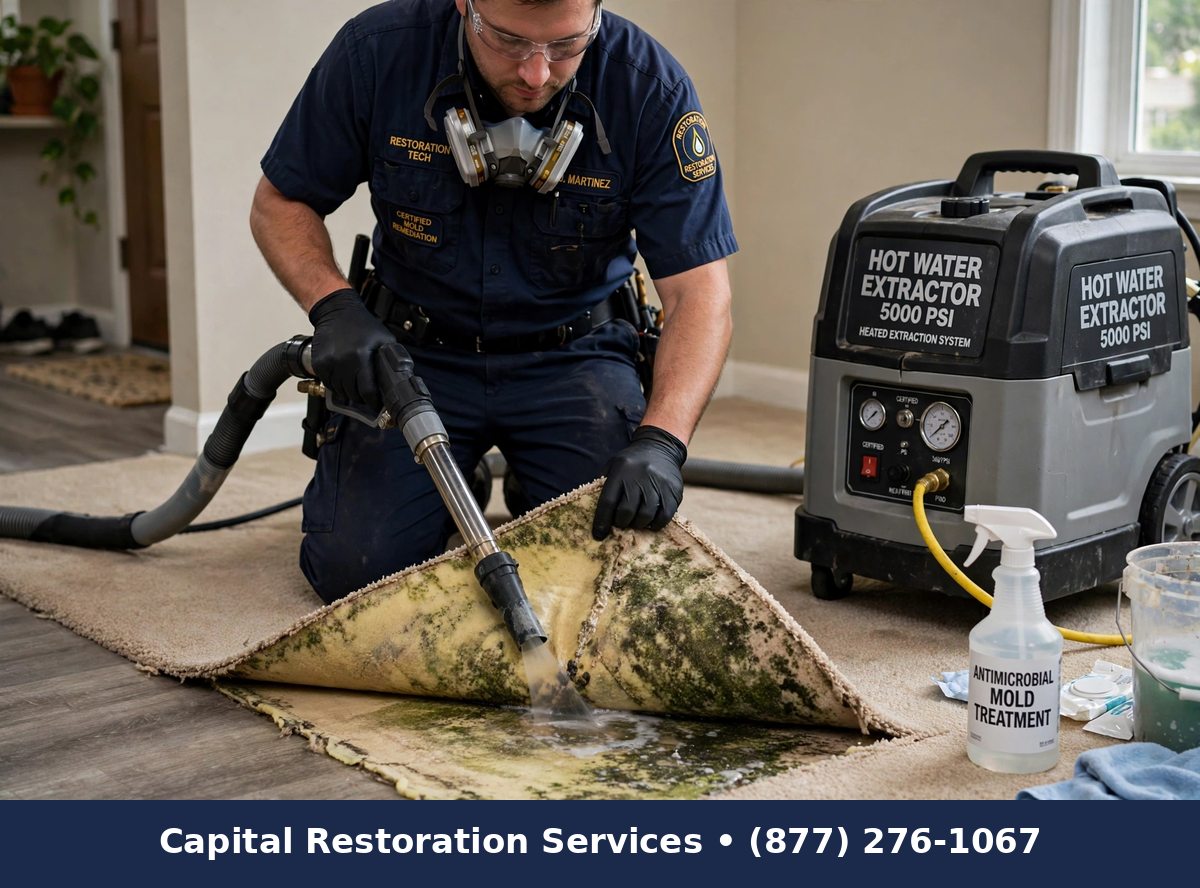
Containment goes up to keep spores out of the rest of the house, because pulling carpet disturbs the colony exactly when it is most mobile. Then the carpet comes up in sections and the pad comes out entirely. There is no saving mold-contaminated pad; it is a porous sponge full of colony, and it gets bagged and removed.
The carpet itself gets an honest verdict. Carpet exposed to clean water with limited growth can sometimes be HEPA-vacuumed, cleaned, and reinstalled over new pad. Carpet soaked by contaminated water, or carpet where growth has penetrated the backing deeply, gets removed. We show you what we find and explain the call.
The subfloor underneath gets full attention. Concrete slabs get cleaned and treated; wood subfloors get moisture-tested, and any affected sections get cleaned and antimicrobial treatment. This is the layer the next carpet will sit on for years, so it has to be right.
The moisture source cannot be skipped
Every carpet mold job has a water story, and the removal is only half the project. Slab moisture wicking up through concrete needs a vapor barrier or sealing solution. A plumbing leak needs a plumber. Chronic humidity needs dehumidification. Exterior drainage issues need grading or gutter work.
We identify the source during inspection and include the correction in the project plan, whether it is our work or a referral to the right trade. New pad and carpet over an unfixed moisture problem is a scheduled repeat of the same job.
Cost factors
Room size and the amount of carpet and pad to remove lead the scope. Subfloor condition, whether the carpet can be saved or must be replaced, and the moisture source correction all factor in. Contaminated-water losses run larger than clean-water ones because more material must go.
Serving homes across the coverage area
Capital Restoration Services removes carpet mold in homes, apartments, and offices throughout the coverage area, and we leave the subfloor verified dry and treated before anything goes back down. If a carpeted room smells musty no matter how often you clean it, call (877) 276-1067. The problem is underneath, and we know how to reach it.
Features
- Room-by-room inspection with moisture and mold assessment
- Carpet pull-back to inspect pad and subfloor condition
- Complete removal of mold-contaminated carpet pad
- HEPA vacuuming of carpet, backing, and subfloor
- Targeted removal of carpet that cannot be salvaged
- Antimicrobial treatment of subfloor and remaining materials
- Moisture source identification and correction plan
Benefits
- Removes the mold colony instead of masking it with cleaning
- Targets the carpet pad, where most carpet mold actually lives
- Stops spores from circulating every time someone walks across the room
- Protects kids and pets who spend the most time on the floor
- Identifies the moisture source so the mold cannot return
- Restores the room to a verifiably clean, dry condition
Frequently asked questions
Where does mold actually grow in carpet?
The pad underneath. Carpet fibers dry relatively quickly, but the pad acts like a sponge, holding moisture for days. That is where mold establishes itself, out of sight, while the carpet surface looks and feels normal.
Do you have to remove all the carpet?
Usually not the whole carpet. The pad almost always has to go. The carpet itself can sometimes be cleaned and saved if the water was clean and the growth is limited, but contaminated carpet gets removed.
What are the signs of mold in carpet?
A persistent musty smell in a carpeted room, discoloration or dark spots on the carpet, allergy symptoms that worsen in that room, or a history of flooding, leaks, or high humidity in the space.
My carpet got wet two days ago. Is it too late?
If the carpet stayed wet more than 48 hours, mold has likely started. If the water was contaminated, sewage or flood water, the carpet and pad should be removed regardless of timing. We assess the water category on every job.
How much does carpet mold removal cost?
It depends on the room size, how much carpet and pad must be removed, whether the subfloor needs treatment, and the moisture source correction. We inspect first and scope the work before anything begins.