Carpet Smoke Damage Cleaning Near Me
Starting price: Call for pricing
Carpet is the largest air filter in your home, and after a fire it holds the most soot. Fine smoke particles settle deep into fibers and pad, where they stain and stink for months. Capital Restoration Services cleans smoke-damaged carpet with a dry-first process that lifts soot before any liquid touches it, then neutralizes the odor at the molecular level.
Why carpet takes the worst of the smoke
During a fire, convection currents carry fine soot particles through every room, and carpet catches them. The fibers act as a filter, trapping particles deep where no broom or household vacuum reaches. What looks like a light dusting on the surface is usually a heavy deposit worked down into the pile and the pad beneath.
Soot is not just dirt. It is acidic, and on carpet fibers it behaves like a dye, bonding to the fiber surface over time. The longer it sits, the more permanent the staining becomes. That is why the first response to smoke-damaged carpet is counterintuitive: do nothing. No walking on it, no vacuuming with the household machine, no scrubbing. Every one of those grinds the soot deeper.
The pad underneath compounds the problem. It absorbs smoke odor the way a sponge absorbs water, and odor in the pad will keep the room smelling like a campfire long after the carpet surface is clean.
The dry-first rule
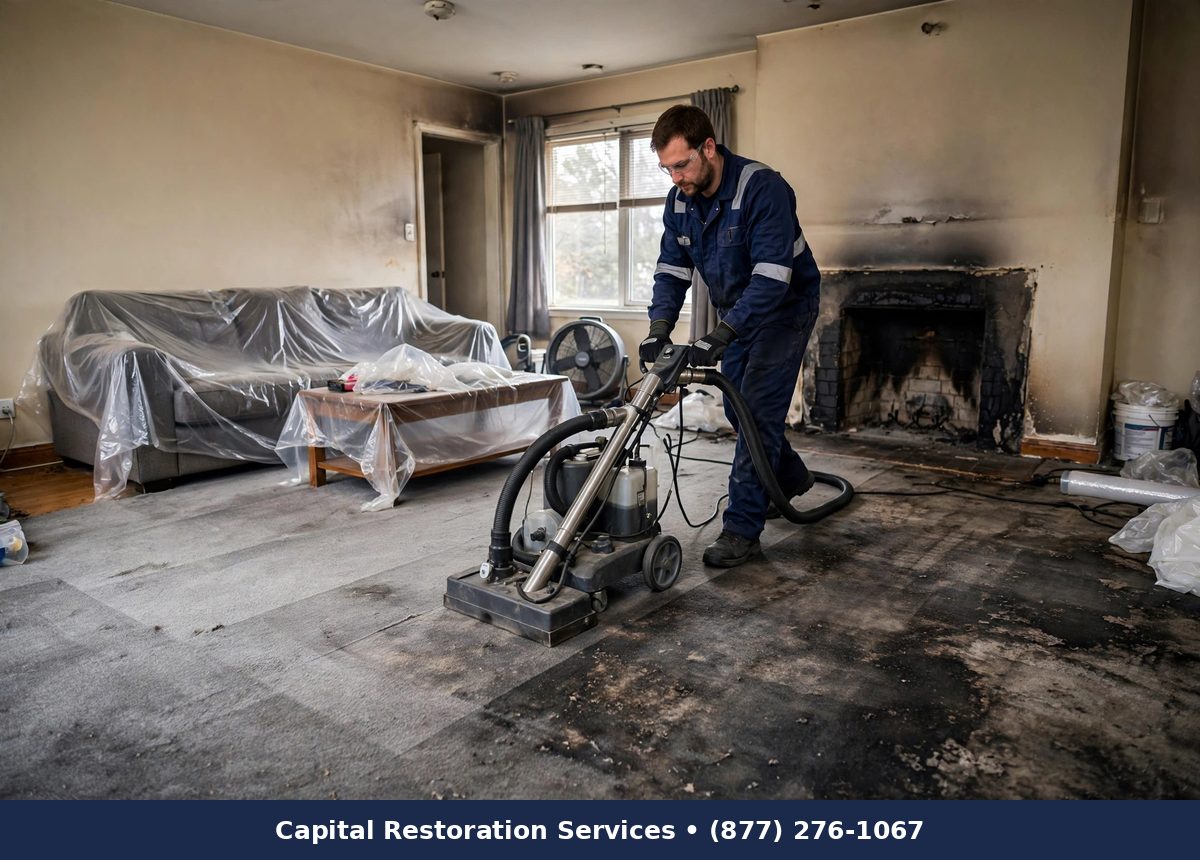
Professional smoke cleaning follows one non-negotiable sequence: remove everything possible in a dry state before any liquid is introduced. We HEPA-vacuum the carpet slowly, in overlapping passes, lifting loose soot while it is still dry and mobile. Chemical sponges follow for soot clinging to the fibers.
This order matters because of chemistry. Soot plus water equals a smeared, set stain. Dry removal first, wet cleaning second. Any company that starts with a steam cleaner on soot-damaged carpet is doing it backwards, and the results show it.
We test-clean the worst area before committing to the whole room. If the heaviest deposit cleans up, the rest will follow. If it does not, we tell you honestly that replacement is the better investment rather than billing for a cleaning that cannot succeed.
Deep cleaning and deodorization
Once dry removal is complete, hot water extraction goes after what remains. We use cleaning agents formulated for smoke residue, with agitation to work the solution into the pile and thorough extraction to pull it back out. On heavy jobs this may happen twice: once before the rest of the restoration work begins, and once after, because construction dust and ongoing work can re-soil the carpet.
Odor gets its own treatment. Thermal fogging sends deodorizing agents into the same fibers and pad spaces the smoke traveled through, neutralizing odor where it hides. Hydroxyl generators break down odor molecules over time and can run while the home is occupied. For severe cases, replacing the pad removes the deepest odor reservoir entirely, and the cleaned carpet goes back over fresh pad.
What can and cannot be saved
Light to moderate soot on quality carpet cleans up remarkably well when the dry-first process starts promptly. The fibers release the soot, the color returns, and deodorization finishes the job. These are the wins that make professional cleaning worth it.
The line is drawn at bonded staining and melted fibers. Soot that has had weeks to dye light-colored carpet may not fully release. Carpet near the fire's origin with heat damage or melted pile is not a cleaning candidate. We make that call during the test clean, before you spend anything on the full job.
Cost factors
Room count and soot severity drive the scope, along with whether pad replacement and deodorization treatment are needed. Light smoke in two rooms is a contained job. Heavy soot throughout a home with pad replacement and fogging is a larger project. The test clean gives us the information to scope it accurately.
Serving homes across the coverage area
Capital Restoration Services cleans smoke-damaged carpet in homes, apartments, and commercial spaces throughout the coverage area, coordinating with the broader fire restoration so the carpet is cleaned at the right point in the sequence. If your carpet is gray with soot, call (877) 276-1067 before anyone walks on it or runs a vacuum over it.
Features
- Dry HEPA vacuuming in slow, overlapping passes
- Chemical sponge treatment for stubborn soot deposits
- Test-cleaning of the worst area before full commitment
- Hot water extraction with smoke-specific cleaning agents
- Carpet pad evaluation and replacement where needed
- Thermal fogging or hydroxyl treatment for trapped odor
- Post-cleaning walkthrough and odor verification
Benefits
- Lifts acidic soot before it permanently dyes carpet fibers
- Removes the smoke odor trapped deep in fibers and pad
- Saves carpet that looks ruined but cleans up professionally
- Prevents soot from spreading to clean rooms during restoration
- Restores rooms to a fresh, odor-neutral condition
- Documents cleaning for insurance contents and structure claims
Frequently asked questions
What is the right way to clean soot from carpet?
Dry removal first: HEPA vacuuming in slow, overlapping passes to lift loose soot while it is still dry. Wet cleaning before dry removal just smears soot deeper and can set stains permanently. The order of operations is everything.
Should I vacuum the soot myself?
Do not. Vacuuming with a standard vacuum blows fine soot back into the air, and foot traffic grinds soot deeper into the fibers where it acts like dye. Stay off the carpet and let professionals handle the dry removal.
Can smoke-damaged carpet be saved?
Often yes, if the dry removal starts before soot bonds. Fine soot can act like pigment dye on carpet fibers, so timing matters. We test-clean the worst area first; if it cleans there, the room is salvageable.
Does the carpet pad need to be replaced?
It usually has to. The pad absorbs odor deeply and rarely releases it fully. Replacing the pad while saving the carpet is the standard approach on smoke jobs.
How much does carpet smoke damage cleaning cost?
It depends on the number of rooms, the soot severity, whether pad replacement is needed, and whether deodorization treatment is required. We test-clean first and scope the work before anything begins.