Ceiling Water Damage Repair Near Me
Starting price: Call for pricing
A ceiling stain is a message from above, and it is never just cosmetic. Water crossed the cavity, soaked the drywall, and may still be sitting up there. Capital Restoration Services repairs water-damaged ceilings by finding the source, drying the cavity, replacing the damaged section, and finishing it to disappear.
Reading the stain
A ceiling stain is diagnostic. Its location, shape, and behavior tell a trained eye where the water came from, and that diagnosis drives the entire repair. Brown rings under an upstairs bathroom mean a fixture, drain, or supply line is leaking. Stains that darken and spread after every rain mean the roof or flashing above has failed. Damp spots clustered around a vent or air handler mean condensate is escaping the HVAC system.
The stain is also the tip of the problem. Water travels along joists and the top of drywall before it drops through, so the entry point is often feet from the visible mark. And the visible stain represents only the water that made it through; more may still be sitting in the cavity above, held by insulation and the paper backing of the drywall.
That hidden water is the real enemy. A ceiling cavity that stays wet grows mold within days, rots the paper facing off the drywall, and saturates insulation that then holds moisture against the joists for weeks. Repairing the surface without addressing the cavity is decorating over a problem.
What we do first
Safety first, because a saturated ceiling is heavy and unpredictable. Drywall soaked with water can weigh several times its dry weight, and a bulging section can let go without warning. We assess whether the ceiling needs immediate relief: a small controlled opening that lets trapped water drain into a bucket, turning a potential collapse into a managed step.
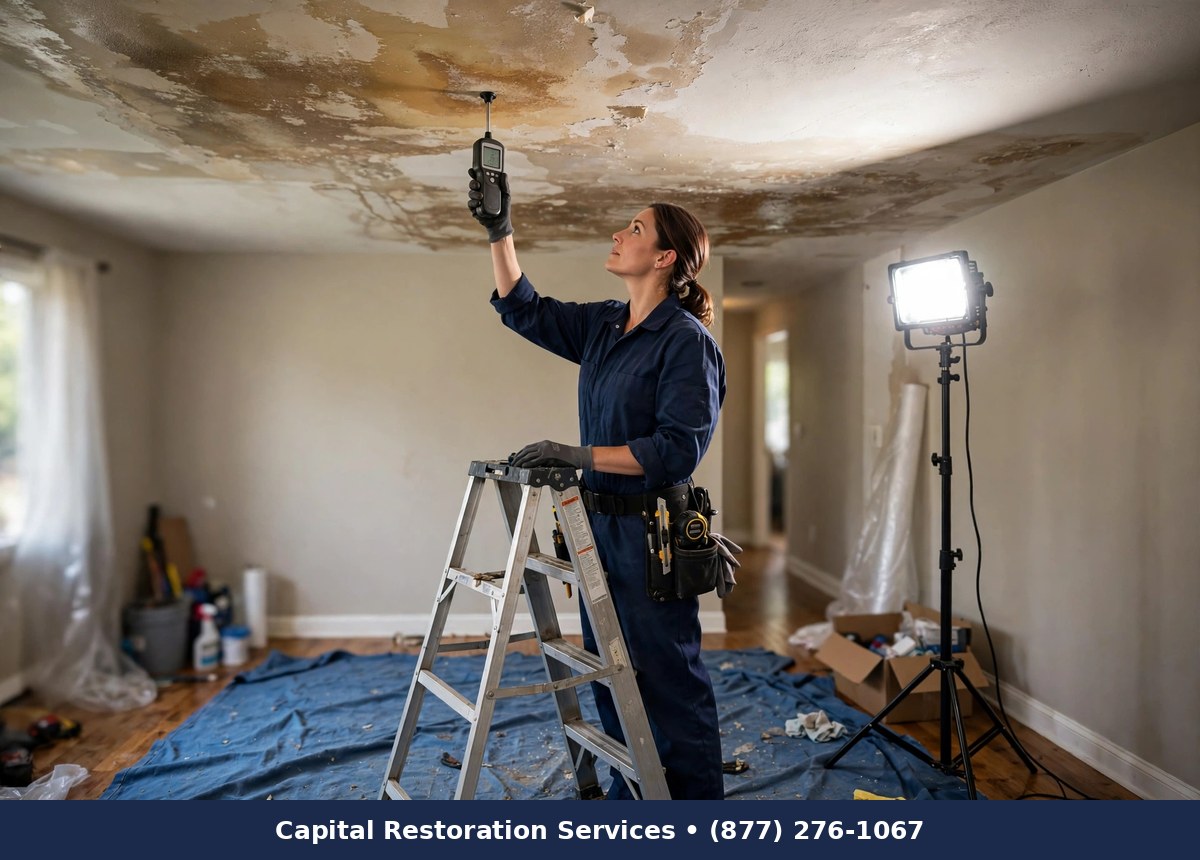
Then the source hunt. Moisture meters trace the wet area beyond the stain's edges. We inspect from above whenever possible, the attic for roof-side leaks, the bathroom or laundry above for plumbing leaks, because finding the source from the dry side is always more accurate than guessing from below.
The source gets fixed before the ceiling does. A roofer for flashing and shingles, a plumber for supply and drain lines, an HVAC tech for condensate issues. We coordinate the trades so the ceiling repair happens once, on a dry structure, instead of twice.
The repair itself
Damaged drywall comes out in clean sections. We cut back to solid, dry material, because patching onto soft, water-degraded board guarantees a callback. The open cavity gets fully inspected: joists checked for rot, insulation assessed, and any mold growth remediated before the cavity is closed.
Drying the cavity is non-negotiable. Air movers directed into the open bay, dehumidifiers handling the room, and moisture readings on the joists and remaining drywall confirm the structure is truly dry. Only then does new drywall go up.
The finish work is where repairs become invisible. New drywall gets taped, mudded, and sanded, then the texture gets matched, orange peel, knockdown, or smooth, to blend with the surrounding ceiling. A stain-blocking primer goes over the repair and any residual discoloration on the remaining ceiling, because water stains bleed through regular paint with insulting persistence. The final topcoat leaves no trace of the repair.
The mold question
Every wet ceiling cavity gets a mold assessment as part of the repair. If growth is found on joists or the back of the drywall, we contain the area and remediate it before closing the cavity. Sealing mold inside a finished ceiling is not an option we offer.
After remediation and drying, the cavity gets an antimicrobial treatment on the structural surfaces. It is inexpensive insurance for a space that will not be opened again for years.
Cost factors
The damaged area's size leads, followed by the source repair and whether cavity mold remediation is needed. A single plumbing leak caught early with a contained stain is a straightforward job. A long-running roof leak that saturated joists, insulation, and half a ceiling, with mold throughout the cavity, is a larger project. Texture complexity and paint matching round out the scope.
Serving homes across the coverage area
Capital Restoration Services repairs water-damaged ceilings in homes, condos, and commercial buildings throughout the coverage area, from emergency drainage the day of the leak to the final invisible finish. If your ceiling is staining, sagging, or bubbling, call (877) 276-1067 before gravity finishes the job.
Features
- Leak source tracing with moisture meters and inspection
- Safe controlled drainage of trapped ceiling water
- Cavity drying with targeted air movement
- Surgical removal of damaged drywall sections
- Mold inspection and remediation inside the cavity
- Stain-blocking primer and seamless finish matching
- Texture matching for popcorn, orange peel, and smooth ceilings
Benefits
- Finds the actual leak source instead of just painting the stain
- Drains trapped water safely before the ceiling comes down
- Dries the cavity above the drywall where mold starts
- Replaces only the damaged section with a seamless finish
- Prevents the next leak from causing the same damage twice
- Documents the loss for roof, plumbing, and homeowner's claims
Frequently asked questions
How do you tell where a ceiling leak comes from?
Read the location. Stains under a bathroom point to plumbing. Stains that grow after rain point to the roof. Stains near vents or AC units point to condensation. We confirm with moisture meters and attic or upper-floor inspection rather than guessing.
My ceiling is sagging and bulging. What should I do?
It is holding water and can collapse. Relieve it with a small controlled hole and a bucket if you can do it safely, keeping clear of light fixtures. Otherwise stay out from under it and call us.
Can you just paint over the stain?
Sometimes, if the drywall is still firm, the source is fixed, and the cavity above is verified dry. But paint over a damp ceiling and the stain bleeds right back through. We verify dryness first, then seal with a stain-blocking primer.
How fast does mold grow in a wet ceiling?
Mold can begin growing in a wet ceiling cavity within 48 hours. That is why the cavity gets opened, inspected, and dried as part of the repair, not just the visible surface.
How much does ceiling water damage repair cost?
It depends on the size of the damaged area, the leak source that must be addressed, whether the cavity needs mold remediation, and the finish matching. We scope it on site before work begins.