Commercial Fire Damage Restoration Near Me
Starting price: Call for pricing
When fire hits a commercial building, every day of downtime costs money and customers. Capital Restoration Services provides structured commercial fire damage restoration: emergency board-up, water extraction, soot and smoke removal, odor control, and rebuild, all sequenced to get your business reopened as quickly as conditions allow. One team handles the whole job, from the first walkthrough to the final clearance check.
A fire at your business is not just property damage. It is lost revenue, displaced employees, and customers going elsewhere while you sort out what comes next. Call (877) 276-1067 right away and a Capital Restoration Services project manager will be on site to assess the damage and lay out a recovery plan. The sooner mitigation starts, the shorter the road back to business as usual.
What commercial fire damage restoration covers
A commercial fire restoration job is wider than a residential one. It covers the building itself: walls, ceilings, flooring, roofing, and framing, plus the systems a business depends on, including HVAC, electrical, plumbing, and fire-suppression equipment. It also covers business contents: inventory, office equipment, furniture, documents, and specialized machinery that may be cleanable rather than replaceable.
What it does not cover is the business side of the loss. We do not manage your business-interruption claim with the insurer; that sits with you and your agent, though our documentation supports it. We also do not decide which equipment is worth repairing versus replacing. We give you a written condition assessment and you make the call with your vendor or insurer.
When your business needs it
Not every fire calls for a full restoration crew, but these situations almost always do:
- A fire triggered sprinklers or drew a hose-line response, because suppression water spreads through floors and ceilings far beyond the burn area
- Soot is still visible on walls, ceilings, inventory, or equipment more than a day after the fire
- Smoke reached the HVAC system, which can redistribute soot and odor to every floor of the building
- The building was left open to weather or the public after fire crews cleared the scene
- Odor persists in porous materials like ceiling tile, carpet, and upholstery after initial cleaning
As a rule of thumb recognized in the IICRC S700 fire restoration standard, soot residue is acidic and attacks surfaces quickly. The longer cleanup waits, the more materials cross the line from cleanable to replaceable.
How the process works
- Step one is assessment. We walk every affected floor, log soot patterns, map smoke migration into ductwork, and measure hidden moisture from suppression water. You get a written scope before any work begins.
- Next we secure the site: board-up of broken windows and doors, tarping of damaged roofing, and temporary fencing where the property needs it.
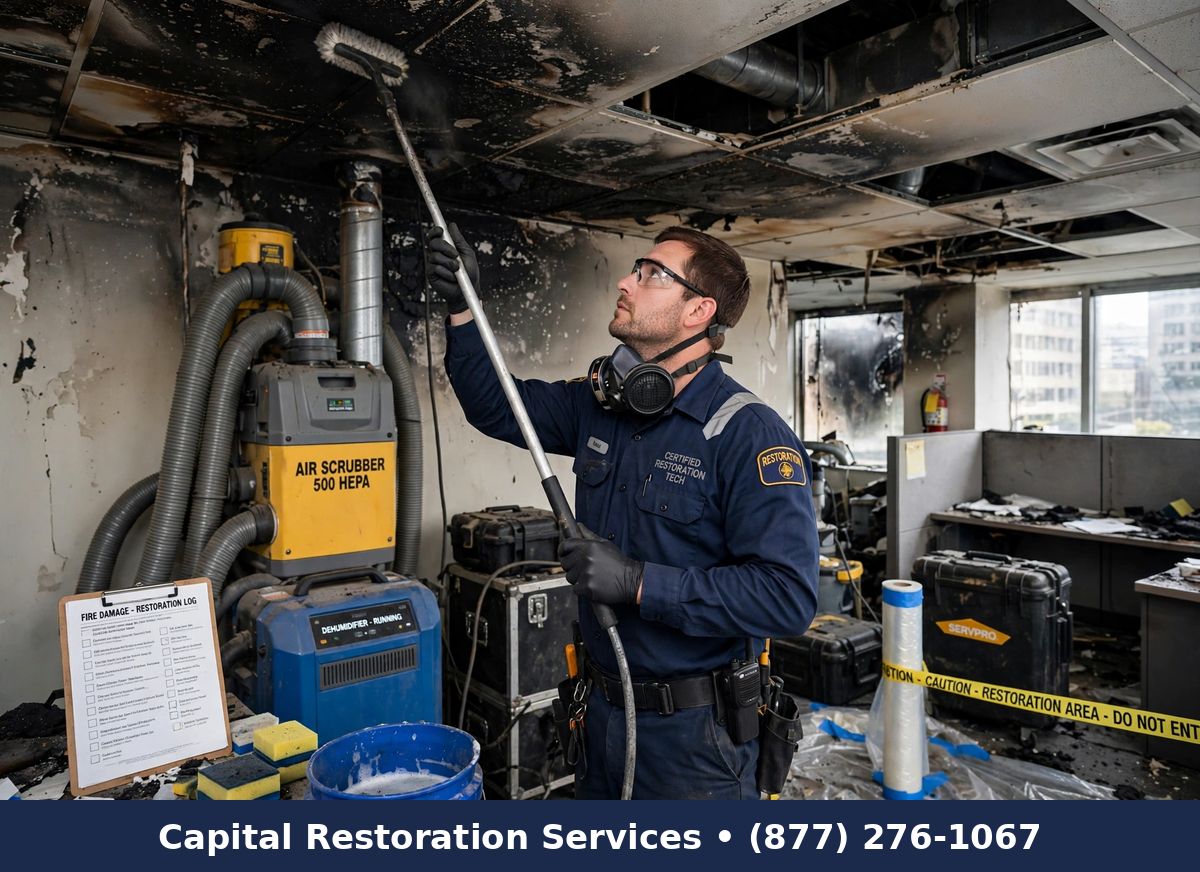
- Water extraction and drying follow. Standing water is removed, then industrial desiccant dehumidifiers and air movers dry structure and contents while moisture meters track progress daily.
- Then source removal. Charred material and unsalvageable drywall and insulation come out first, because odor cannot be neutralized while the source remains in the building.
- Cleaning and deodorization come next: HEPA vacuuming, detergent cleaning of structural surfaces, soda blasting for brick, concrete, and steel, then hydroxyl or thermal-fogging treatment for remaining odor.
- Contents restoration runs in parallel. Electronics, machinery, documents, and inventory are cleaned, tested, or packed out for off-site restoration.
- Reconstruction follows: damaged walls, ceilings, flooring, and finishes are repaired or rebuilt, with permits and inspections handled.
- The job closes with a final evaluation. We walk the site with you and confirm structural integrity, air quality, and cleanliness before you hand keys back to tenants or staff.
What affects the cost
The cost of commercial fire restoration turns on a handful of practical factors. Size is the biggest: a single-suite kitchen fire costs far less than a multi-floor loss. The depth of soot penetration matters too. Light dusting on painted walls cleans up quickly, while soot driven into porous block or wood framing takes far more labor. Contents change the math: a warehouse full of inventory adds a major cleaning or pack-out line to the scope. Access and scheduling matter as well. A building that can only be worked nights or weekends, or one in a dense downtown core with limited staging room, runs slower. And emergency work always costs more than scheduled work: a 2 a.m. board-up and extraction costs more than the same work planned in daylight. For an exact figure, call (877) 276-1067. A walkthrough lets us scope the job properly.
How we serve your area
Capital Restoration Services serves offices, retail centers, restaurants, healthcare facilities, schools, warehouses, and multi-family properties across our service area. We adapt to how your business runs: damaged zones can be isolated with containment barriers while clean areas keep operating, and crews can work overnight or on weekends to avoid disrupting customers and staff. Every project is documented step by step, so your insurance carrier and your property records stay clean. When the work is done, we walk the site with you and confirm it is safe, clean, and ready to reopen.
Features
- Emergency board-up, temporary fencing, and roof tarping for commercial properties
- Industrial water extraction and desiccant dehumidification after sprinkler or hose-line suppression
- Soot removal with HEPA vacuuming, dry-chemical sponges, and soda blasting for masonry and steel
- Odor neutralization with hydroxyl generators and thermal fogging
- Cleaning and evaluation of electronics, machinery, documents, and inventory
- Phased reconstruction planned around your operating hours
Benefits
- Less downtime: crews can work nights and weekends so your operating schedule takes the smallest hit possible
- One point of contact from the first assessment through the final walkthrough
- Insurance-ready documentation with photos, moisture logs, and cleaning records at every stage
- Damaged zones sealed off with containment barriers so clean areas can keep running
- Commercial code compliance handled, including permits and required inspections
- A workspace your employees, tenants, and customers can return to with confidence
Frequently asked questions
How long does commercial fire restoration take?
Light smoke damage can take a few days; an extensive loss with reconstruction can take weeks to months. Your written assessment includes a timeline, and we update it as the project progresses so you can plan staffing and operations.
Can parts of my business stay open during restoration?
Often, yes. We isolate damaged zones with containment barriers and negative air, and schedule disruptive work overnight or on weekends. It depends on the extent of the damage and local code requirements, which your project manager reviews with you.
What drives the cost of commercial fire restoration?
The size of the affected area, how deeply soot penetrated surfaces, the volume of contents to clean or pack out, access constraints, and whether emergency or scheduled hours are used. Call (877) 276-1067 and a walkthrough will give you a properly scoped quote.
Will my insurance cover the restoration?
Most commercial property policies cover fire and smoke damage, including emergency mitigation. Our documentation is built to support your claim: photos, moisture logs, and cleaning records at every stage. Confirm the details with your agent.
Do you handle the HVAC system after a fire?
Yes. Smoke settles deep in ductwork and air handlers, and a contaminated system will redistribute soot and odor to every floor. We isolate the system, assess contamination, and clean ducts and coils before it restarts.