Commercial Mold Remediation Near Me
Starting price: Call for pricing
Mold in a commercial building is a health concern, a legal concern, and a reputation concern all at once. Capital Restoration Services provides commercial mold remediation built for occupied buildings: full containment, HEPA negative air, physical removal of contaminated materials, and third-party clearance testing. We schedule around your tenants, employees, and operating hours.
Mold in a commercial building is not the same problem as mold in a house. The people who work, shop, learn, or heal inside your building are your responsibility, and tenants and employees notice problems fast. Call (877) 276-1067 at the first sign of a musty odor or visible growth, and Capital Restoration Services will inspect the problem and tell you plainly what it takes to fix it.
What commercial mold remediation covers
A professional commercial mold job covers the full sequence: inspection and moisture mapping, full containment of the work area, physical removal of mold-damaged materials like drywall, insulation, carpet, and ceiling tile, HEPA cleaning and antimicrobial treatment of the structure left behind, dehumidification to correct the moisture problem, and post-remediation verification testing to prove the space is clean. Contaminated materials are bagged inside containment and disposed of as regular construction waste, never dragged through clean hallways.
What it does not cover is the repair that caused the moisture in the first place. We find and document the source: a roof leak, a plumbing failure, a failed condensate drain, a ventilation problem. The actual repair belongs to the appropriate trade, and we coordinate with them so remediation only starts once the source is truly corrected. Starting cleanup while water is still coming in is how buildings end up remediated twice.
Signs your building has a mold problem
Commercial mold rarely announces itself politely. Watch for these:
- Musty or earthy odor complaints from tenants, employees, or customers
- Visible growth on ceiling tiles, walls, baseboards, or around HVAC vents
- Water stains that keep returning after repainting
- Occupants reporting allergy-like symptoms that ease when they leave the building
- Growth discovered during a roof, plumbing, or HVAC service call
- A tenant-commissioned mold test or failed indoor air quality screening
One caution from the IICRC S520 standard: what you see is not the whole problem. Remediation scope should be set by inspection plus sampling, not by eyeballing the visible patch.
How the remediation process works
- Inspection and moisture mapping come first. Infrared cameras and pin meters locate wet framing and hidden growth behind walls and above ceilings. You receive written findings and a defined scope.
- Source correction follows. The leak, drainage failure, or humidity problem must be fixed before cleaning begins. Mold is a symptom, and work done under an active leak will be undone within weeks.
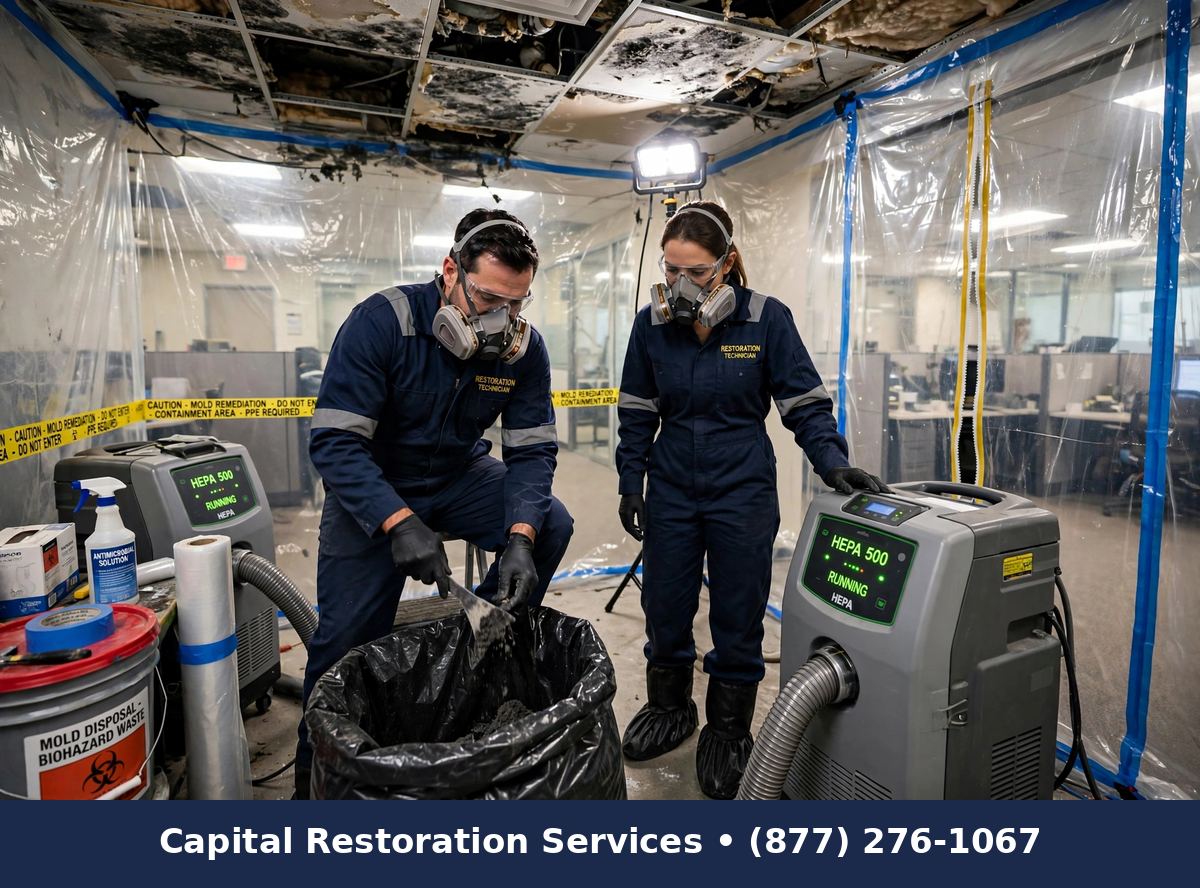
- Containment goes up next. Polyethylene sheeting seals the work area floor to ceiling, supply and return vents are blocked, and HEPA-filtered air scrubbers hold the zone under negative pressure so spores cannot drift into occupied space.
- Physical removal is the core of the job. Contaminated drywall is cut back beyond visible growth, soaked insulation and carpet padding are bagged inside containment, and unsalvageable ceiling tile comes out.
- Structural cleaning follows. Remaining framing and sheathing get HEPA vacuuming, damp wiping, and antimicrobial treatment. Bleach on porous wood is not part of a professional protocol; physical removal and proper cleaning are.
- Drying and dehumidification run through the project. Materials must test dry and within normal moisture ranges before the job can close.
- Verification closes the work. An independent third-party assessor inspects the area and runs air and surface sampling. Containment comes down only when the space meets clearance criteria.
- Restoration rebuilds what was removed: new drywall, insulation, paint, and flooring, matched to the existing space.
What shapes the cost of a commercial job
Square footage of contamination is the starting point, but reach matters just as much. Growth on an open office wall is straightforward; growth inside wall cavities, above drop ceilings, in a crawl space, or inside an HVAC system takes far more labor and containment. Materials drive the next line: how much must be physically removed and rebuilt versus cleaned in place. The moisture source adds complexity too, since a simple plumbing repair is one thing and a building-envelope problem is another. Off-hours scheduling, common in occupied buildings, carries a premium over daytime work. And third-party clearance testing is a separate line item that serious property managers should insist on. For a real number, call (877) 276-1067 and we will scope the building in person.
How we keep your business running
Capital Restoration Services remediates offices, retail centers, restaurants, hotels, healthcare facilities, schools, warehouses, and multi-family properties across our service area. Occupied buildings are our normal working environment, not an exception. We coordinate with property managers and building engineers on access, schedule noisy demolition outside business hours, keep adjacent occupied areas monitored, and document everything for your insurance file and property records. When clearance testing passes, you get a clean building and the paperwork to prove it.
Features
- Full containment with 6-mil polyethylene barriers and HEPA negative air machines
- Moisture mapping with infrared cameras and pin meters to find hidden growth
- Physical removal of contaminated drywall, insulation, ceiling tile, and flooring
- HEPA vacuuming and antimicrobial treatment of structural members
- Commercial dehumidification to correct the underlying moisture problem
- Third-party post-remediation verification and clearance testing
Benefits
- Occupied spaces stay protected: work zones fully sealed off from tenants, employees, and customers
- Off-hours and weekend scheduling keeps remediation away from business hours
- Liability exposure reduced through documented, standards-based remediation
- Independent clearance testing proves the building is clean when the job closes
- Moisture sources corrected so growth does not return a few months later
- Straightforward communication with property managers, engineers, and ownership throughout
Frequently asked questions
Can remediation happen while the building is still occupied?
Often, yes. The work zone is sealed with polyethylene barriers and held under negative pressure with HEPA air scrubbers, so spores cannot migrate into occupied space. We monitor air quality in adjacent areas during the job and schedule the most disruptive work outside business hours.
What is the IICRC S520 standard?
ANSI/IICRC S520 is the industry's standard of care for professional mold remediation. Its core principle is physical removal of contaminated material, not chemical fogging. It requires source correction first, proper containment, and post-remediation verification before the space is released.
Do you test the air before and after the work?
Yes. We take baseline air and surface samples during inspection to scope the work, and after remediation an independent third-party assessor runs clearance testing. The area is released only when indoor results compare favorably with outdoor baselines and no visible growth remains.
How much does commercial mold remediation cost?
The square footage of contamination, how hard it is to reach (wall cavities, HVAC, crawl spaces cost more than open walls), how much material must be removed versus cleaned, the complexity of the moisture source, and whether work must happen off-hours. Call (877) 276-1067 for an inspection and a properly scoped proposal.
Will the mold come back after remediation?
Not if the moisture problem is truly fixed. Mold is a symptom; water is the cause. We verify the source is corrected and that materials test dry before the job closes, and we can advise on humidity control so conditions stay below the threshold mold needs.