Commercial Water Damage Restoration Near Me
Starting price: Call for pricing
Water in a commercial building is a race against the clock: every hour of standing moisture spreads damage and pushes mold closer. Capital Restoration Services provides commercial water damage restoration at scale, with truck-mounted extraction, desiccant dehumidification, and daily moisture monitoring across large floor plates. We stabilize the building fast, then dry it methodically while your business keeps running where it can.
The first day of a commercial water loss is about control, not perfection. Water does not respect floor plans: it runs down elevator shafts, wicks up drywall, and pools under flooring where nobody looks. Call (877) 276-1067 the moment you find it, and Capital Restoration Services will mobilize a crew sized for commercial work, not a single residential van. The first 24 hours usually decide how big this job gets.
What commercial water damage restoration covers
Commercial water restoration covers the full path from wet to dry to rebuilt: emergency water extraction, structural drying of walls, floors, ceilings, and framing, moisture mapping and daily monitoring, antimicrobial treatment to prevent mold, content protection and inventory documentation, and reconstruction of anything that could not be saved. It applies to every source a building can throw at you: burst supply lines, failed water heaters, sprinkler discharges, roof leaks, storm intrusion, and sewage backups.
What it does not cover is the plumbing, roofing, or mechanical repair that caused the loss. We stop the bleeding by shutting off and documenting the source, then coordinate with the right trade for the permanent fix. We also do not replace ruined inventory at its purchase price; we document condition and salvage what drying and cleaning can save, and your insurer handles valuation.
Why commercial water jobs are a different animal
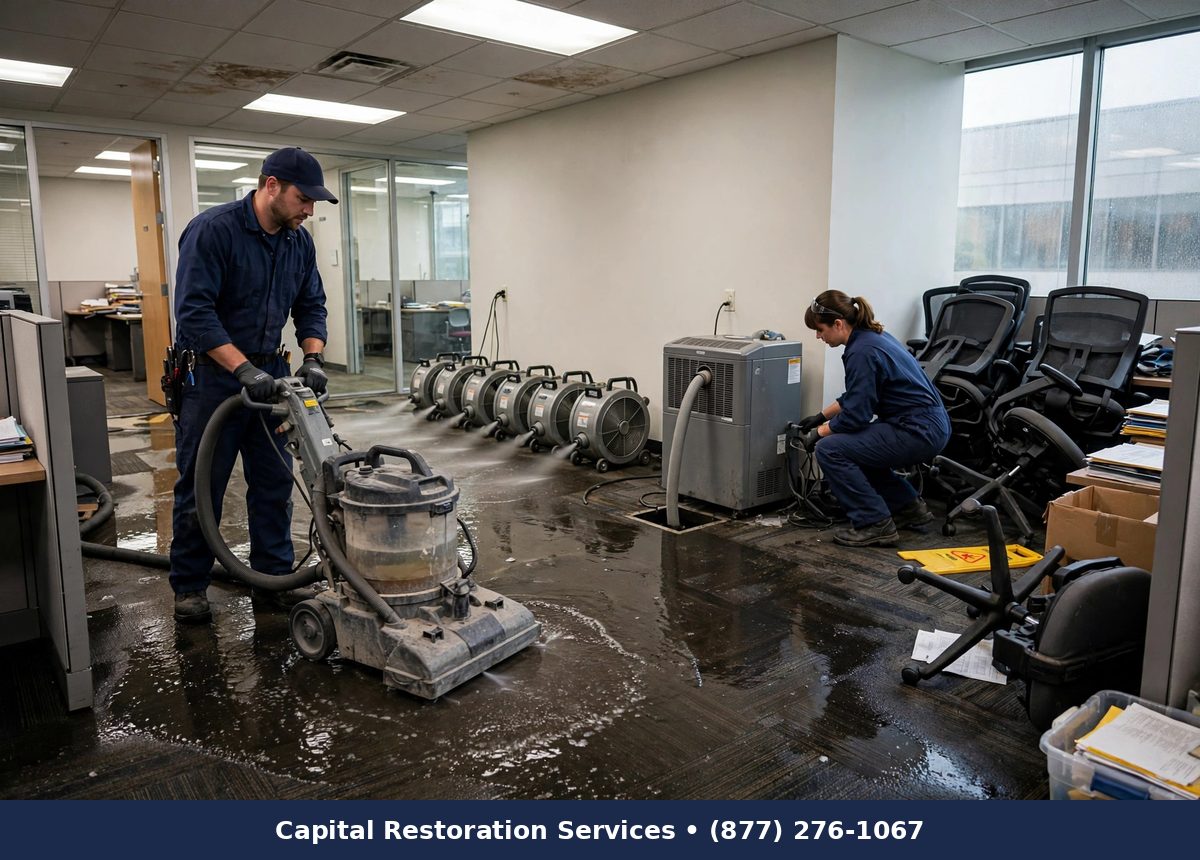
Scale is the obvious difference. A commercial loss can mean thousands of square feet across multiple floors, and residential equipment simply cannot move that much air or pull that much moisture. Large-loss work uses truck-mounted extractors, desiccant dehumidifiers for big open or poorly insulated spaces, and dozens of air movers staged across the floor plate. The second difference is occupancy: offices, retail floors, and lobbies often need to stay open, so drying gets sectioned and scheduled around people. The third is complexity: server rooms, elevators, commercial kitchens, and medical suites each carry their own risks and protocols. The IICRC S500 standard, the industry's reference for water damage restoration, sorts every job by water category and class of intrusion so the safety measures and drying strategy match the actual conditions.
When to call for professional help
Some water problems are bigger than they look. Call when:
- Standing water covers a commercial floor, hallway, or tenant space
- Water is coming through ceilings or running down walls on any floor
- A sprinkler head discharged, even if the fire was small
- Sewage or floodwater entered the building, which is a health hazard, not a cleanup chore
- Materials still feel damp days after a leak was fixed
- A musty smell appears in the days following any water event
A useful rule from the S500 playbook: water migrates. If you can see it in one place, moisture meters will usually find it in two more.
How the restoration process works
- Stabilization comes first. We stop the source, assess electrical and slip hazards, protect server rooms and sensitive equipment, and set containment barriers so water stops spreading into clean areas.
- Assessment and documentation follow. Infrared cameras and moisture meters map every wet surface, including hidden pockets behind walls and under flooring. Everything is photographed and logged for your insurance file.
- Extraction removes standing water fast. Truck-mounted units handle large volumes; portable extractors reach offices, closets, and other tight spaces.
- Structural drying begins. Air movers drive evaporation off wet surfaces while dehumidifiers pull that moisture out of the air. The science is psychrometry: controlling temperature, humidity, and airflow together so materials dry without warping or growing mold.
- Monitoring runs daily. Technicians record moisture readings in materials and air, reposition equipment as zones dry, and keep a drying log that proves the building reached dry standards.
- Antimicrobial treatment is applied to affected surfaces to prevent mold from colonizing damp materials during the dry-out.
- Content protection runs in parallel. Furniture, equipment, inventory, and records are moved to dry areas, covered in place, or inventoried for off-site cleaning.
- Reconstruction closes the job. Unsalvageable drywall, flooring, and finishes are rebuilt to commercial code, and the space is cleaned for handover.
What affects the cost
The footprint of the loss is the starting point, but water category matters just as much: clean supply-line water is the simplest case, while gray or black water demands stricter safety protocols and more disposal. How deeply the structure is saturated decides the equipment bill, because a Class 3 or 4 intrusion with water trapped in assemblies needs far more drying power than surface wetting. Content work adds its own line: the volume of furniture, inventory, and records to protect or pack out. Access constraints, night and weekend scheduling in occupied buildings, and emergency dispatch premiums all move the number. For an exact figure, call (877) 276-1067. An on-site assessment is the only honest way to scope it.
How we serve your area
Capital Restoration Services restores offices, retail centers, hotels, healthcare facilities, schools, warehouses, restaurants, and multi-family properties across our service area. Our project managers meet your facilities team on arrival, agree on which areas stay operational, and keep daily communication flowing so there are no surprises. Equipment placement respects exits, hallways, and elevators, and drying sections are released floor by floor so you can reopen in stages. When the meters read dry and the space is rebuilt, we walk it with you and hand it back ready for business.
Features
- 24/7 emergency dispatch with large-loss crews and multiple extraction units
- Truck-mounted and portable extraction for large floor plates and hard-to-reach areas
- Desiccant and refrigerant dehumidification matched to the space and season
- Moisture mapping with infrared cameras, pin meters, and hygrometers
- Daily drying reports with readings tracked against dry standards
- Content protection, inventory documentation, and pack-out coordination
Benefits
- Faster reopening: large-loss equipment and multiple crews compress timelines
- Business continuity planning keeps revenue flowing during the project
- Insurance-ready documentation including moisture maps and daily drying reports
- Mold prevented by drying to verified dry standards, not by guesswork
- One project manager coordinating crews, trades, and your facilities team
- Clean, dry, code-compliant space returned floor by floor
Frequently asked questions
How fast does commercial water damage need to be handled?
The first 24 hours usually decide how big the job gets. After that, structural drying typically runs several days, with moisture meters tracked daily. Larger losses with saturated structure or reconstruction take longer; your project manager gives you a timeline after the initial assessment.
What is the difference between clean, gray, and black water?
Clean water from a supply line is straightforward. Gray water from appliances or drains carries contaminants and needs stricter handling. Black water, sewage or floodwater, is a health hazard and requires full protective protocols. We identify the category on arrival and work to the right safety standard.
Can our business stay open during drying?
Usually some of it can. We section the building, dry floor by floor or wing by wing, and schedule noisy work outside business hours. Server rooms, kitchens, and healthcare spaces get special protection protocols. Your project manager maps out what stays open before equipment is placed.
What affects the cost of commercial water restoration?
Footprint of the loss, water category, how deeply structure is saturated, equipment density needed to dry it, content protection and pack-out volume, and emergency versus scheduled timing. Call (877) 276-1067 for an on-site assessment and a scoped proposal.
Will insurance cover the restoration?
Yes. Most commercial property policies cover sudden water damage and the mitigation needed to stop it spreading. Our documentation package, moisture maps, equipment records, and daily drying reports, is designed for adjusters. Gradual leaks are treated differently by most policies, so review yours with your agent.