Content Cleaning After Fire Near Me
Starting price: Call for pricing
After a fire, the building is only half the loss. Your furniture, clothing, electronics, documents, and keepsakes carry soot and odor that ordinary cleaning cannot touch. Capital Restoration Services provides professional content cleaning after fire: item-by-item assessment, ultrasonic cleaning, textile restoration, electronics decontamination, and ozone deodorization. Restoration first, replacement only when it is truly unavoidable.
The fire is out, the structure is being handled, and then it hits you: everything you own smells like smoke. Furniture, clothes, dishes, electronics, the kids' toys, the box of photographs in the closet. Call (877) 276-1067 and Capital Restoration Services will take inventory of your belongings and give you an honest answer about what can be saved. Most people are surprised by how much comes back.
What content cleaning after a fire covers
Content cleaning covers everything inside the building that is not the building: furniture and upholstery, clothing and textiles, electronics and appliances, dishes and housewares, documents and photographs, artwork, collectibles, and children's items. Each category gets a different treatment. A wood dresser is not cleaned the way a stack of dishes is, and a laptop is not cleaned the way a sofa is.
What it does not cover is structural cleaning; walls, ceilings, and ductwork belong to the building restoration scope. We also do not decide what your belongings were worth. We document condition, restore what can be restored, and give your adjuster the inventory they need for valuation.
Why soot needs a specialist
Soot is not dirt. It is acidic, and the clock starts the moment it lands. Within hours it can tarnish metals and stain finishes permanently; within days it yellows walls and drives odor deep into porous materials. Different fires leave different residues, and the industry sorts them by behavior: dry smoke leaves a powdery residue that lifts with HEPA vacuuming and chemical sponges, wet smoke leaves a sticky film that needs solvent-based cleaners, and protein residue from kitchen fires is nearly invisible but carries a brutal odor. Using the wrong method makes things worse. Water on dry soot smears it into the surface; aggressive solvents on the wrong finish cause damage beyond the original loss. Professional content cleaning starts with identifying what you are dealing with.
How the cleaning process works
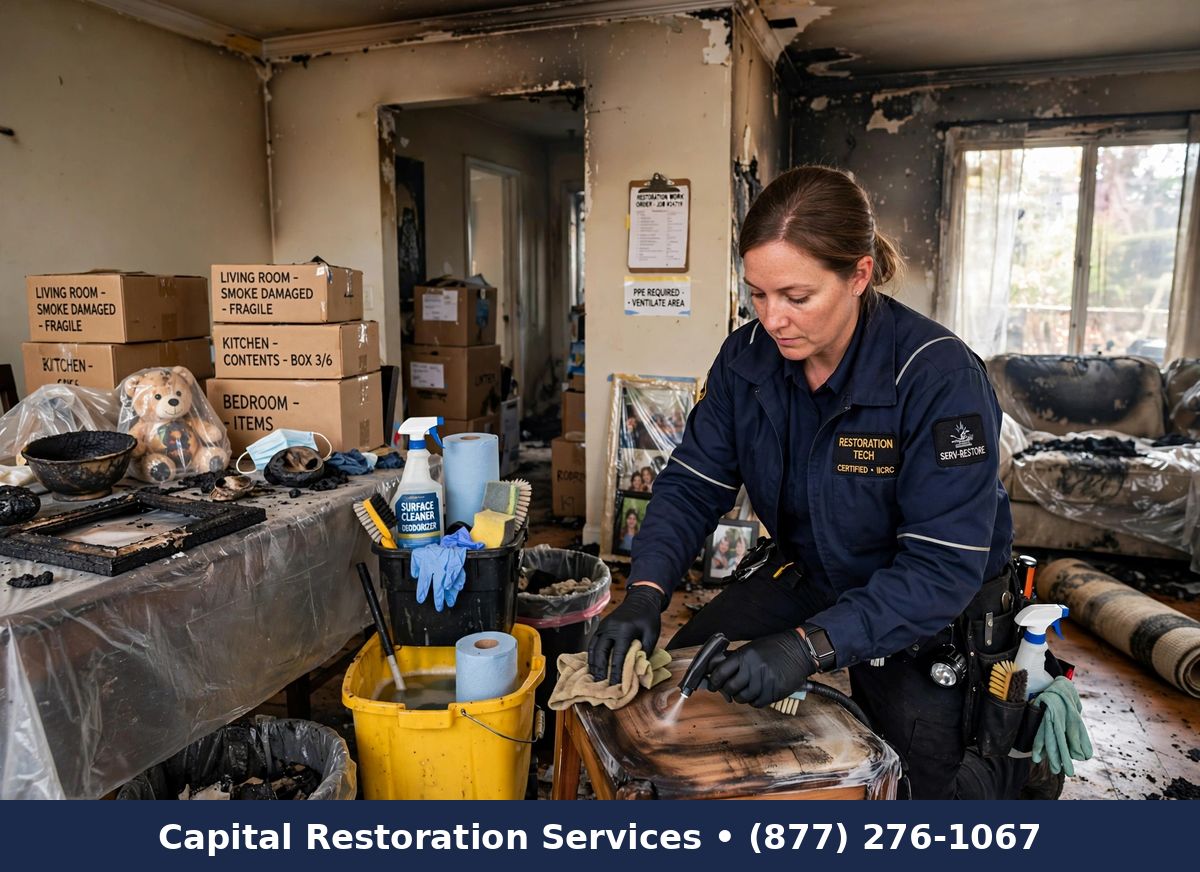
- Assessment and inventory come first. Every item is examined, photographed, and logged. We sort belongings into what can be restored, what needs testing, and what is beyond saving, and we say so plainly before you spend a dollar on cleaning.
- Items bound for the facility are packed with protective wrapping and transported to our cleaning center, where they are logged again on arrival.
- Hard contents get HEPA vacuuming followed by method-matched cleaning: dry sponges for powdery soot, solvent cleaners for sticky residue, careful hand work for antiques and fine finishes.
- Delicate and intricate items go through ultrasonic cleaning. High-frequency sound waves create microscopic cavitation bubbles in a cleaning bath that dislodge soot from crevices and internal channels no brush can reach, without abrasion.
- Electronics are opened, decontaminated, and finished with a deionized rinse that protects against electrical issues as drying begins, then tested for function.
- Textiles take their own path. Smoke-affected clothing goes into an ozone chamber that breaks down odor molecules, then through dry cleaning or wet cleaning depending on fabric and soil, finishing and pressing included.
- Deodorization closes the loop. Thermal fogging and hydroxyl treatments neutralize any remaining odor at the molecular level. Masking fragrances are not part of the program.
- Cleaned contents are inventoried, packed, and either stored or returned to your restored property and placed where they belong.
What affects the cost
Material type and value lead the estimate: hand-cleaning an antique takes longer than running dishes through ultrasonic. The smoke residue type matters because wet smoke and protein residue demand more labor than dry soot. Volume counts too, since a whole-house pack-out of textiles is a different job than a single room of furniture. Electronics decontamination is skilled bench work priced by complexity. And the honest variable is restorability: money spent assessing items that turn out to be unsalvageable is money wasted, which is why we triage before we clean. Call (877) 276-1067 for an itemized assessment.
How we serve your area
Capital Restoration Services cleans contents for homeowners, renters, landlords, and businesses across our service area after residential and commercial fires. We work directly with your adjuster, providing the itemized inventories and condition documentation claims need. Cleaned belongings can be stored securely while structural work finishes, then returned and set in place when the property is ready. The goal is simple: when you walk back in, your things are clean, odor-free, and where they belong.
Features
- Item-by-item assessment and photo-documented inventory before any cleaning
- Ultrasonic cavitation bath that cleans crevices and internal channels without abrasion
- Dry and wet cleaning methods matched to soot type and material
- Ozone chamber and thermal fogging for deep odor neutralization
- Bench-level electronics decontamination with post-cleaning function checks
- Textile restoration including dry cleaning, wet cleaning, and finishing
Benefits
- More of your belongings saved: method-matched cleaning restores items others would discard
- Honest triage: you learn early what is restorable and what is not
- Insurance-ready itemized inventory with condition photos
- Odor fully removed, not masked, through chamber and fogging treatments
- Secure handling from your property to our facility and back
- Your home returns to normal faster when contents come back clean and organized
Frequently asked questions
How do you choose the cleaning method for each item?
Smoke residue type decides the method. Dry, powdery soot responds to HEPA vacuuming and dry chemical sponges. Sticky wet-smoke residue needs solvent-based cleaning. Protein residue from kitchen fires is nearly invisible and needs specialized degreasers. Matching the method to the residue is the difference between cleaning and smearing.
Can electronics be saved after smoke exposure?
Many electronics can be saved if treated before corrosion sets in. We open, clean, and decontaminate circuit boards and components, then finish with a deionized rinse that prevents electrical issues. Honest assessment first: we tell you when an item is beyond safe restoration.
What about clothing and fabrics?
Clothing and soft goods usually respond very well. Smoke-affected textiles go through an ozone chamber to break down odor molecules, then dry cleaning or wet cleaning depending on fabric and soil level. Items are finished, pressed, and packaged before return.
What affects the cost of content cleaning?
Material type and value, the kind of smoke residue, how many items need treatment, whether ultrasonic or hand cleaning is required, and the volume of textiles. An itemized inventory lets us give you a real number; call (877) 276-1067 to start the assessment.
Will the smoke smell come back later?
Not with proper treatment. We use ozone chambers, thermal fogging, and hydroxyl treatments that neutralize odor at the molecular level rather than covering it. If an item still smells after treatment, we tell you plainly instead of sending it back.