Crawl Space Encapsulation for Mold Prevention Near Me
Starting price: Call for pricing
A vented crawl space is a mold factory: damp earth, humid outside air, and dark wood framing. Capital Restoration Services provides crawl space encapsulation for mold prevention, a complete sealing system with a heavy-duty vapor barrier, sealed vents, drainage, and dedicated dehumidification. It removes the moisture mold needs, protecting your home's structure and the air your family breathes.
Here is a fact most homeowners never hear: a large share of the air on your first floor started in your crawl space. Warm air rises through the house and pulls replacement air up from below, a process building scientists call the stack effect. So when your crawl space is damp and growing mold, you are breathing it upstairs. Call (877) 276-1067 and Capital Restoration Services will inspect your crawl space and tell you honestly whether encapsulation is the fix.
What crawl space encapsulation covers
Encapsulation is a complete moisture-control system, not a sheet of plastic on the dirt. It covers clearing and cleaning the space, remediating any existing mold, installing interior drainage and a sump pump where water intrudes, laying a heavy-duty vapor barrier across the floor and up the walls with sealed seams, closing foundation vents permanently, insulating the foundation walls, and installing a dedicated dehumidifier that holds the space at mold-hostile humidity year-round.
What it does not cover is exterior water management. If gutters dump at the foundation or grading slopes toward the house, that gets addressed first, because no interior system outruns bad drainage. We also do not encapsulate over active mold; growth is remediated before the space is sealed.
Why vented crawl spaces grow mold
For decades, builders vented crawl spaces on the theory that outside air would keep them dry. In humid climates it does the opposite. Warm, humid air enters the vents, meets cooler surfaces in the crawl space, and condenses. The result is a dark space with wet wood, wet insulation, and relative humidity that sits in the range mold loves. Add a little ground moisture wicking up through bare earth and you have ideal growing conditions.
This is why a vapor barrier alone so often disappoints. It blocks ground moisture but leaves humid air infiltration untouched, so mold keeps appearing on joists and subflooring. Encapsulation treats moisture as a multi-directional threat and closes every pathway at once.
How the encapsulation process works
- Inspection comes first. We measure humidity, check for standing water, look for mold on framing and subflooring, assess insulation condition, and note drainage problems outside.
- The space is cleared and cleaned. Debris, fallen insulation, and contamination come out. Any existing mold is remediated to a clean baseline.
- Drainage is installed where needed. An interior drain channel directs water to a sump pump basin, and the pump moves it out of the space automatically.
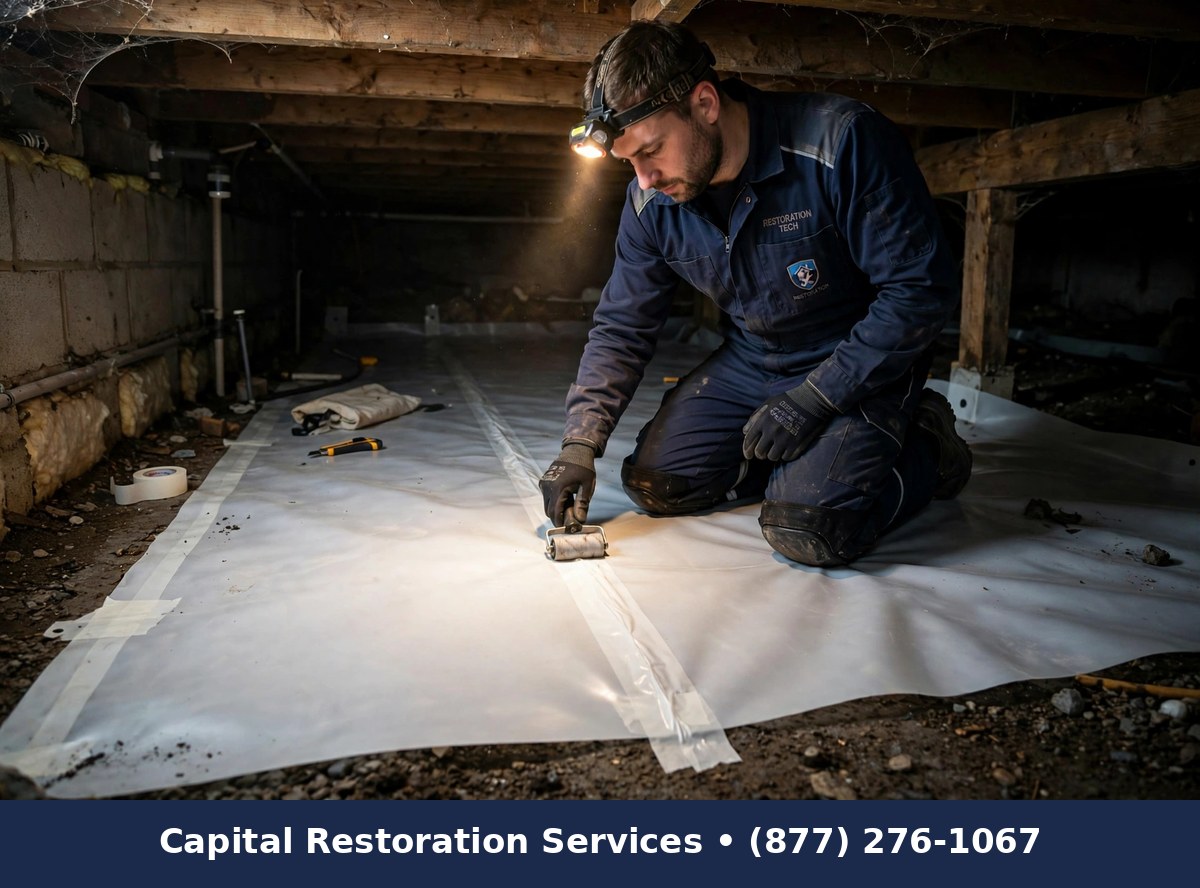
- The vapor barrier goes down. Heavy 12 to 20 mil reinforced liner covers the floor and runs up the foundation walls, with seams overlapped and sealed and edges mechanically fastened.
- Vents are sealed permanently, and every penetration, pipes, ducts, wiring, is sealed where it passes through the liner and walls.
- Insulation is applied to the foundation walls and rim joists, which keeps the space thermally stable and protects pipes from temperature swings.
- A dedicated dehumidifier is installed and tied into a drain. It runs automatically, holding relative humidity below the level where mold and dust mites can thrive.
- The final walkthrough verifies sealed seams, proper drainage operation, and humidity readings, and we show you how to monitor the space.
What affects the cost
The footprint of the crawl space sets the baseline, since liner and labor scale with square footage. Access matters too: a tall, clear crawl space is straightforward, while a low, debris-filled one takes more labor. The condition of the space adds scope when mold remediation, standing water, or failed insulation must be handled first. Drainage needs vary; some homes need only a liner and dehumidifier, others need a full interior drain and sump pump. Insulation choices round out the proposal. For an exact number, call (877) 276-1067. Every crawl space is different enough that an on-site inspection is the only honest way to price it.
How we serve your area
Capital Restoration Services encapsulates crawl spaces for homeowners across our service area, from older homes with original vented foundations to newer builds showing early moisture problems. We handle the full sequence in-house, remediation, drainage, liner, insulation, and dehumidification, so there are no handoffs between contractors. After installation, we leave you with a clean, dry, monitorable space and guidance on keeping it that way. When the air rising into your home starts from a sealed, dehumidified space instead of a damp void, the whole house feels the difference.
Features
- Heavy-duty 12 to 20 mil vapor barrier across floor and up foundation walls
- Foundation vents permanently sealed against humid outside air
- Interior drainage and sump pump where groundwater is a concern
- Dedicated crawl space dehumidifier holding humidity below mold-friendly levels
- Rigid foam insulation on foundation walls and rim joists
- Sealed penetrations around pipes, ducts, and wiring
Benefits
- Mold loses the damp environment it needs, so growth stops and does not return
- Cleaner air upstairs: the space feeding your living areas is dry and sealed
- Wood framing, joists, and subfloor stay dry and structurally sound
- Musty odors that drifted up through floors disappear
- Floors feel warmer and the home holds temperature more evenly
- A clean, dry crawl space that is safe for storage and easy to inspect
Frequently asked questions
Is encapsulation different from just laying a vapor barrier?
A vapor barrier alone only blocks ground moisture; humid outside air still enters through vents and condensation still forms. Encapsulation seals the vents, wraps the walls, manages drainage, and adds a dehumidifier, addressing every moisture source as a system.
Do you remove existing mold before encapsulating?
Yes, existing mold must be remediated first. Sealing mold inside a new encapsulation traps the problem rather than solving it. We remediate growth, then encapsulate, so the sealed space starts clean and stays that way.
Is the dehumidifier really necessary?
Yes, it is considered essential. The vapor barrier stops ground moisture, but humidity can still enter through foundation walls and seasonal air changes. A dedicated dehumidifier holds relative humidity below the threshold where mold and dust mites thrive.
What affects the cost of encapsulation?
Footprint and access, the condition of the space (mold remediation, debris, standing water add scope), whether drainage or a sump pump is needed, and insulation choices. Call (877) 276-1067 for an on-site inspection and a detailed proposal.
How soon will I notice a difference?
Most homeowners notice odors fading within a day or two. Humidity readings drop quickly once the dehumidifier is running. The bigger payoffs, dry framing and stable indoor humidity, build over the following weeks.