Crawl Space Mold Remediation Near Me
Starting price: Call for pricing
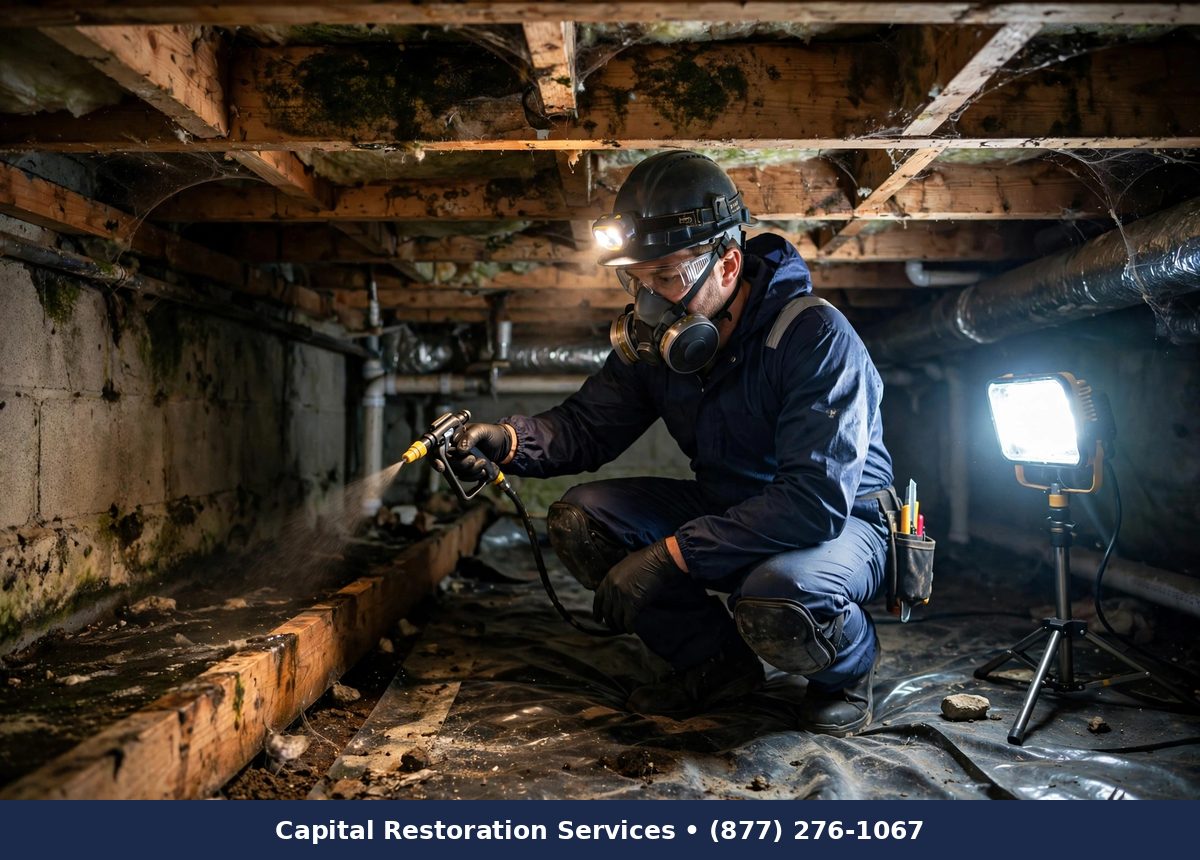
Mold in a crawl space is easy to ignore and expensive to ignore. It spreads across joists, subflooring, and insulation in the dark, feeding on wood and moisture while spores drift upstairs. Capital Restoration Services provides crawl space mold remediation built for confined spaces: careful access work, HEPA-controlled removal, soda or dry ice blasting for framing, and correction of the moisture that caused it. Remediation first, then prevention that lasts.
Nobody goes into their crawl space for fun, which is exactly why mold thrives there. It can spread across joists and subflooring for years, digesting wood and releasing spores into the air your home pulls upward, before anyone notices a musty smell. By the time sagging insulation or warped floors appear, the problem is advanced. Call (877) 276-1067 and Capital Restoration Services will inspect the space properly and show you what is really going on down there.
What crawl space mold remediation covers
Crawl space remediation covers the full cleanup of the space beneath your home: inspection and moisture mapping, safe removal of contaminated insulation, HEPA-controlled cleaning of framing, soda or dry ice blasting where growth covers large areas of wood, antimicrobial treatment of remediated surfaces, and identification of the moisture source that fed the growth. Debris and bagged materials leave the space sealed, never dragged through the house.
What it does not cover is the moisture fix itself. We find the source, a plumbing leak, poor drainage, failed grading, venting that invites humid air, a sweating duct, and document it. The repair may be ours or a trade's, but remediation only holds if the water problem is solved. Sealing a still-wet crawl space is how homeowners pay for the same job twice.
Why crawl space mold is a special case
A crawl space is not a room, and treating it like one fails. Access is tight, clearances are low, and every surface is wood, the exact food mold wants. Growth rarely sits in one convenient spot. It runs along joist bays, spreads across the underside of the subfloor, and hides around beams, blocking, and the thousands of fasteners in the framing. Scrubbing joist by joist around every nail is slow and misses spots.
That is why professional crawl space work leans on blasting methods. Soda blasting propels sodium bicarbonate against the wood; the particles crumble on impact and lift contamination from every nook without harming the framing. Dry ice blasting goes further: frozen CO2 pellets sublimate on contact, so there is no secondary waste to collect and no moisture added to already-damp wood. Both reach the crevices hand tools cannot. Fogging alone, by contrast, never removes growth or staining, it only treats the surface.
There is also a second organism to watch for. Surface mold stains wood; wood-destroying fungi digest it. If framing shows softness or structural weakening, that is a different severity level, and we tell you plainly when wood needs replacement rather than cleaning.
How the remediation process works
- Inspection and mapping come first. We photograph growth, measure moisture in framing and soil, check insulation condition, and trace the water source. You get findings in plain language.
- The moisture source is addressed before or alongside cleaning. A plumbing repair, drainage correction, or duct sealing happens now, because cleaning over an active leak is wasted work.
- Contaminated insulation is removed under HEPA control and bagged inside the space. Wet fiberglass with mold growth is not salvageable.
- Framing is cleaned by method. Light surface growth gets HEPA vacuuming and antimicrobial treatment; widespread growth across joists and subflooring gets soda or dry ice blasting.
- Remediated wood receives antimicrobial treatment to inhibit regrowth.
- The space is dried and verified. Framing must test within normal moisture ranges before we consider the job complete.
- We close with documentation: photos, moisture readings, and a clear recommendation on prevention, usually encapsulation or dedicated dehumidification.
What affects the cost
The square footage of affected framing is the baseline, but access difficulty moves the number fast: a tall, clear crawl space is one job, a two-foot-high maze of ducts and debris is another. The cleaning method matters, since blasting large areas costs more than treating light surface growth. Insulation removal and replacement adds material and labor. And the moisture correction, from a simple plumbing fix to drainage work, is its own line. For an exact figure, call (877) 276-1067. Crawl spaces vary too much for phone estimates.
How we serve your area
Capital Restoration Services remediates crawl spaces across our service area, from older homes with original vented foundations to newer builds with drainage failures. Our crews are trained for confined-space work with proper protective equipment and air monitoring. We handle the sequence in-house: remediation, moisture correction, and, when you are ready, full encapsulation for long-term prevention. When we leave, your crawl space is clean, dry, documented, and ready to stay that way.
Features
- Confined-space work protocols with proper PPE and air monitoring
- HEPA vacuuming and controlled removal of contaminated insulation
- Soda blasting and dry ice blasting for mold on joists and subflooring
- Antimicrobial treatment of remediated framing
- Moisture source identification: drainage, plumbing, ventilation, grading
- Post-remediation drying verification before the space is closed up
Benefits
- Growth removed from framing, not just sprayed over
- Air rising into your home no longer carries spores from below
- Wood framing dried and protected so rot cannot advance
- Moisture source identified and corrected, so growth does not return
- Safe working practices in a confined space, handled by trained crews
- Clear path to encapsulation if you want long-term prevention
Frequently asked questions
Can I handle crawl space mold myself?
In most cases, no. Crawl spaces are confined, low-clearance environments where proper containment, negative air, and PPE matter. Disturbing large areas of growth without controls can push spores into the living space. Call (877) 276-1067 for a professional assessment.
Will fogging alone fix it?
Fogging kills surface organisms but does not remove growth or staining from wood, and it does nothing about the moisture source. Professional remediation physically removes contamination from framing and corrects the water problem, which is the only combination that lasts.
Is dry ice blasting safe in a crawl space?
No. Dry ice sublimates on contact, so there is no secondary waste to collect, and the process adds no moisture to already-damp wood. In confined crawl spaces we monitor air quality during blasting, since CO2 buildup must be managed.
What affects the cost of crawl space mold remediation?
Square footage of affected framing, access difficulty, the blasting or cleaning method required, how much insulation must be removed and replaced, and the moisture correction needed afterward. Call (877) 276-1067 for an inspection and a detailed scope.
Will the mold come back?
Only if the moisture problem is fixed and humidity is controlled. That is why we identify the water source during remediation and recommend encapsulation or dehumidification afterward. Remediation without moisture control is a temporary fix.