Crawl Space Water Damage Repair Near Me
Starting price: Call for pricing
Water in a crawl space is three problems wearing one disguise: the water itself, the damage it has already done, and the pathway that let it in. Capital Restoration Services provides crawl space water damage repair that handles all three: emergency water removal, structural drying and repair of joists and subflooring, and drainage or sump protection to keep it from happening again. One call, one crew, one complete fix.
Most homeowners discover crawl space water by accident: a musty smell, a sagging floor, or a home inspector's flashlight finding a small lake under the house. By then the water has been there a while, and it has been busy. Wood absorbs it, insulation sags with it, and mold starts within days. Call (877) 276-1067 and Capital Restoration Services will get the water out, dry the structure properly, repair what the water damaged, and fix the reason it got in.
Three jobs people confuse as one
Water in a crawl space is really three different jobs, and skipping any of them is why the problem keeps coming back. First is water removal: getting the standing water out and drying the structure. That handles the water that is already there. Second is waterproofing: drainage, sump pumps, and grading that stop future water from entering. That handles the pathway. Third is structural repair: fixing joists, sills, and subflooring the water already damaged. That handles the consequences. A company that only pumps the water has done one third of the job.
What crawl space water damage repair covers
Our repair scope covers the full sequence: emergency pumping and extraction of standing water, removal of saturated insulation, structural drying of all framing with moisture verification, repair or replacement of rotted joists, sill plates, and subfloor sections, installation of interior drainage and sump pump systems where needed, grading and downspout corrections outside, and finally vapor barrier and insulation replacement once the space is dry.
What it does not cover is the exterior earthwork beyond basic grading, like a full French drain system around the entire foundation, which may need an excavation contractor. We also do not handle the plumbing repair if a burst pipe caused the flood; we coordinate with a plumber and start drying the moment the leak is stopped.
How we find where the water came from
The repair starts with detective work, because the fix depends entirely on the source. We look for the telltale signs: water staining on foundation walls shows the high-water mark, efflorescence marks where water has wicked through block, the pattern of wet versus dry soil shows whether water comes from above or below, and the timing matters, water after every rain points to drainage and grading, while constant dampness points to groundwater or plumbing. Downspouts discharging at the foundation and soil sloping toward the house are the most common culprits we find. A plumber's leak leaves a different signature: localized soaking near supply or drain lines.
How the repair process works
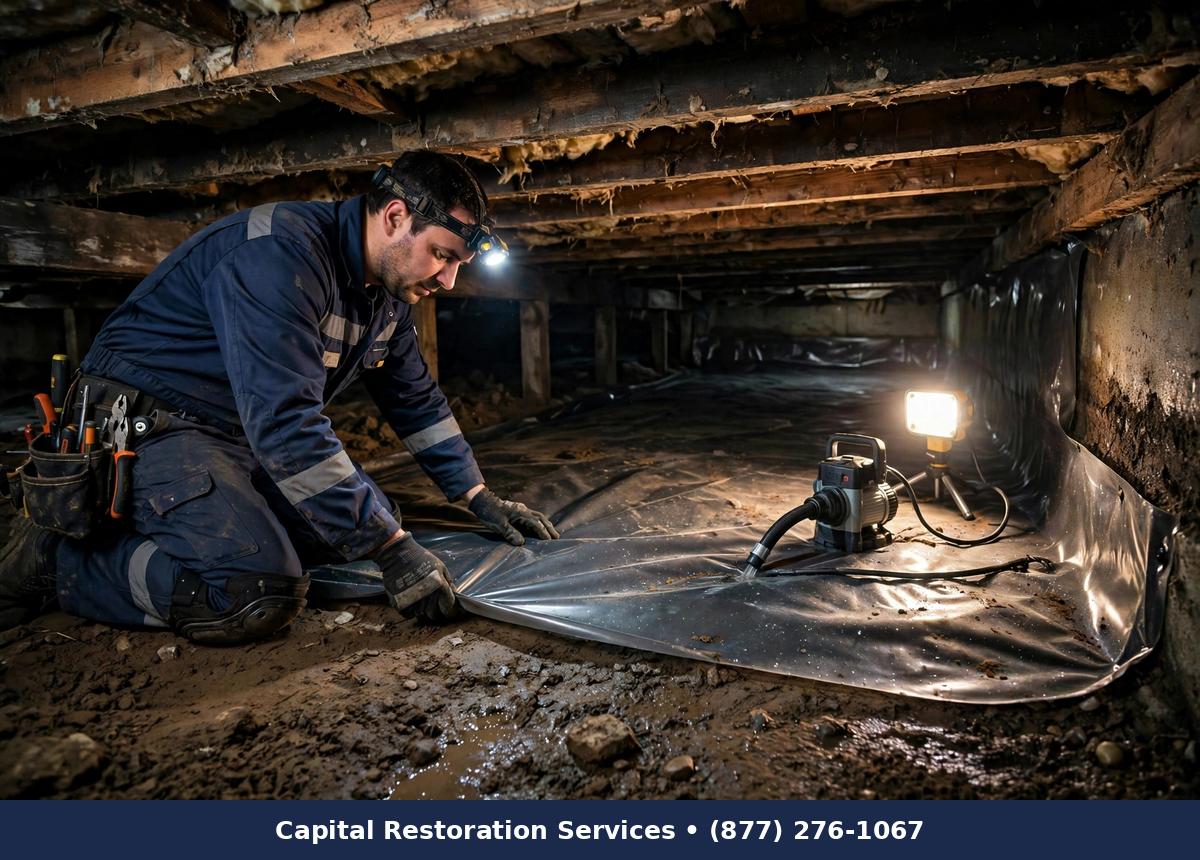
- Emergency water removal comes first. Pumps and extraction equipment remove standing water, and saturated insulation is pulled out and bagged. The screwdriver test tells us about the wood: if it sinks in easily, that framing is compromised.
- Structural drying follows. Air movers and dehumidifiers dry joists, beams, and subflooring, with moisture meters tracking progress until framing tests within normal ranges. This takes days, not hours.
- Damaged structure is repaired. Rotted joist sections are sistered or replaced, damaged sill plates are swapped, and weakened subfloor sections are cut out and replaced. Support posts are reset where settlement occurred.
- Waterproofing goes in. An interior drainage channel directs water to a sump basin, a pump with battery backup moves it out automatically, and the discharge runs well away from the foundation.
- The exterior is corrected. Gutters are checked, downspouts get extensions, and grading is adjusted so soil slopes away from the house.
- The space is finished clean. A new vapor barrier goes down, fresh insulation goes up, and the final inspection verifies dry readings throughout.
What affects the cost
The extent of water intrusion sets the baseline, but structural damage moves the number most: sistering a few joists is one thing, replacing sections of subfloor is another. Whether drainage or a sump system must be installed from scratch adds a significant line. Insulation replacement scales with the area affected. Access difficulty matters in every crawl space job, and emergency pumping carries a premium over scheduled work. For an exact figure, call (877) 276-1067. An inspection with photos is the only honest way to scope it.
How we serve your area
Capital Restoration Services repairs water-damaged crawl spaces across our service area, from single-event floods to chronic seepage that has been quietly rotting framing for years. We handle the complete sequence in-house: extraction, drying, structural repair, and waterproofing, so you are not coordinating three contractors. When we leave, the space is dry, the structure is sound, the water has a managed path out, and you have the documentation to prove it.
Features
- Emergency standing water pumping and extraction from crawl spaces
- Structural drying of joists, beams, subflooring, and sill plates
- Joist, sill, and subfloor repair or replacement where water caused rot
- Interior drainage channels and sump pump installation with battery backup
- Grading, gutter, and downspout assessment to redirect water away
- Vapor barrier and insulation replacement after the space is dry
Benefits
- Standing water gone fast, before it spreads damage upward
- Framing dried to verified levels, not just surface-dry
- Rotted joists and sills repaired or replaced for structural safety
- Drainage and sump protection so the next storm does not repeat the cycle
- Insulation replaced and space cleaned for a healthy restart
- Documentation with photos and readings for your insurance file
Frequently asked questions
I found standing water in my crawl space. What should I do first?
Do not just pump it out and close the hatch. That handles the symptom, not the source. Photograph everything for insurance, check gutters and grading, and call (877) 276-1067 so the space is properly dried and the entry point is found.
Is a one-time flood different from recurring water?
If water appears after more than one rain event, the problem is systemic and needs drainage correction, a sump pump, or grading work. A one-time plumbing leak is different. Our inspection identifies which one you have.
My sump pump did not keep up. Why?
A failed sump pump, a tripped breaker, a clogged discharge line, or a pump overwhelmed by volume. We diagnose the failure, replace or upgrade the pump, and add battery backup where power loss is the risk.
What affects the cost of crawl space water damage repair?
Extent of water intrusion, structural damage to joists and subflooring, whether drainage or a sump system must be installed, insulation replacement, and access difficulty. Call (877) 276-1067 for an inspection and a detailed scope.
Does homeowners insurance cover crawl space water damage?
Sometimes partially, depending on the source. Sudden events like burst pipes or storm intrusion are commonly covered; long-term seepage often is not. Our photo documentation and moisture readings support your claim; confirm the details with your agent.