Dehumidification for Mold Control Near Me
Starting price: Call for pricing
Mold does not need a flood. It needs sustained humidity, and most homes cross that line every summer. Capital Restoration Services provides dehumidification for mold control: professional-grade equipment, properly sized and placed, that holds your home's humidity in the range where mold cannot thrive. It is the simplest, most reliable mold prevention there is: take away the moisture, and the mold never starts.
Here is the uncomfortable truth about mold: it does not need a burst pipe or a flood. It needs air that stays damp. When indoor relative humidity sits above 60 percent for weeks, which happens in countless homes every summer, ordinary airborne spores settle on drywall, wood, and dust and start growing. No leak required. Call (877) 276-1067 and Capital Restoration Services will measure your home's humidity and show you exactly where you stand.
The humidity numbers that matter
Public health guidance is refreshingly specific on this one. The EPA recommends keeping indoor relative humidity below 60 percent, ideally between 30 and 50 percent. The CDC goes further and suggests keeping it no higher than 50 percent. The reason is biological, not bureaucratic: below 50 percent, mold growth is strongly inhibited. Between 50 and 60, it can creep along if food is available. Above 60, most household molds thrive, and above 70, growth can turn aggressive within days. Dust mites, which trigger many of the same allergy complaints, need humidity in the mid-60s and up to thrive. One machine, properly run, takes both problems down at once.
There is also a clock running. The EPA notes that wet materials should be dried within 24 to 48 hours, because after that window mold can establish on its own. Dehumidification is how you win that race in spaces that stay damp chronically, not just after a single event.
What dehumidification for mold control covers
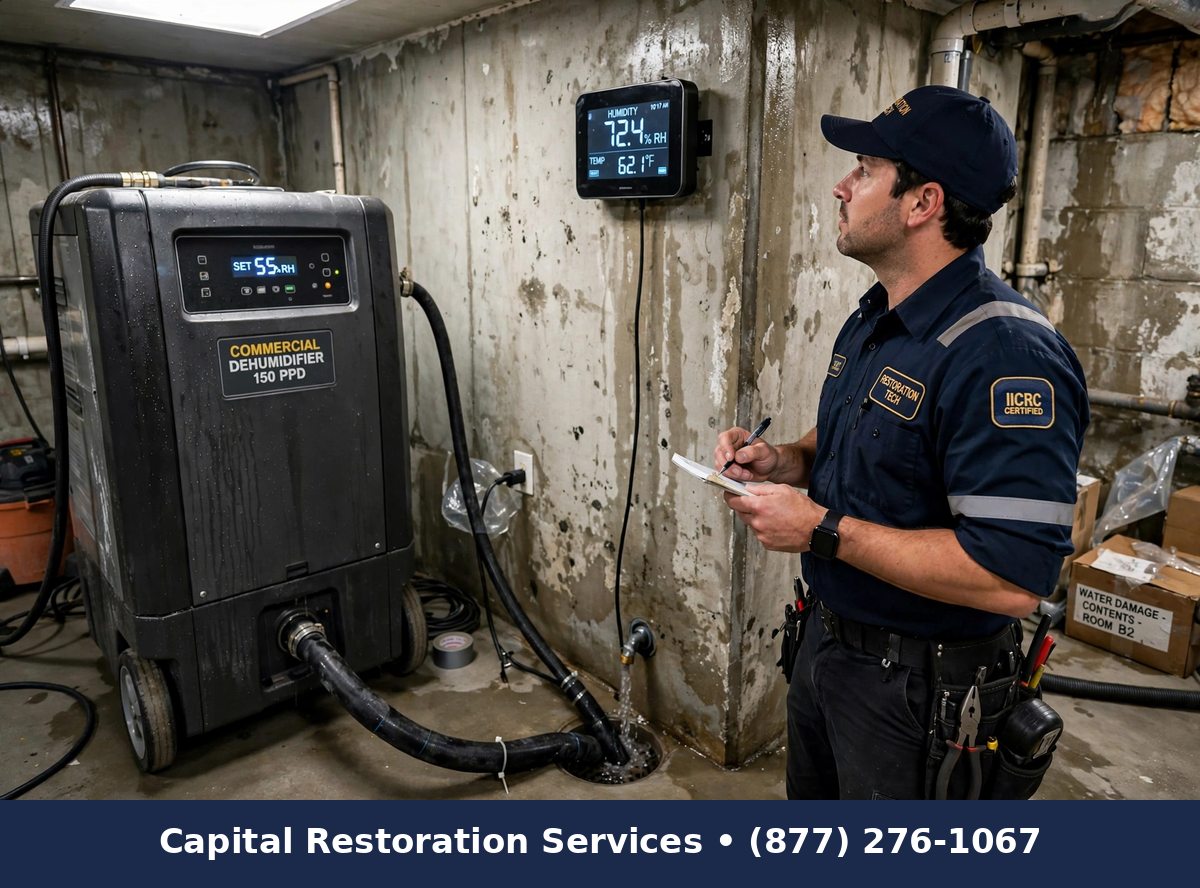
This service covers professional humidity control as a mold prevention program: on-site humidity assessment with calibrated meters, equipment properly sized to the space and its moisture load, installation with continuous drainage, humidistat controls set to hold the target range automatically, and follow-up readings that verify the space is staying where it should. It covers basements, crawl spaces, and any chronically damp area of the home.
What it does not cover is remediation of mold that is already established. Lowering humidity stops growth from spreading, but colonies rooted in drywall or framing still need professional removal. We assess honestly and tell you which side of that line you are on. It also does not replace fixing active water intrusion; a dehumidifier cannot outrun a leak.
Why professional equipment beats a store-bought unit
A consumer dehumidifier and a professional LGR unit share a name and almost nothing else. Conventional refrigerant units stall when humidity drops toward the 50 percent range and ice up in cool spaces like crawl spaces. LGR, low-grain refrigerant, units keep extracting moisture at far lower humidity levels, which is exactly where mold prevention lives. They pull dramatically more water per day, drain continuously instead of demanding bucket duty, and run on humidistats that hold a setpoint automatically.
Sizing matters as much as the machine. An undersized unit runs constantly and never reaches target; an oversized one short-cycles. We size on real conditions, space volume, starting humidity, and moisture load, and we verify with readings, not assumptions.
How the service works
- Assessment comes first. We measure humidity in the problem areas and adjacent spaces, check for active water intrusion, and look for existing mold that would need remediation before or alongside dehumidification.
- Equipment is selected and placed. The unit is sized to the space, positioned for proper airflow, and connected to a drain so it runs continuously without attention.
- Controls are set. The humidistat is programmed to hold humidity in the target range, and the unit cycles automatically as conditions change with weather and seasons.
- Verification follows. We return to check readings across the space and confirm humidity is holding steady, adjusting placement or settings if any zone lags.
- For permanent installations, we tie the system into the space properly: sealed crawl spaces, finished basements, and integration with sump and drainage where applicable.
What affects the cost
The size of the space and its starting humidity set the baseline, since larger and damper areas need bigger equipment. Whether the space is open or cut into compartments matters, because compartmentalized areas may need multiple units or ducted airflow. Drainage availability decides whether a simple gravity drain works or a condensate pump is needed. And the engagement type counts: a permanent installation with automatic controls is a different scope than temporary drying after a water event. For an exact figure, call (877) 276-1067. A quick on-site assessment gives you a real number.
How we serve your area
Capital Restoration Services installs and services dehumidification for mold control in homes across our service area, with particular attention to basements, crawl spaces, and the humid months when indoor readings climb. We pair dehumidification with encapsulation, waterproofing, and remediation when the situation calls for it, so humidity control is part of a complete moisture strategy rather than a lone appliance. The goal is simple: air in your home that stays in the range where mold cannot grow, verified by readings you can see.
Features
- Professional LGR dehumidifiers sized to the space, not one-size-fits-all
- Hygrometer-verified humidity readings before, during, and after
- Continuous drainage setups, no bucket emptying
- Targeted placement for basements, crawl spaces, and problem rooms
- Humidistat controls that hold humidity automatically in the safe range
- Integration with encapsulation and waterproofing systems
Benefits
- Mold loses the moisture it needs: growth stalls and new colonies cannot establish
- Humidity held in the zone public health guidance recommends
- Dust mites and musty odors decline along with the moisture
- Wood framing, drywall, and belongings protected from moisture damage
- Continuous, automatic operation with no buckets to empty
- Verified with real readings, not guesswork
Frequently asked questions
What humidity level prevents mold?
The ceiling is 60 percent, and the comfort zone is 30 to 50. The practical move is a hygrometer in your dampest room: readings that sit in the 60s for days mean that space needs dehumidification, and readings in the 70s mean mold is likely already getting established.
Why not just buy a dehumidifier from the store?
For a damp closet, a store unit might do. For a basement or crawl space carrying a real moisture load, they are undersized, demand constant bucket emptying, and lose effectiveness right as humidity nears the target. Professional equipment is sized to the actual space, drains on its own, and gets verified with meter readings instead of hope.
Will a dehumidifier remove mold that is already there?
No. Dehumidification prevents new growth and stops existing colonies from spreading, but established mold on materials still needs professional remediation. We tell you honestly which situation you have.
What affects the cost of dehumidification?
Space size and starting humidity, whether the area is open or compartmentalized, drainage availability for continuous operation, and whether it is a permanent installation or a temporary drying setup. Call (877) 276-1067 for an assessment.
Can mold come back after dehumidification?
Once humidity is controlled and any existing growth is remediated, the risk drops dramatically. The key is consistency: humidity that swings back up every summer lets mold reestablish. Permanent installations with automatic controls solve that.