Dehumidification Services Near Me
Starting price: Call for pricing
After water extraction, the real work begins: getting moisture out of everything the water touched. Capital Restoration Services provides professional dehumidification services for water-damaged properties, with commercial LGR and desiccant equipment, daily moisture monitoring, and drying plans built on psychrometry, not guesswork. We dry the structure completely, verify it with meters, and document every step.
The water is gone, the floors look dry, and it is tempting to call it done. That is exactly when the expensive mistakes happen. Water hides in wall cavities, under flooring, and inside framing, and it keeps working long after the surface looks fine: warping wood, bubbling paint, and feeding mold that appears weeks later. Call (877) 276-1067 and Capital Restoration Services will map the hidden moisture and dry the structure properly, with meters proving every step.
What professional dehumidification covers
This service covers the complete structural drying program after a water loss: moisture mapping with meters and infrared cameras, a drying plan based on the class of intrusion, placement of commercial dehumidifiers and air movers as a coordinated system, daily monitoring and equipment adjustments, and final verification against dry standards with a complete drying log. It covers homes and businesses after plumbing failures, storm intrusion, appliance leaks, and any event that soaked building materials.
What it does not cover is the water extraction that comes before drying; standing water is removed first under a separate scope. It also does not cover reconstruction of materials that cannot be dried and must be removed, though we identify those during mapping and coordinate the rebuild.
Drying is a science, not a waiting game
The industry has a word for it: psychrometry, the study of how air, temperature, and moisture interact. Drying works by controlling all three at once. Air movers create airflow across wet surfaces, which drives evaporation. Dehumidifiers pull that evaporated moisture out of the air so evaporation can continue. Warmth accelerates the process. Get the balance wrong and materials dry on the surface while staying wet inside, or dry too fast on one face and warp.
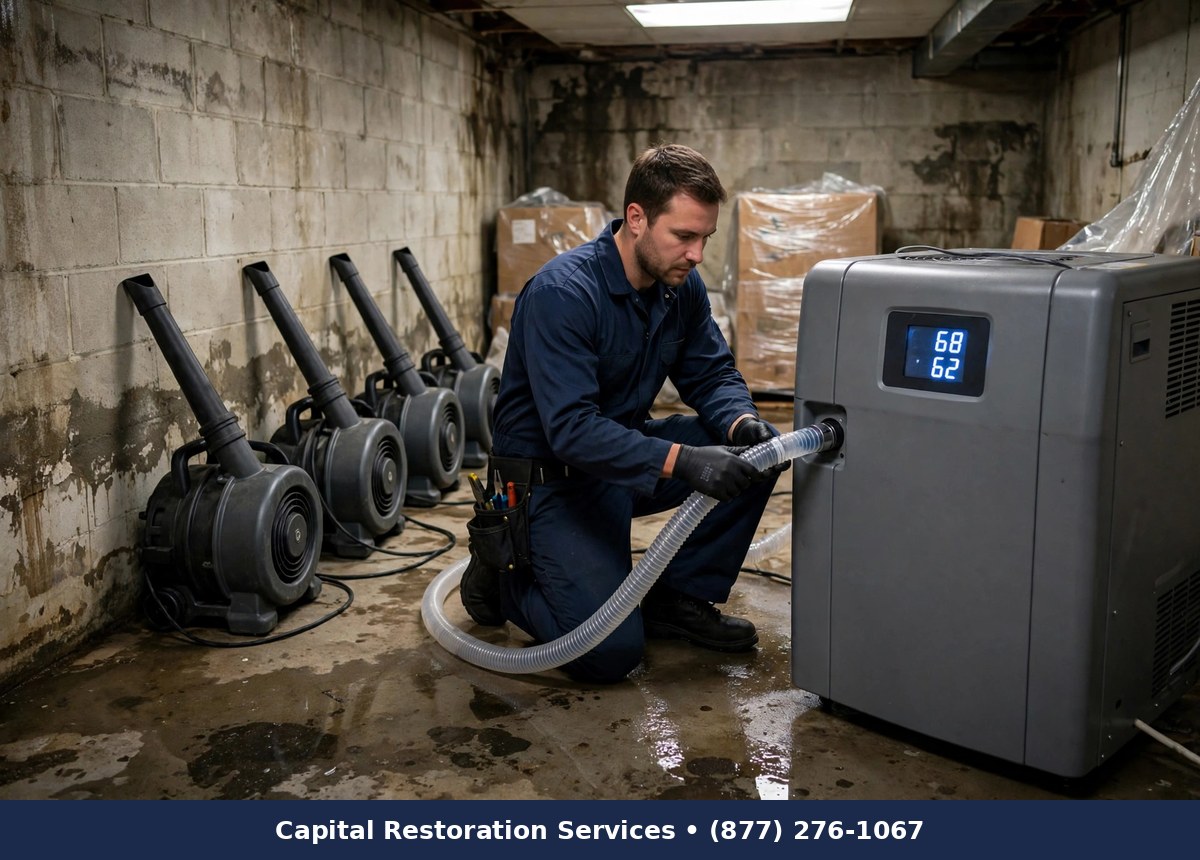
That is why equipment choice matters. Conventional refrigerant dehumidifiers stall as humidity drops and ice up in cool spaces. LGR, low-grain refrigerant, units keep extracting at much lower humidity levels and are the workhorse of structural drying. Desiccants go further still: they adsorb moisture onto a rotating medium and work at temperatures where refrigerant units quit entirely, which makes them the choice for cold crawl spaces, unheated structures, and deep drying goals. We match the machine to the conditions, not to habit.
How the drying program works
- Moisture mapping comes first. Pin meters, hygrometers, and infrared cameras locate every wet material, including hidden pockets behind walls and under floors. Dry standards are established from unaffected materials in the same building.
- The drying system is designed. Dehumidifiers and air movers are sized to the water load and positioned so airflow reaches every wet surface. Containment goes up where needed to create an efficient drying chamber.
- Equipment runs continuously. Units drain on their own around the clock; nobody is emptying buckets. The system runs until readings, not the calendar, say the job is done.
- Monitoring happens daily. Technicians record moisture content in materials and humidity in the air, reposition equipment as zones dry, and log everything. If a wall cavity stalls, we open it or redirect airflow rather than hoping.
- Adjustments keep the program efficient. As materials release moisture, equipment is scaled back in dried zones and concentrated where moisture persists.
- Verification closes the job. Final readings across all affected materials must meet dry standards before equipment is removed. You receive the complete drying log.
What affects the cost
The class of water intrusion is the starting point: surface wetting dries fast, while deeply saturated assemblies need far more equipment time. Material types matter, since dense hardwoods and multi-layer assemblies release moisture slowly. The size and layout of the space decides how many units and how much monitoring labor the program needs. Temperature conditions count too, because cold spaces dry slower and may need desiccant equipment. And duration follows the readings: the program runs until dry standards are met. For an exact figure, call (877) 276-1067. Moisture mapping is the only honest basis for a quote.
How we serve your area
Capital Restoration Services runs structural drying programs for homes and businesses across our service area after every kind of water loss. Our technicians work from measurements, and the drying log we hand you documents the entire program for your insurance file. When equipment rolls out, the structure is verified dry, which means reconstruction starts on a solid foundation and mold never gets its opening. That is the difference between drying and hoping.
Features
- Commercial LGR dehumidifiers for standard structural drying
- Desiccant dehumidifiers for cold spaces and deep, low-grain drying
- Air movers positioned for balanced evaporation across all wet surfaces
- Daily moisture readings with pin meters, hygrometers, and infrared cameras
- Drying logs documenting progress against dry standards
- Containment and negative air to protect clean areas during drying
Benefits
- Structure dried to verified dry standards, documented with readings
- Mold and secondary damage prevented during the critical window
- Drying plan built on measurements, not calendar days
- Equipment adjusted daily as materials release moisture
- Faster path to reconstruction and normal life
- Clear records that support your insurance claim
Frequently asked questions
How do you know when everything is actually dry?
Not reliably. Materials can feel dry on the surface while holding moisture deep inside, especially in wall cavities and under flooring. We verify with pin meters and hygrometers against established dry standards before equipment comes out.
How long does structural drying take?
It depends on the class of water intrusion, the materials involved, and conditions. We take readings daily and adjust equipment as zones dry. The job ends when meters confirm dry standards, not when a set number of days passes.
What is the difference between air movers and dehumidifiers?
They move the same air, but dehumidifiers remove moisture from it. Air movers without dehumidification just push wet air around. The two work as a system: movers drive evaporation off surfaces, dehumidifiers pull that moisture out of the air.
What affects the cost of professional drying?
The water load, the materials saturated, the size and layout of the space, temperature conditions, and how long drying must run. Call (877) 276-1067 for an assessment and a properly scoped drying plan.
Can I just run fans instead?
In most cases, yes. Fans help, but a sealed drying chamber with professional dehumidification dries faster and more completely, and the monitoring proves it. For small, clean-water spills on hard surfaces, fans alone may be enough; we will tell you honestly.