Document and Photo Drying Near Me
Starting price: Call for pricing
Some things cannot be reordered: family photographs, legal records, business files, rare books. When water reaches them, the clock starts immediately. Capital Restoration Services provides document and photo drying with professional methods: rapid stabilization, vacuum freeze drying, desiccant chambers, and careful air drying. We triage fast, document everything, and save what can be saved.
Here is what nobody tells you until it is too late: wet paper has a clock, and it runs fast. Mold can start growing on damp documents within 48 to 72 hours. Photographs are even more unforgiving; once a wet print dries stuck to another print or to frame glass, the image is gone. But there is a move that buys time, and almost nobody knows it: freeze them. Call (877) 276-1067 at the first sign of water on your documents and photos, and Capital Restoration Services will triage the situation before the clock runs out.
What document and photo drying covers
This service covers the recovery of paper-based and photographic materials after water damage: emergency stabilization and triage, vacuum freeze drying for books and bound volumes, desiccant chamber drying for large document volumes, careful air drying for photographs and prints, cleaning of soot and grime from salvaged pages, and digital scanning when originals cannot be fully restored. It covers family photographs, legal and financial records, business files, books, artwork on paper, and archival collections.
What it does not cover is electronic data recovery from damaged drives; that is a separate specialty. We also do not appraise the monetary value of rare books or artwork. We stabilize, dry, clean, and document condition, and appraisers or adjusters handle valuation.
The first hours decide everything
If your documents and photos are wet right now, here is what to do before we arrive. Do not try to peel apart stuck photographs; you will tear the emulsion. Do not rub wet prints. If you cannot air-dry items within 48 hours, rinse off mud with clean cold water, interleave photographs with wax paper, seal everything in plastic bags, and freeze them. Freezing does not damage paper; it pauses the disaster. Items can stay frozen until there is time to dry them properly, and they dry through sublimation even in the freezer.
For items you can address immediately, air-dry documents flat in small stacks on absorbent paper, changing the blotting material as it soaks through. Stand damp books upright and fan the pages. Lay photographs face-up on clean paper towels, never touching the image surface, and never in direct sun or wind, which curls them.
How professional recovery works
- Triage comes first. We sort everything by priority, contamination level, and material sensitivity. Photographs and mold-threatened items go first; stable frozen items wait their turn.
- Stabilization stops the clock. Items that cannot be dried immediately are blast-frozen or kept frozen, halting mold and buying working time.
- Vacuum freeze drying handles books and bound volumes. Frozen moisture converts directly to vapor under vacuum, which prevents the warping and distortion that ruins air-dried books.
- Desiccant chambers dry large volumes. Documents sit in controlled rooms where desiccant dehumidifiers pull moisture from the air, drying paper gently and evenly. This method also keeps the collection accessible during the process.
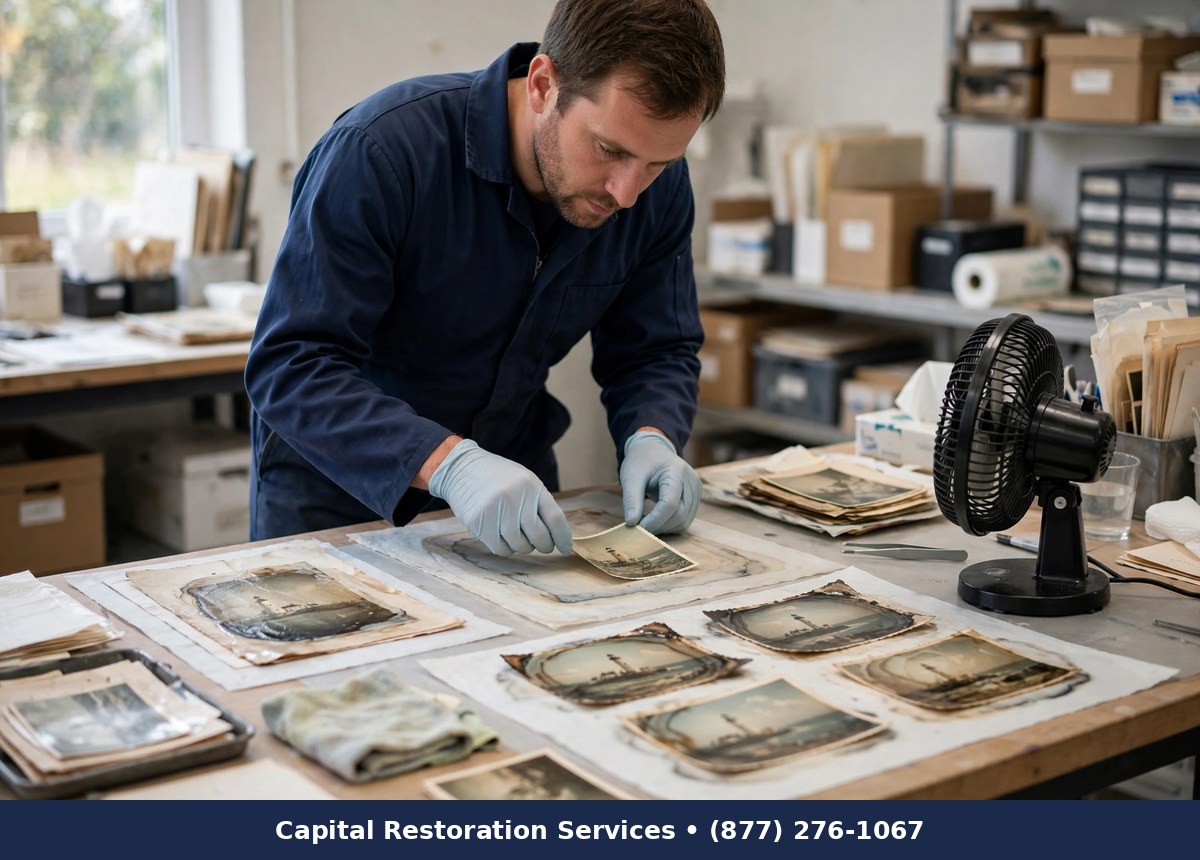
- Photographs get hand treatment. Wet prints are rinsed, separated with care, and air-dried emulsion-up on clean blotting material. Negatives and slides are hung or laid flat depending on condition.
- Cleaning follows drying. Trained staff remove dirt and fungal spores with specialized sponges and HEPA vacuuming, never with liquid that would re-wet the paper.
- Digital backup preserves what drying cannot. High-resolution scanning creates faithful replicas of anything too distorted to restore, so the information survives even when the paper does not.
- Everything is inventoried, re-boxed, re-labeled, and returned with a complete record.
What affects the cost
Volume is the starting point: a box of family photos is a different job than a flooded file room. Material type matters because photographs and bound volumes demand far more hand labor than loose documents. Contamination level counts; clean water is the best case, while sewage or mud adds cleaning and safety protocols. The drying method follows the materials: vacuum freeze drying and desiccant chambers are specialized processes. And urgency matters, since emergency triage in the first hours costs more than scheduled recovery of already-frozen items. For an exact figure, call (877) 276-1067. A look at what you have is the only honest basis for a plan.
How we serve your area
Capital Restoration Services recovers documents and photographs for homeowners, businesses, law offices, medical practices, and institutions across our service area. We understand that some of what we handle is confidential, and chain-of-custody protocols protect sensitive records throughout. Whether it is a shoebox of family photos or a room of business records, we treat every item as irreplaceable until proven otherwise, because usually, it is.
Features
- Emergency triage and stabilization within the critical first hours
- Vacuum freeze drying that prevents warping and distortion
- Desiccant drying chambers for large volumes of documents
- Hand air-drying for photographs with emulsion-safe handling
- Digital scanning and reproduction when originals cannot be fully saved
- Secure chain-of-custody tracking for confidential records
Benefits
- Irreplaceable items get a real chance instead of a trash bag
- The 48-hour mold window is beaten with fast stabilization
- Chain of custody documented for insurance and legal needs
- Digital copies preserve information even when paper cannot be saved
- Secure handling for confidential and sensitive records
- Items returned organized, labeled, and ready to file
Frequently asked questions
My photos are wet and I cannot deal with them right now. What do I do?
Put them in sealed plastic bags and freeze them. Freezing buys time: it halts mold growth and lets items be thawed and dried properly later. Do not let wet photos dry stuck together or stuck to glass.
What gets priority in document recovery?
Photographs, because their emulsion softens and sticks permanently if mishandled. Then anything already showing mold, then high-value or legally critical records. Volume items like archived files can wait frozen while priority pieces are treated.
Do you offer digital scanning of damaged documents?
Yes, as a backup when paper cannot be fully restored. High-resolution scanning preserves the information and the image even when the original remains distorted. We recommend it for anything with legal or archival value.
What affects the cost of document recovery?
Volume and material type, contamination level, whether freeze drying or desiccant drying is needed, and how much hand work photographs require. Call (877) 276-1067 for an assessment and a clear salvage plan.
Does insurance cover document restoration?
It depends on the source. Clean water damage to documents is commonly covered under contents provisions. Our inventory, photography, and chain-of-custody documentation support the claim; confirm details with your agent.