Document and Photo Restoration After Fire Near Me
Starting price: Call for pricing
Fire does not have to touch paper to ruin it. Soot and smoke travel through a building, settling on books, records, and photographs, and the residue is acidic enough to keep damaging them. Capital Restoration Services provides document and photo restoration after fire: HEPA and dry-sponge soot removal, careful page-by-page cleaning, controlled deodorization, and quality control on every item. We save what smoke tried to take.
After a fire, people expect the charred rooms to be a loss. What surprises them is the rest of the house: books on shelves two rooms away, turned gray with soot. Photo albums that smell like a campfire. Business records coated in a fine acidic film. Fire does not need to touch paper to damage it; smoke carries soot everywhere air goes, and the residue keeps eating at paper long after the fire is out. Call (877) 276-1067 and Capital Restoration Services will assess your documents and photographs and start the cleaning before the damage sets permanently.
What fire document restoration covers
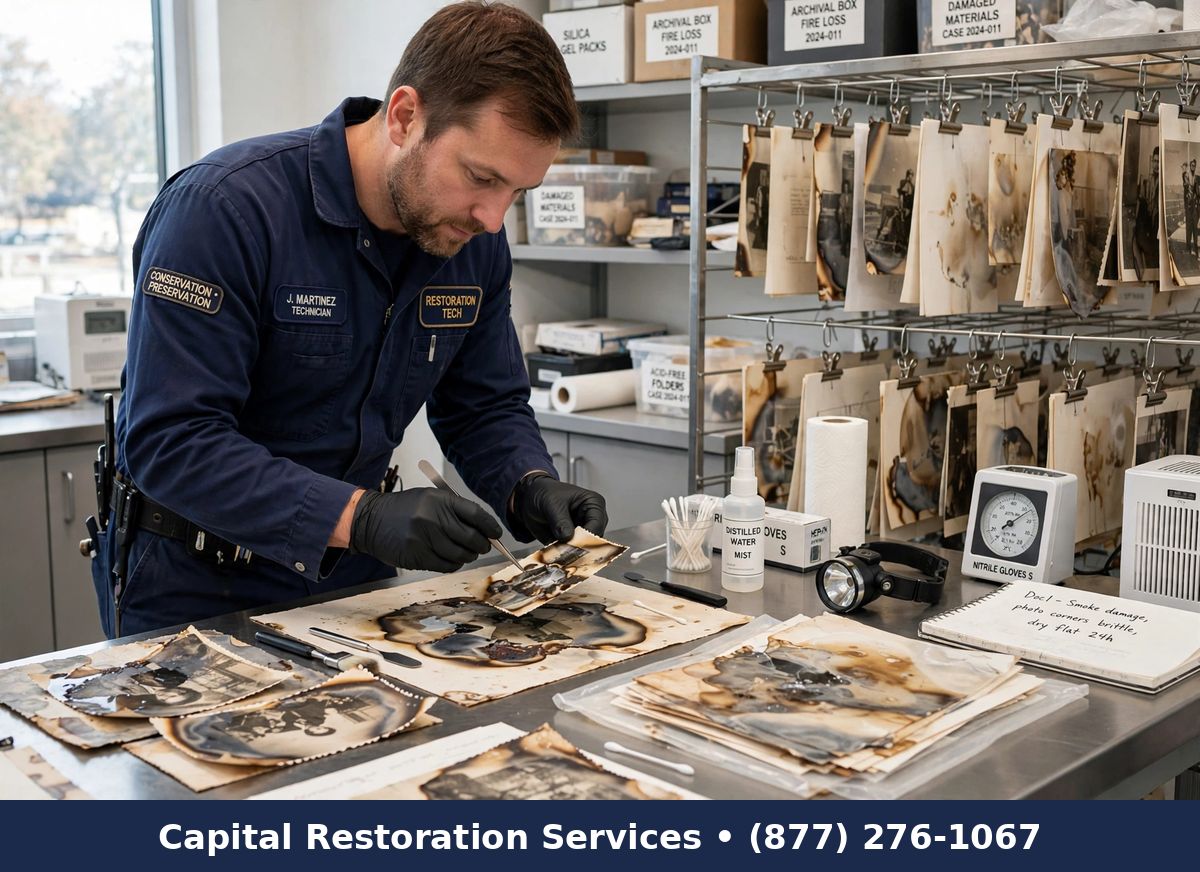
This service covers recovery of paper and photographic materials affected by soot, smoke, and ash: HEPA vacuuming of loose particulate, dry chemical sponge cleaning of book covers and page edges, page-by-page treatment of smoke-damaged volumes, ionized air washing for documents, controlled deodorization for smoke odor absorbed into paper and bindings, photograph rinsing and emulsion-safe drying, and digital scanning when originals cannot be fully restored. It covers books, legal and business records, family photographs, artwork on paper, and collections.
What it does not cover is charred material; paper that actually burned cannot be restored, though we can often salvage the surviving portions of partially burned items. It also does not cover the water damage from suppression efforts, which is handled under document drying with different methods.
Why soot on paper is urgent
Soot is not dust. It is acidic, and on paper that matters enormously. Dry smoke from a fast, hot fire leaves a fine powdery residue that lifts relatively well. Wet smoke from a slow, smoldering fire leaves a sticky film that smears if handled wrong. Protein residue from kitchen fires is nearly invisible and carries a brutal odor. The longer any of them sits, the deeper it bonds: soot etches, odor penetrates bindings, and what was cleanable in week one becomes permanent in month two. That is why document recovery starts with speed.
There is also a handling trap. The instinct is to wipe, but wiping soot on paper grinds it into the fibers. Professional cleaning lifts instead of rubbing: HEPA vacuums pull loose particulate first, then dry sponges collect what remains. Water is never the first move on a smoke-damaged document.
How the restoration process works
- Assessment and triage come first. We sort items by soot type, severity, and value, and set aside anything too fragile for standard handling.
- Loose soot is removed with HEPA vacuuming. Every book exterior, document stack, and photo album gets vacuumed before any contact cleaning begins.
- Contact cleaning follows. Dry chemical sponges wipe down book covers, spines, and backs. Then each volume is opened, pages are fanned in both directions, and the fore-edge is wiped clean.
- Documents get particulate treatment. Specialized sponges and ionized air washing lift soot from paper surfaces without wetting them.
- Photographs are rinsed and dried by hand. Soot is rinsed from prints with clean water, and they are dried emulsion-up on clean blotting material, handled only by the edges.
- Deodorization treats the absorbed odor. Items go through controlled ozone chamber treatment, dosed carefully, since overexposure can degrade paper and adhesives. The goal is odor neutralized at the source, never masked.
- Quality control closes the loop. Every item gets a white-glove check: any soot transfer or lingering odor sends it back through the process. Only clean, odor-neutral items are packed for return.
- Digital backup preserves the rest. Anything too damaged for full restoration is scanned at high resolution so the information survives.
What affects the cost
Volume and condition lead the estimate: a shelf of lightly sooted books is one job, a library with heavy smoke penetration is another. Soot type matters because sticky wet smoke and protein residue demand more labor than powdery dry soot. How deeply odor penetrated bindings decides the deodorization cycles needed. And hand labor is the real variable: page-by-page cleaning is meticulous work priced by the item. For an exact figure, call (877) 276-1067. Seeing the collection is the only honest way to scope it.
How we serve your area
Capital Restoration Services restores fire-damaged documents, books, and photographs for homeowners, businesses, law firms, and institutions across our service area. We work with your adjuster, providing itemized inventories and condition reports the claims process needs. Cleaned items are stored securely while your property is restored, then returned organized and ready to shelve. Smoke tried to take your records and memories; our job is to give them back.
Features
- HEPA vacuuming and dry chemical sponge cleaning for soot-covered books
- Page-by-page fore-edge cleaning for smoke-damaged volumes
- Particulate removal sponges and ionized air washing for documents
- Controlled ozone chamber deodorization for smoke odor in paper
- Photograph rinsing, separation, and emulsion-safe drying
- White-glove quality control inspection on every restored item
Benefits
- Soot lifted from paper without smearing it deeper
- Smoke odor neutralized, not masked with fragrance
- Books, records, and photos handled with archival care
- White-glove quality control before anything is returned
- Digital backup for items too damaged to restore fully
- Secure chain of custody for sensitive and confidential records
Frequently asked questions
How soon after a fire should documents be treated?
Time matters more than method here. Soot is acidic and keeps working on paper the longer it sits, and odor drives deeper into bindings. Call (877) 276-1067 promptly so items can be stabilized and cleaned before damage becomes permanent.
Can smoke-damaged books be saved?
Many can. We clean covers and page edges with dry methods, treat odor in controlled chambers, and run a white-glove check on every volume. Books that absorbed heavy smoke through the page block are harder, and we tell you honestly which ones made it.
What about photographs with smoke and soot on them?
Wet photographs are the priority, since emulsion softens and sticks. We rinse, separate, and dry prints emulsion-up, handling them only by the edges. Stuck-together prints go to specialists rather than being forced apart.
What affects the cost of fire document restoration?
Volume and condition, the type of soot (dry, wet, or protein residue), how deeply odor penetrated bindings, and how much hand labor each item needs. Call (877) 276-1067 for an assessment and an itemized plan.
Does insurance cover document restoration after a fire?
Often, yes, under contents coverage for fire and smoke. Our itemized inventory and condition documentation are built for the claims process. Confirm the specifics with your agent.