Drywall Mold Removal Near Me
Starting price: Call for pricing
Drywall is mold's favorite food: paper faces front and back with a gypsum core that holds moisture. Once mold takes hold in it, cleaning the surface does nothing, because the growth runs through the board. Capital Restoration Services provides drywall mold removal the right way: containment, physical removal of contaminated board, cavity cleaning and drying, and proper reinstallation. We remove the problem instead of covering it up.
Here is the thing about drywall: it is a mold sandwich. Paper face on the front, paper face on the back, and a gypsum core between them that holds moisture like a sponge. Mold starts on the paper, threads through the core, and colonizes the back face and the wall cavity. By the time you see a spot on the wall, the colony is usually much bigger than the spot. Call (877) 276-1067 and Capital Restoration Services will find the full extent of it and remove it properly.
Why moldy drywall must be removed, not cleaned
The industry standard is unambiguous on this point. IICRC S520 classifies drywall as a porous material, and porous materials with mold growth get removed, not cleaned. Bleach on the surface kills nothing inside the board; the water in the bleach solution just feeds the colony deeper. Encapsulating paint is explicitly prohibited as a remediation method: it traps moisture and food behind the surface and the growth continues where you cannot see it.
This is also why knowing the species does not change the job. Whether the growth is black, green, or white, and whatever genus a lab would assign it, the response is identical: remove the material, clean the cavity, fix the moisture. Anyone selling you a species test as a decision tool is selling you a delay.
What drywall mold removal covers
This service covers the complete removal and replacement cycle: moisture mapping to define the true extent of contamination, containment of the work area under negative pressure, physical removal of all mold-affected drywall cut back beyond visible growth, removal of contaminated insulation from the cavities, HEPA cleaning and antimicrobial treatment of studs and plates, drying verification of the open cavities, and reinstallation of new drywall finished to match.
What it does not cover is the repair that caused the moisture: the plumbing leak, the roof failure, the grading problem. We identify and document the source so the right fix happens before new board goes up. Closing a wall over an active leak is how the whole job repeats.
How the removal process works
- Inspection and mapping come first. Moisture meters and infrared cameras trace how far the dampness traveled, because wicking carries moisture well above the visible stain. The removal boundary is marked beyond all affected material.
- Containment goes up. Polyethylene sheeting seals the work area, vents are blocked, and a HEPA-filtered air scrubber holds negative pressure so spores cannot migrate into clean rooms.
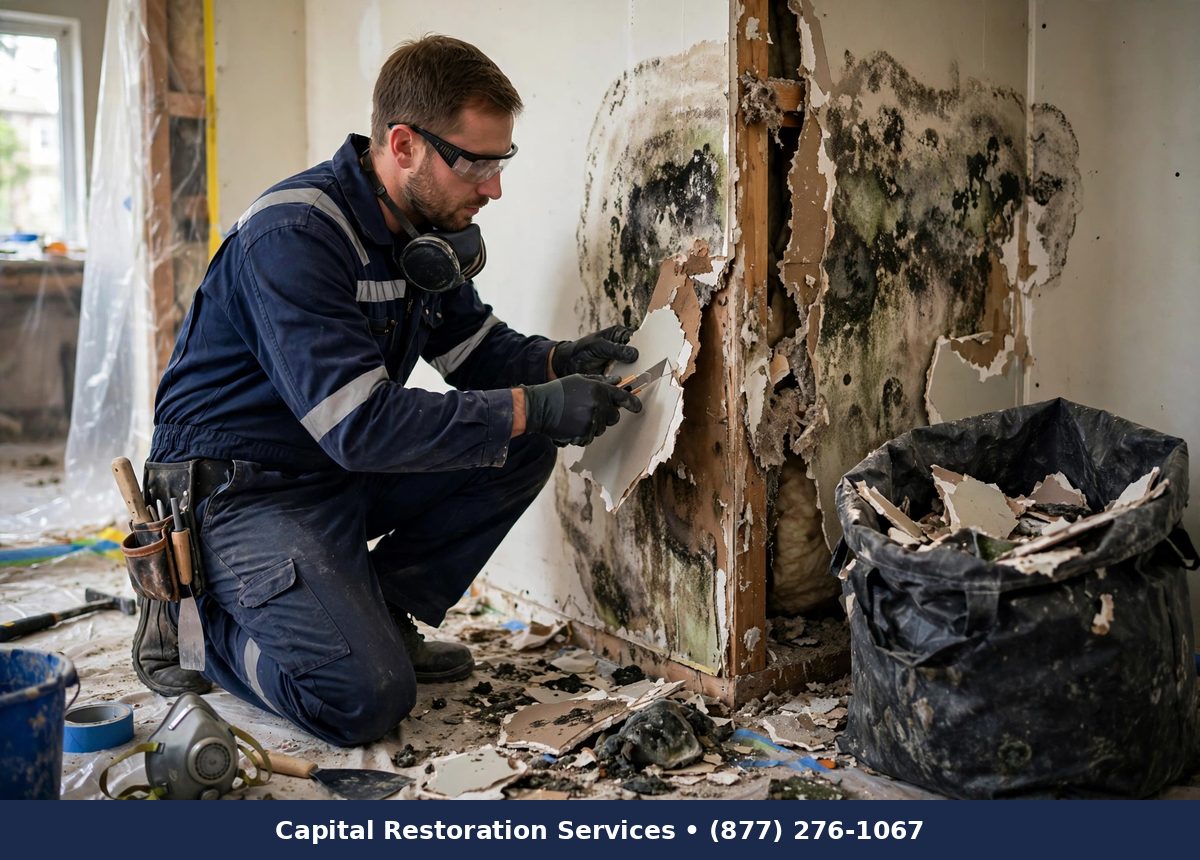
- Contaminated drywall comes out. Panels are cut back past the visible growth, removed in controlled sections, and bagged inside containment. Insulation behind the board comes out too; wet fiberglass with mold is not salvageable.
- The cavity is cleaned. Studs, plates, and sheathing get HEPA vacuuming and antimicrobial treatment. The open wall is inspected for any structural damage the moisture caused.
- Everything dries and is verified. Cavities must test within normal moisture ranges before new board goes in. This is the step that prevents the next colony.
- New drywall goes up. In moisture-prone areas we recommend mold-resistant board, which uses a fiberglass face instead of paper. Tape, mud, texture, and paint finish the wall to match.
- The final walkthrough confirms clean work, dry readings, and a wall that looks like the mold was never there.
What affects the cost
Square footage of affected wall is the baseline, but cavity involvement moves the number: insulation removal, stud treatment, and drying verification add real labor. The moisture source repair is its own line, from a simple plumbing fix to a building-envelope issue. Finish level matters too, since matching texture and paint in a finished living space takes more care than a garage wall. And access counts: walls behind built-ins or tile cost more to open and restore. For an exact figure, call (877) 276-1067. An inspection with moisture readings is the only honest basis for a quote.
How we serve your area
Capital Restoration Services removes mold-damaged drywall for homeowners, landlords, and property managers across our service area, from single bathroom walls to multi-room flood damage. We handle the full sequence in-house, containment through refinishing, so you are not coordinating a remediator and a drywall contractor separately. When we leave, the mold is gone, the moisture is fixed, and the wall is whole again.
Features
- Moisture mapping to find the full extent of contamination
- Containment with negative air to protect the rest of the home
- Physical removal of mold-contaminated drywall and insulation
- HEPA cleaning and antimicrobial treatment of studs and wall cavities
- Moisture source identification and correction
- Reinstallation with mold-resistant drywall where appropriate
Benefits
- Mold physically removed, not painted over or sprayed
- Hidden cavity growth found and eliminated, not sealed inside
- Moisture source corrected so new drywall stays clean
- Clean wall cavities verified dry before new board goes up
- Mold-resistant materials used in the rebuild where appropriate
- Documentation with photos for your insurance file
Frequently asked questions
Can you just paint over mold on drywall?
No. Painting over active mold is explicitly not an approved remediation method. Paint traps moisture and organic material behind the surface, which accelerates hidden growth. Contaminated drywall must be physically removed.
How do I know if there is mold behind my drywall?
Watch for a persistent musty odor with no visible growth, bubbling or warped paint, drywall that feels soft or sounds hollow when tapped, and allergy-like symptoms that improve when you leave the house. A moisture meter reading above normal on the wall surface is a strong signal.
Does mold go all the way through drywall?
No. Mold begins on the face paper, migrates through the gypsum core, and can colonize the back paper and the wall cavity. Once it reaches the core, surface cleaning cannot reach it. The panel has to come out.
What affects the cost of drywall mold removal?
The square footage affected, whether cavities and insulation are involved, the moisture source repair needed, and the finish level of the rebuild. Call (877) 276-1067 for an inspection and a detailed scope.
Does insurance cover mold in drywall?
It depends on the moisture source. Sudden events like burst pipes are commonly covered; gradual leaks and long-term humidity usually are not. Our photo documentation supports your claim. Ask your adjuster whether the source qualifies as sudden and accidental.