Drywall Water Damage Repair Near Me
Starting price: Call for pricing
Drywall and water are old enemies. The board wicks moisture upward far past the visible line, swells, softens, and feeds mold if left damp. Capital Restoration Services provides drywall water damage repair: moisture mapping, controlled drying where board can be saved, surgical removal where it cannot, and seamless reinstallation. We fix the wall and the reason it got wet.
Water does not stop where you can see it stop. Drywall drinks through capillary action, wicking moisture upward well past the visible stain, and the paper faces feed mold within days if the board stays damp. A wall that looks like it has a six-inch problem often has a two-foot problem. Call (877) 276-1067 and Capital Restoration Services will map the real extent with meters and fix the wall properly, not just cosmetically.
What drywall water damage repair covers
This service covers the complete recovery of water-affected drywall: moisture mapping of walls and cavities, controlled drying of board that can be saved, surgical removal of board that cannot, wall cavity drying and insulation replacement, and reinstallation with tape, texture, and paint matched to the existing wall. It covers damage from burst pipes, appliance leaks, roof intrusion, flooding, and any event that soaked the walls.
What it does not cover is the source repair. The plumbing fix, the roof repair, the appliance replacement happens first or alongside, because new drywall over an active leak is a temporary wall. We identify the source and coordinate the fix.
The save-or-remove decision
Not all wet drywall needs to come out, and not all of it can stay. The decision comes down to three factors. First, the water category: clean water from a supply line is the best case, while contaminated water means removal regardless of appearance. Second, time: board wet for a day or two often dries in place, while board wet for many days usually will not. Third, condition: drywall that is swollen, soft, crumbling, or separating at the seams has lost its integrity and comes out.
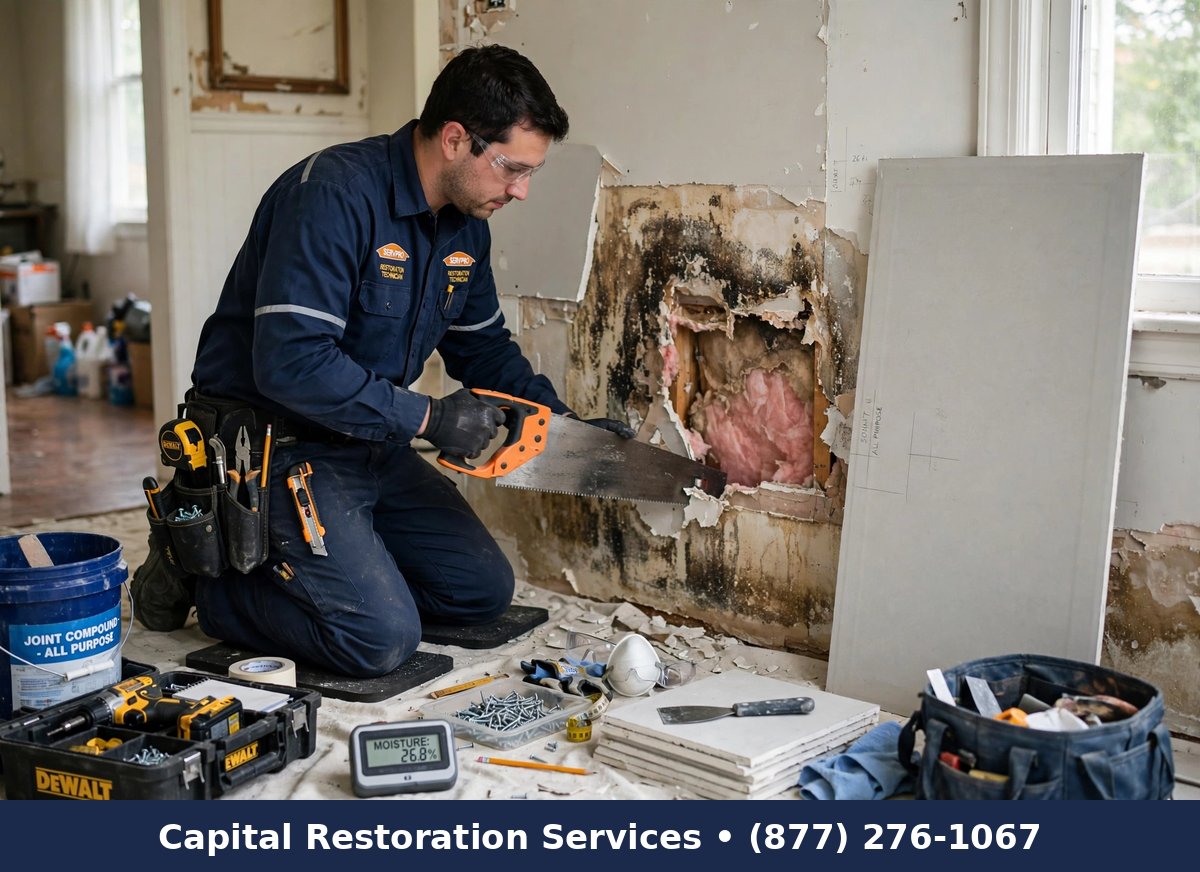
Where removal is needed, flood cuts are the standard approach. After flooding, drywall typically comes out to a practical height, which lets full replacement sheets go back in cleanly and opens the cavity for drying and insulation replacement. The cut line goes above the wicking line, never at it, because moisture always travels higher than the eye suggests.
How the repair process works
- Mapping comes first. Pin meters and infrared cameras trace moisture through the board and into the cavity, establishing exactly how far the water traveled and which sections can be dried in place.
- The source is stopped. No drying or rebuilding begins until the leak is fixed and the water is done coming in.
- Salvageable drywall is dried in place. Baseboards come off, the wall bottom is exposed for airflow, and directed air movers and dehumidifiers dry the board and cavity together. Meters track progress daily.
- Unsalvageable board is removed. Flood cuts open the wall cleanly, wet insulation is pulled and bagged, and the open cavity is cleaned.
- Cavities are dried and verified. With the wall open, drying is fast and thorough, and every surface must test dry before new board goes in.
- New drywall is installed. Full sheets where flood cuts allow, finished with tape, mud, and texture matched to the surrounding wall.
- Paint completes the repair. Matched paint over the repair area, blended so the fix disappears.
- The final check confirms dry readings, solid walls, and a finish you cannot distinguish from the original.
What affects the cost
Linear feet of affected wall set the baseline, but cavity involvement changes it: insulation replacement and cavity drying add real scope. The finish level matters enormously, since matching heavy texture or custom paint in a finished living room takes far more labor than a garage wall. Water category counts too, because contaminated water means more removal and stricter handling. And the source repair, from a simple supply line to a roof issue, is its own line. For an exact figure, call (877) 276-1067. Moisture mapping is the only honest basis for a quote.
How we serve your area
Capital Restoration Services repairs water-damaged drywall for homeowners, landlords, and businesses across our service area, from single-room leaks to whole-house flood recovery. We handle the sequence in-house, mapping through refinishing, so one crew owns the wall from wet to perfect. When we leave, the moisture is gone, the structure is verified dry, and the only evidence of the repair is a wall that looks like nothing ever happened.
Features
- Moisture mapping with pin meters and infrared cameras
- Controlled structural drying for salvageable drywall
- Surgical flood cuts and removal of unsalvageable board
- Wall cavity drying with ventilation and dehumidification
- Wet insulation removal and replacement
- Tape, texture, and paint matching for invisible repairs
Benefits
- Walls dried or replaced based on readings, not guesses
- Wicking damage caught above the visible waterline
- Cavities dried and verified before new board goes in
- Insulation replaced where it trapped moisture
- Texture and paint matched so repairs disappear
- Full photo documentation for your insurance claim
Frequently asked questions
Can wet drywall be dried and saved?
Often, yes, if the water was clean, the board is not swollen or soft, and seams are intact. We verify with moisture meters. Drywall soaked by contaminated water, or wet for more than a couple of days, usually needs to come out.
How far up the wall does water damage go?
Higher than you think. Drywall wicks water upward through capillary action, so damage commonly extends a foot or more above the visible line. We map it with meters and cut back to clean, dry board.
Do you cut drywall after a flood?
Yes. After flooding, drywall is typically removed to a practical height, often four feet for lower water levels, which allows full sheets to go back in cleanly. Higher water means higher cuts.
What affects the cost of drywall water damage repair?
The extent of wet drywall, whether insulation and cavities are involved, the finish level of the rebuild, and the water source repair. Call (877) 276-1067 for an inspection and a detailed scope.
Does insurance cover water-damaged drywall?
Sudden events like burst pipes and appliance failures are commonly covered; gradual leaks usually are not. Our moisture maps and photo documentation support the claim. Confirm with your agent.