Duct Cleaning After Fire Near Me
Starting price: Call for pricing
During a fire, your HVAC system becomes the smoke's delivery network, pulling sooty air through returns and pushing it into every room. Afterward, that same system holds the contamination: soot in the ducts, residue on the coils, odor in the liner. Capital Restoration Services provides duct cleaning after fire for the complete system, ducts, coils, blower, and filters, following NADCA guidance. Clean the distribution network, or the smell comes back with every cycle.
Here is the cruel irony of a house fire: the system designed to keep your air clean becomes the thing that spreads the contamination. During the fire, the HVAC pulls smoky air through the returns and distributes soot to rooms the flames never touched. After the fire, every startup reheats trapped smoke compounds and pushes fine particulate back into your living space. If the smoke smell returns on schedule with each heating or cooling cycle, your ducts are telling you exactly where the problem lives. Call (877) 276-1067 before you run the system again, and Capital Restoration Services will inspect it properly.
What duct cleaning after a fire covers
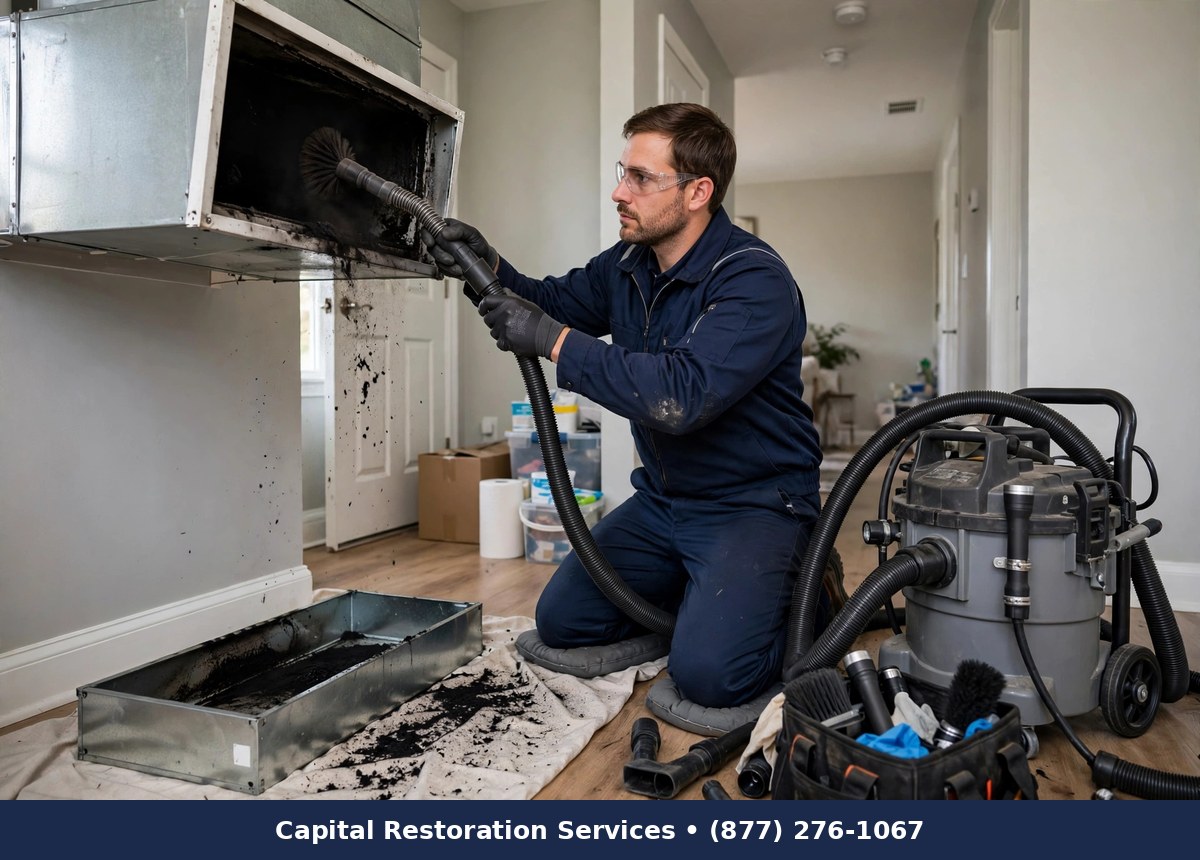
This service covers the complete HVAC system, not just the visible vents: inspection of all ductwork, the air handler, evaporator coil, blower assembly, dampers, and filters; negative-pressure cleaning of supply and return ducts with HEPA-filtered collection; mechanical agitation with rotary brushes for adhered soot; coil and blower cleaning; replacement of contaminated filters; and repair or sealing of heat-damaged duct sections.
What it does not cover is mechanical HVAC repair beyond cleaning. If heat cracked the heat exchanger or damaged control boards, that belongs to an HVAC contractor, and we flag it in our assessment. We also do not replace the full system; we clean and restore what is restorable and tell you plainly what is not.
Why the whole system matters, not just the ducts
Industry guidance from NADCA, the duct cleaning association, is explicit: clean all components of the HVAC system, not just the air ducts. Smoke residue settles on everything the air passes through. Soot on the blower wheel causes imbalance and premature bearing failure. Particulate packed into evaporator coil fins chokes heat transfer and efficiency. Residue on dampers and inside the air handler keeps feeding odor into the airstream. Cleaning the ducts while leaving a soot-coated coil is like washing the dishes and putting them back in a dirty cabinet.
Some components cannot be cleaned at all. Fiberglass duct liner absorbs odor compounds into the material itself. Flexible duct runs have an inner core that cannot be scrubbed without tearing. Rubber and foam gaskets degrade after heat exposure. When we find these, we recommend replacement rather than selling you a cleaning that will not hold.
The correct sequence: removal first, deodorizing second
Smoke odor gets treated backward more than any other part of fire restoration. Deodorizers, ozone, and fogging in open air do not remove residue sitting inside ductwork; they treat the air around it. If the source stays in place, the smell returns as soon as normal humidity and airflow resume. The correct order is always removal first, then treatment: clean or replace the contaminated components, then apply deodorization to what remains. Reversing that order wastes money and produces temporary results.
How the cleaning process works
- The system is shut down and inspected. We assess soot levels in the ductwork, check the coil, blower, and heat exchanger for contamination and heat damage, and determine which components can be cleaned and which need replacement.
- The work zone is set up under negative pressure. A HEPA-filtered collection unit connects to the duct system so dislodged soot is captured, not redistributed.
- Ductwork is cleaned mechanically. Rotary brushes agitate adhered soot from duct walls while the vacuum pulls everything into sealed collection. Supply and return sides both get treated.
- Components are cleaned individually. The blower assembly, evaporator coil, dampers, and registers are cleaned or replaced as the assessment dictated.
- Filters are replaced immediately, with a second replacement scheduled after restoration work finishes and the last of the construction dust clears.
- Deodorization follows cleaning. With the source removed, thermal fogging or hydroxyl treatment neutralizes remaining odor in the system.
- Verification closes the job. The system is inspected clean before restart, and the first cycles are monitored for any returning odor.
What affects the cost
System size and duct layout set the baseline: more runs and more components mean more labor. Duct material matters, since lined or flexible duct may need partial replacement rather than cleaning. Contamination severity decides the method, from standard cleaning to aggressive agitation. Component replacement, coils, blower parts, filters, adds its own line. And access counts: systems buried in tight attics or crawl spaces take longer. For an exact figure, call (877) 276-1067. An inspection of your specific system is the only honest basis for a quote.
How we serve your area
Capital Restoration Services cleans fire-affected HVAC systems for homes and businesses across our service area, working to NADCA-aligned practices on every job. We coordinate with your overall fire restoration timeline so the duct system is clean before the rooms are finished, not after. When the system restarts and the air comes out clean and odor-free, that is when the house truly stops smelling like the fire.
Features
- Full-system inspection: ducts, coils, blower, filters, and dampers
- Negative-pressure cleaning with HEPA-filtered collection
- Rotary brush agitation for stubborn soot inside ductwork
- Evaporator coil and blower assembly cleaning
- Filter replacement with post-restoration follow-up filters
- Duct sealing and repair of heat-damaged sections
Benefits
- Smoke odor eliminated at the source, not just masked
- Soot no longer recirculating through every room
- System efficiency restored with clean coils and blower
- Corrosion from acidic residue stopped before it damages equipment
- Verified clean with inspection before the system restarts
- Documentation for your insurance claim
Frequently asked questions
How soon after a fire should the HVAC be inspected?
As soon as possible, and ideally before the system runs again. Every cycle reheats trapped smoke compounds and pushes soot deeper into the system. Shut the system down after a fire and call (877) 276-1067 for an inspection.
Is cleaning just the ducts enough?
Usually not. Industry guidance calls for cleaning the full system: ductwork, coils, blower assembly, and dampers. Smoke residue settles on every component the air passes through, so cleaning ducts alone leaves contamination in place.
Do ducts ever need to be replaced instead of cleaned?
Sometimes. Fiberglass duct liner and flexible duct runs absorb odor into the material itself and often cannot be cleaned effectively. We assess each section honestly and recommend replacement where cleaning will not hold.
What affects the cost of post-fire duct cleaning?
System size, duct material and layout, contamination severity, how many components need cleaning or replacement, and access. Call (877) 276-1067 for an inspection and a detailed scope.
Does insurance cover HVAC cleaning after a fire?
Many policies cover HVAC cleaning and restoration as part of fire damage claims. Our itemized component assessment supports the claim. Confirm the specifics with your agent.