Emergency Mold Remediation Near Me
Starting price: Call for pricing
Mold spreads fast when moisture goes unchecked, and it hides behind walls and under floors where you cannot see it. Capital Restoration Services provides emergency mold remediation: we find the moisture source, contain the area, remove the mold, and verify the space is clean. If you smell mustiness or see growth spreading, call (877) 276-1067.
What Emergency Mold Remediation Covers
Not every mold problem is an emergency, but some cannot wait. Mold after flooding, a burst pipe, a sewage backup, or any water damage that was never fully dried is an emergency: moisture is actively feeding growth, and every day the affected area gets bigger. Emergency mold remediation is the fast, contained removal of that mold along with the moisture that caused it.
Capital Restoration Services handles the urgent cases. We respond quickly, set up containment to protect the rest of your home, physically remove what mold has colonized, and fix or flag the moisture source. The work ends with verification that the space is clean and dry, not just painted over.
Signs You Should Not Wait on Mold
- Visible mold spreading across walls, ceilings, or floors, especially if it keeps growing.
- A strong, persistent musty smell after a leak, flood, or plumbing failure.
- Mold in more than one room, which points to a moisture problem bigger than one spot.
- Water damage that was never fully dried, even if it happened weeks ago.
- Mold near or inside the HVAC system, which can push spores through the whole house.
- Anyone in the home with breathing trouble, new allergies, or asthma flare-ups that ease up when they leave.
When several of these show up together, waiting is the most expensive option. Growth continues, damage deepens, and the eventual cleanup gets bigger.
Why Mold Needs Remediation, Not Just Cleaning
Here is the point the EPA stresses above all others: mold control is moisture control. Scrubbing visible mold while the leak continues is a temporary fix. Bleach can lighten surface staining, but it cannot reach mold rooted in porous drywall, wood, or insulation. Painting over growth traps moisture underneath and guarantees it returns.
Real remediation removes the problem at its source. Contaminated porous materials come out. Semi-porous surfaces like framing are HEPA-vacuumed and wiped.
The moisture source, a leak, condensation, or drainage issue, is corrected. Antimicrobials may be applied as a finishing step, but they are never the whole plan. That is the difference between remediation and a cleaning job that fails in a month.
How Emergency Mold Remediation Works, Step by Step
We start with an inspection. Moisture meters and infrared cameras map where water went, including behind walls and under floors. The visible mold is only the headline; the moisture map tells us the real boundary of the work.
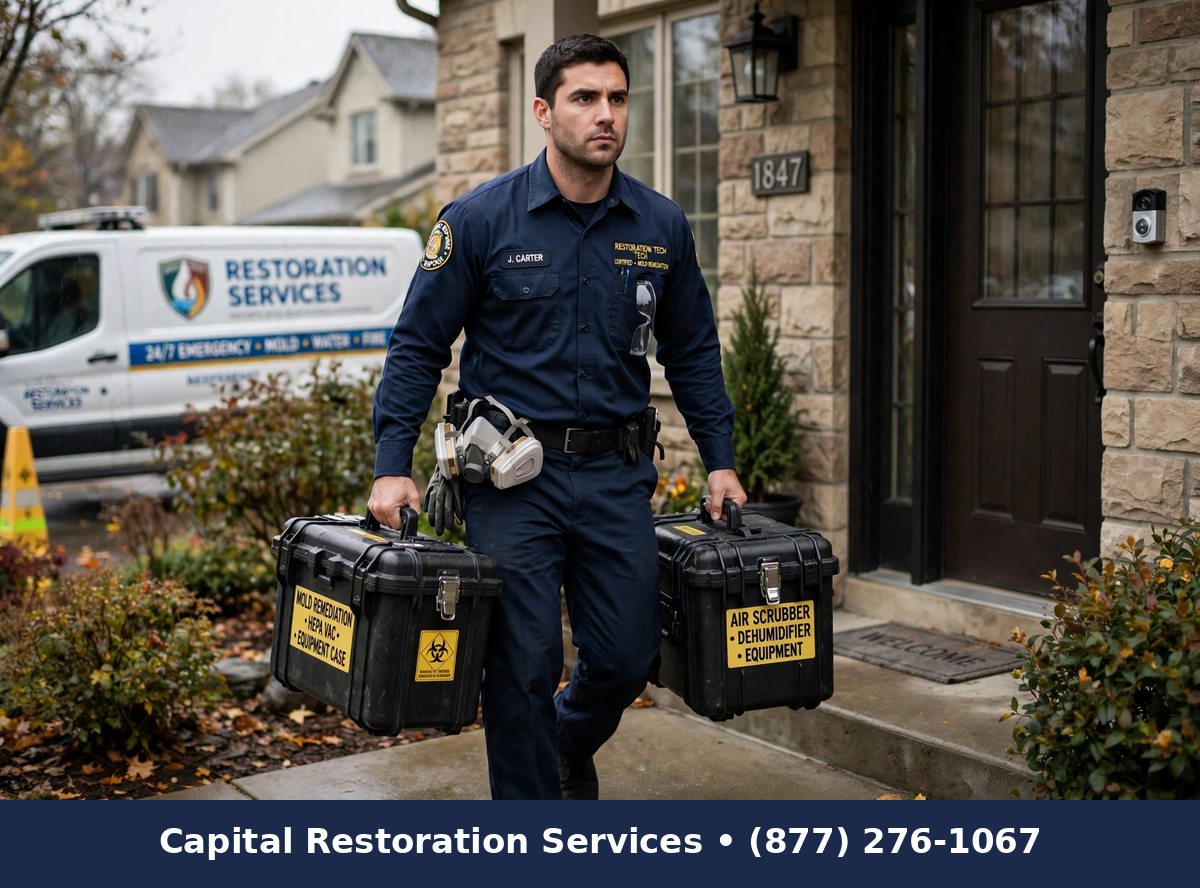
Next comes containment. We seal the work area with plastic sheeting and run HEPA-filtered negative-air machines so spores cannot drift into clean rooms while we work. HVAC vents in the zone are covered, and crews wear proper protective gear.
Then removal. Mold-damaged drywall, insulation, carpet pad, and flooring are cut out and bagged. Framing and other surfaces that can be saved are HEPA-vacuumed and damp-wiped. An EPA-registered antimicrobial is applied as a secondary step, never as a substitute for physical removal.
Finally, verification. We confirm moisture readings are back in the normal range, recheck for visible growth, and run air checks where appropriate before the containment comes down.
What Affects the Cost of Mold Remediation
The size of the affected area is the starting point: a small bathroom patch and a flooded basement are different worlds. How much material must be removed matters too. Drywall and insulation that mold has colonized cannot be cleaned; they come out and get replaced.
Access shapes the job as well. Mold in an open basement is easier to reach than mold inside a wall cavity, under a tub, or in a crawl space. The moisture repairs, plumbing fixes, drainage work, or ventilation changes needed to keep mold from returning are part of the scope. Timing plays a role: emergency response and work in occupied homes need extra containment and care. We inspect first, then explain the full scope before work begins.
Homes and Buildings Capital Restoration Services Helps
Capital Restoration Services remediates mold in single-family homes, apartments, and condos, from basements and bathrooms to attics and crawl spaces. We also work in offices, retail spaces, rental properties, and houses of worship where a roof leak or plumbing failure turned into a building-wide problem.
Moisture does not care what kind of building it is in, and neither does mold. Wherever it is, the fix is the same: find the water, contain the area, remove the growth, and verify it is gone. Call (877) 276-1067 and we will take it from there.
Features
- Moisture inspection with meters and infrared cameras to find hidden dampness
- Sealed containment and negative-air pressure to protect clean areas
- Physical removal of mold-damaged drywall, insulation, and flooring
- HEPA vacuuming and damp-wiping of remaining surfaces
- EPA-registered antimicrobial treatment as a finishing step
- Post-remediation verification with moisture readings and air checks
Benefits
- Stop mold from spreading room to room while you wait
- Fix the moisture source so the mold does not come back
- Protect your household from ongoing exposure during cleanup
- Keep spores contained instead of scattered through the house
- Get documentation of the work for insurance and peace of mind
- Move back into a space verified clean and dry
Frequently asked questions
How much mold is too much to handle myself?
The EPA suggests calling a professional when mold covers more than about 10 square feet, or when it follows flooding, hides inside walls, or reaches the HVAC system. If you have asthma or a weakened immune system, call a pro even for smaller patches.
Can I just bleach the mold?
Bleach is mostly water, and on porous materials the water soaks in while the chlorine stays on the surface, which can actually feed the mold you were trying to kill. EPA guidance points to a different fix: correct the moisture source and physically remove the material the mold has colonized.
Why does the mold keep coming back?
Because the moisture never left. Leaks, condensation, and high humidity feed regrowth within days of a surface-only cleanup. Until the dampness is gone for good, mold will keep returning to the same spots.
Is mold dangerous to my health?
Mold exposure can irritate eyes, skin, and airways, and it hits harder for people with asthma, allergies, or weakened immune systems. We cannot diagnose health effects, but we can remove the exposure quickly and safely. Talk to your doctor about symptoms.
How much does emergency mold remediation cost?
Cost follows the size of the affected area, how much material must be removed, how hard the space is to access, the moisture repairs needed, and how quickly the job must be done. The inspection gives you the full picture, from removal to moisture repairs, before we start.