Emergency Tarping After Fire Near Me
Starting price: Call for pricing
Fire can leave your roof burned through or cut open where firefighters vented heat and smoke, and every hour of exposure invites rain and wind damage. Capital Restoration Services installs heavy-duty emergency tarps over damaged roof areas, anchored to shed water and hold through storms. Call (877) 276-1067 any time, day or night, for a fast response.
What emergency tarping after a fire actually does
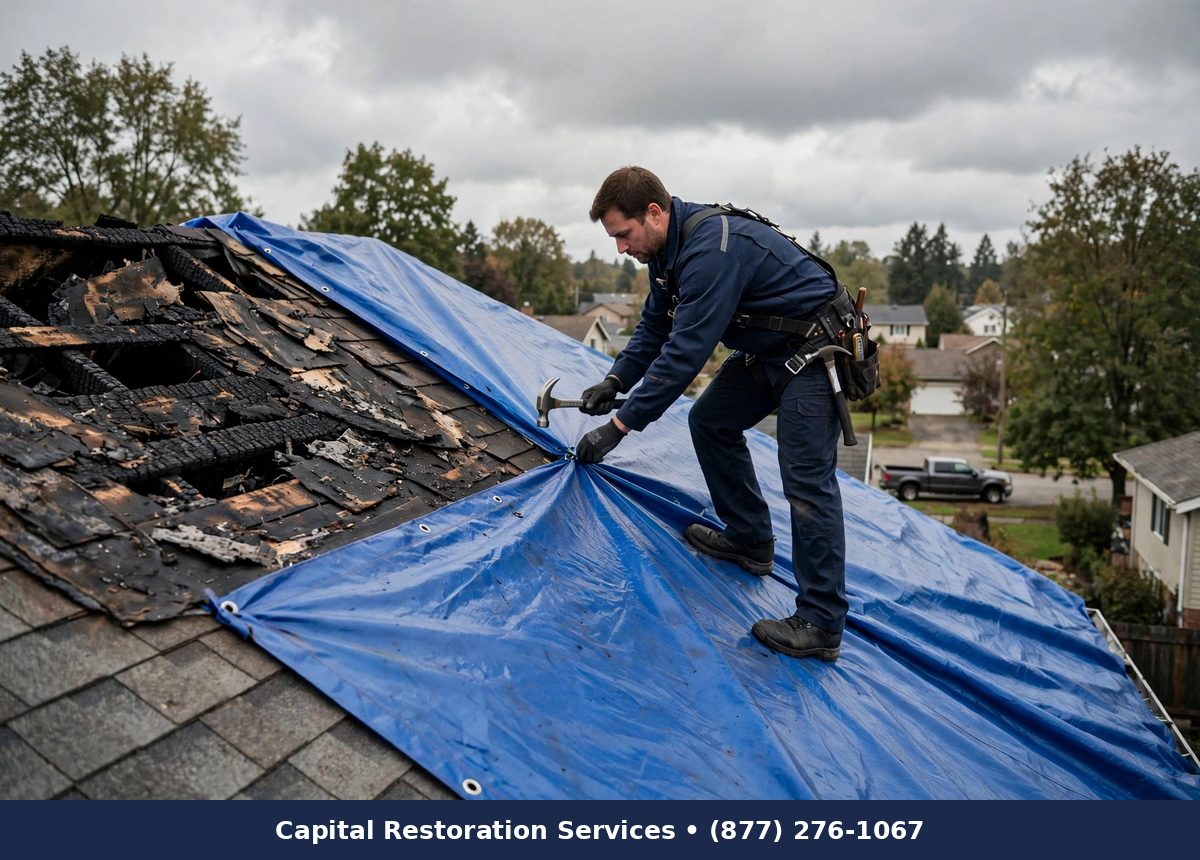
Fire leaves roofs with two kinds of openings: places where flames burned through, and square holes where firefighters cut in to let heat and smoke escape. Both let rain straight into rooms that are already damaged. An emergency tarp is a heavy-duty waterproof cover laid over those openings and anchored so it sheds water the way a roof should.
This is strictly temporary protection. A tarp does not repair shingles, decking, or framing, and it does not make a roof strong again. Its only job is to buy time: dry weeks while you line up the real repair.
When your roof needs a tarp right away
- Firefighters cut ventilation holes in the roof during the fire.
- Flames burned through shingles and decking, leaving open patches.
- Ridge caps, flashing, or gable ends are missing or melted.
- Rain is in the forecast before repairs can be scheduled.
- Water is already dripping through ceilings into rooms below.
If you see any of these, do not climb up to look closer. Fire can weaken decking and framing in ways you cannot see from the surface, and a weakened roof can give way underfoot.
How we install a fire-damage tarp
Safety comes first. Our crew checks the roof's condition before anyone steps on it, working from ladders and solid framing wherever possible instead of walking across charred decking.
Then we clear loose debris so the tarp lies flat. We size the tarp to extend several feet past the damage on every side, and we run it over the ridge line whenever we can, because water must flow over the tarp and never underneath it.
Edges get wrapped around furring strips or lumber boards and fastened down. On wide spans we add extra strips across the middle so wind cannot lift the tarp and turn it into a sail. Every finished tarp gets photographed, and those photos become part of your insurance documentation.
What changes the cost of emergency tarping
Size is the biggest factor. A single vent hole is a quick job, while a large burned section needs a bigger tarp, more lumber, and more anchoring. Steep or high roofs take longer and need more safety setup than a low, walkable slope.
Timing matters too. Night and weekend emergency calls cost more than scheduled daytime work. Multiple openings mean multiple tarps, and each one adds material and labor. Call (877) 276-1067 and we will talk through your situation and give you a clear quote.
Mistakes to avoid before help arrives
Do not nail a thin hardware-store tarp over the hole yourself. A loose tarp catches wind, tears loose, and can rip more shingles off on its way down, leaving you worse off than before. Stay off the roof entirely until a crew has checked its strength.
Inside, move valuables, papers, and electronics out from under any drip. Set out buckets where water is coming in, and if drywall is bulging with trapped water, keep people clear of that spot. Then let the crew handle the roof.
Serving homes and businesses after fire
We tarp single-family homes, duplexes, and apartment buildings, plus small businesses with flat or pitched roofs: restaurants, shops, offices, and houses of worship. Capital Restoration Services is a local team, so we know how fast weather moves in here and why same-day cover matters.
When the tarp is up, we hand you photos and notes your adjuster can use. Then you decide your next step on the permanent repair, knowing the weather is locked out in the meantime. Call (877) 276-1067 and we will get your roof covered.
Features
- Heavy-duty waterproof tarps sized past the damage on all sides
- Over-the-ridge placement so rain runs off, never underneath
- Furring-strip and lumber anchoring that resists wind lift
- Debris clearing for a flat, tight seal before placement
- Coverage for vent holes, burn-through, and missing ridge sections
- Photo documentation for your insurance file
- Same-day emergency response, day or night
Benefits
- Keeps rain and snow out of rooms that are already damaged
- Stops a small roof opening from becoming major water damage
- Buys you calm, dry weeks while you plan permanent repairs
- Shows your insurer you took steps to prevent further loss
- Holds through storms instead of peeling off at the first gust
- Protects soot-covered interiors so cleanup can begin sooner
Frequently asked questions
How long can a tarp stay on my roof?
A well-anchored tarp holds for weeks while you arrange permanent repairs. It is temporary by design, since sun and wind wear tarps down, so plan the real repair as soon as you can.
Will the tarp damage my roof?
We fasten into areas already slated for repair and the solid framing around the damage. The small fastener marks are nothing next to the water damage a rainstorm would cause through an open roof.
How much does emergency tarping cost?
It depends on the size of the damaged area, the height and pitch of your roof, whether we come out at night, and how many openings need covering. Call (877) 276-1067 and describe what the fire left behind, and we will price your job from that.
Can I put a tarp up myself?
After a fire, no. Charred decking and weakened framing can collapse under your weight, and a loose tarp that catches wind can injure you or tear off and damage more of the roof.
Does insurance cover tarping?
Most homeowner policies cover emergency steps that prevent further damage, and tarping is a textbook example. We photograph everything so you have proof for your claim.