Fire Damage Demolition Services Near Me
Starting price: Call for pricing
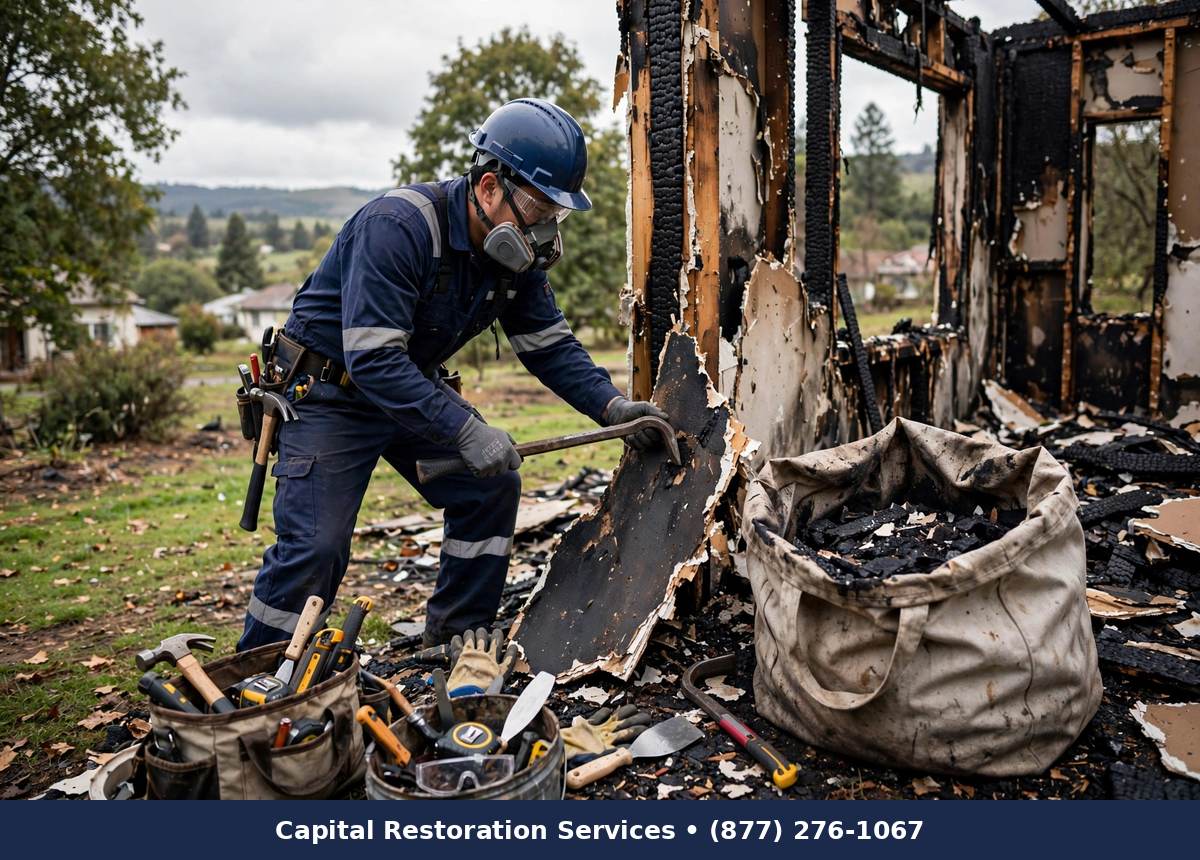
When fire damage goes deeper than the surface, the right move is to take the ruined material out, not paint over it. Capital Restoration Services performs controlled fire damage demolition, removing charred and smoke-saturated building materials room by room while protecting everything that can still be saved. It is the clean break your rebuild begins from.
What Fire Damage Demolition Covers, and What It Does Not
Fire damage demolition is the controlled removal of building material that a fire has destroyed beyond cleaning. That usually means charred studs, smoke-soaked insulation, blistered flooring, and drywall that has absorbed soot and odor through its full thickness. It does not mean knocking the whole house down. Our crews take out the ruined layers room by room and leave the sound structure standing, so the rebuild has a clean shell to work from.
It also does not include the rebuild itself. Demolition is the middle chapter: after the fire is out and the assessment is done, and before new walls, wiring, and finishes go in. Some homeowners ask whether we can clean everything and skip demolition. The honest answer is that some things can be cleaned, framing that only took smoke for example, and some cannot. Charred material holds odor at a molecular level and keeps breaking down. Taking it out is the only real fix.
When Demolition Is the Right Call
- You can see charring on framing, subfloor, or roof decking
- Drywall smells like smoke even after the room has been cleaned
- Insulation is matted, melted, or carries a heavy burn smell
- Flooring is warped or blistered from heat or hose water
- An adjuster or contractor has flagged material that cannot be restored
- The space needs to be opened up to find hidden damage in walls or ceilings
If only the surface is sooty with no heat damage underneath, cleaning may be enough. We tell you which one it is during the walkthrough, before any teardown begins.
How Our Demolition Process Works
Everything begins with a documented walkthrough. We map the damage room by room, photograph what we find, and mark what comes out and what stays. This becomes the scope your insurance adjuster approves, so there are no surprises later.
Next we set up containment. Plastic barriers and a negative-air machine keep dust, soot, and fine debris inside the work area and out of the clean parts of your home. HEPA-filtered air scrubbing runs while we work. Then the teardown begins: wet or dry methods chosen by material, charred and saturated layers removed down to sound wood or masonry, and debris bagged and hauled daily.
Where fire has weakened a wall, ceiling, or floor system, we place temporary supports before working near it. Load-bearing members get extra respect. Nothing structural comes out without a plan for what carries the load in the meantime. As each area is cleared, we log it against the original scope, so your rebuild crew knows exactly what they are walking into.
The last step is handoff. The space is swept clean, the air scrubbers run until the fine dust settles out, and you get a summary of what was removed and what remains. Your contractor can frame, wire, and finish without digging through debris.
What Drives the Cost of Fire Demolition
The biggest factor is scope: one scorched kitchen costs less to strip than two floors of a townhouse. Access matters too. A clear main-level room is quick work; a finished attic or a tight crawlspace slows every trip to the truck.
Material plays a role. Lathe and plaster takes longer to remove cleanly than drywall, and older homes can hold surprises like multiple flooring layers or materials that need special handling. Severity counts as well. Light smoke damage to finishes is a different job than structural char that needs shoring.
Timing is the last lever. Emergency stabilization right after the fire moves faster on our schedule but is priced for urgency; planned demolition a week later, after the adjuster has visited, is typically more straightforward to quote. For an exact number on your home, call (877) 276-1067 and we will put a scope on paper.
Serving Homes and Businesses Across Our Area
Capital Restoration Services handles fire demolition in single-family homes, townhouses, and rowhouses, plus the restaurants, shops, and small offices that sit between them. Each has its own rhythm: a family needs the work done around their temporary housing; a storefront needs the street-facing side kept clean and presentable.
Older neighborhoods mean older construction, and we are used to both. Whether it is balloon-framed walls in a century-old home or lightweight trusses in a newer build, we adjust the approach to the building in front of us. When you are ready to talk through what comes out and what stays, call (877) 276-1067 and we will walk it with you.
Features
- Selective teardown of charred framing, drywall, flooring, and insulation
- Negative-air containment and barriers that keep dust and soot in the work zone
- Temporary shoring and load-path care around weakened walls and ceilings
- Structural wood cleaning options, including media blasting, before rebuild
- Sorting of salvageable materials from debris for insurance documentation
- Daily debris hauling and a swept-clean site at the end of each workday
Benefits
- Stops smoke odor trapped in charred material from drifting into clean areas
- Protects the parts of your home the fire never touched
- Gives your adjuster a clear, documented scope of the loss
- Shortens the rebuild by handing your contractor a clean, dry, ready shell
- Keeps your household safer by getting weakened structure and debris out of the way
- Helps you avoid paying to rebuild around material that should have come out
Frequently asked questions
Can you save my framing instead of tearing it out?
Often, yes. Lightly smoked framing can usually be cleaned with HEPA vacuuming and media blasting and sealed before rebuild. Wood that is deeply charred or structurally weakened has to come out. We show you the difference during the walkthrough so the decision is based on what we can see, not a guess.
How long does fire demolition take?
A single burned room often takes one to two workdays. A multi-room job with shoring and debris hauling can run a week or more. We give you a timeline with the scope before work begins.
Will demolition affect my insurance claim?
It usually helps it. A documented, photographed scope gives your adjuster a clear record of the loss. We write our scope in plain language and share it with you, so nothing gets lost between our crew and your carrier.
What happens to my belongings during demolition?
Anything salvageable gets packed and moved to a clean area or stored off-site before teardown begins. We do not demolish a room with your belongings still in it. You approve the pack-out list first.
Do I need a permit for this?
Most cities require a demolition or alteration permit once structural material is removed. We handle the permit application for you and schedule any required inspections, so the rebuild can begin without delays.