Fire Damage Odor Neutralization Near Me
Starting price: Call for pricing
Cleaning takes off the soot you can see. Fire damage odor neutralization goes after the smell you cannot reach, the smoke molecules locked inside drywall, framing, and concrete that surface cleaning never touches. Capital Restoration Services treats the whole structure with professional deodorization methods that break odor down at its source, so your home smells like itself again.
What Fire Odor Neutralization Treats, and What It Does Not
Odor neutralization is the treatment phase that comes after cleaning. Soot removal clears the visible residue; neutralization deals with the invisible part, odor molecules driven deep into porous building materials by heat and pressure. It treats drywall, framing, subfloor, and masonry that hold smoke long after the surfaces look clean.
It does not replace cleaning, and it cannot save material that is charred through. Where wood is burned beyond its surface, the burned material still has to come out; no deodorizer reverses char. Neutralization works on what can be saved: surfaces that are structurally sound but saturated with smoke. Think of it as the difference between wiping a stain and treating the fabric.
When a Property Needs Whole-Structure Treatment
- A burn smell hangs on weeks after the soot has been cleaned
- The odor spikes when the heat runs or on warm, humid days
- Smoke reached multiple rooms or traveled through the HVAC system
- Unfinished wood, concrete, or brick in the basement or attic took on smoke
- Protein smoke from a kitchen fire left a sharp, clinging residue
- You are about to repaint or refinish and want the smell gone first
If the smell is confined to one small area with light smoke, targeted cleaning may be enough. Whole-structure treatment is for the stubborn cases where the building itself has become the odor source.
Our Neutralization Process, Layer by Layer
We begin by identifying how the fire burned. A fast, hot fire leaves different residue than a slow smolder, and protein smoke from cooking behaves differently from wood or synthetic smoke. That diagnosis decides which methods we use.
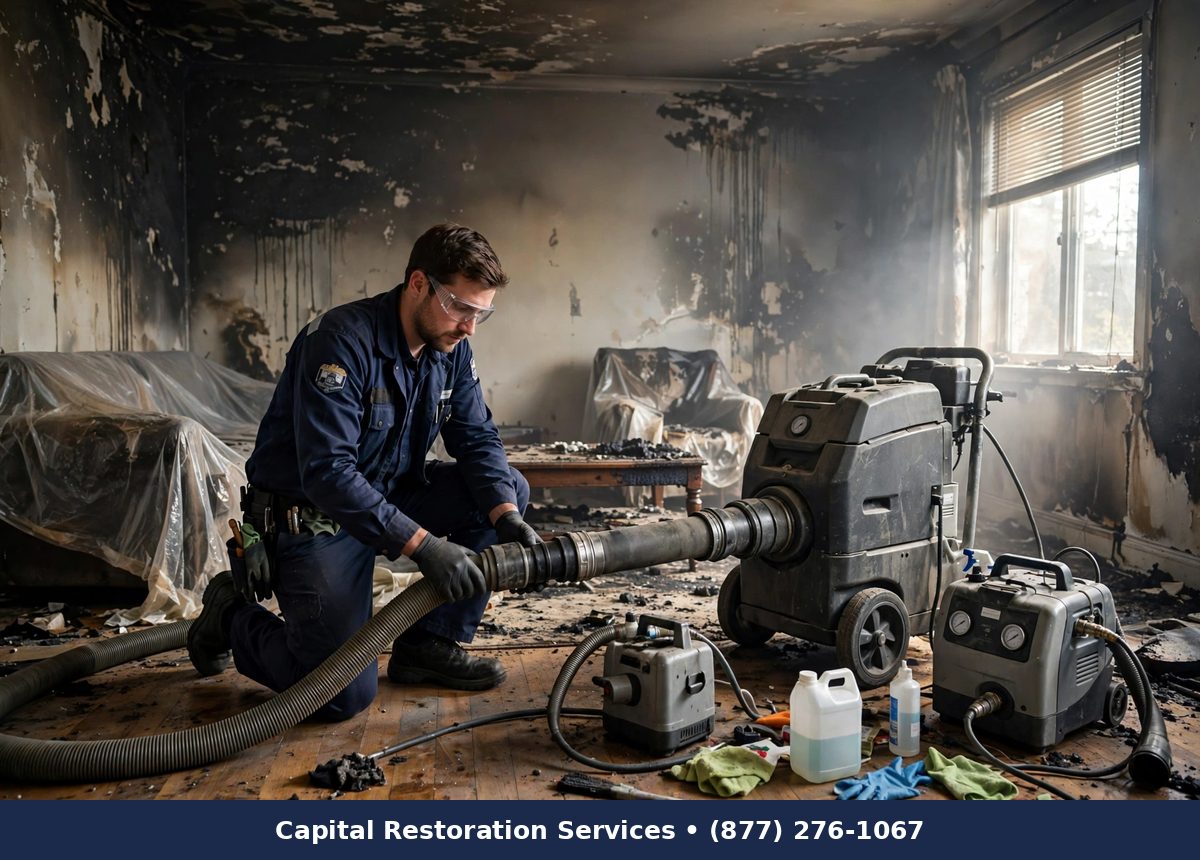
Cleaning comes first. Loose soot and ash are HEPA-vacuumed and washed off so treatments reach the material instead of the dirt on top of it. Then we apply thermal fogging: a heated deodorizer becomes a fine fog that travels into pores and cavities the way the smoke did, neutralizing odor where it lodges.
Hydroxyl treatment runs alongside the rest of the work. These units produce odor-destroying molecules that are safe around people and pets, so the house can stay livable while the air keeps getting cleaner. For framing and masonry that will not give up their residue, we apply odor-sealing encapsulants, specialty coatings that lock the last traces in for good. In severe cases we may add ozone treatment, always with the building empty and fully aired before anyone returns.
The final pass is verification. We walk every treated space, checking for odor at the nose level, corners, closets, inside cabinets, because that is where a missed pocket shows up. Anything still carrying smell gets another round before we call the job done.
What Shapes the Cost of Odor Neutralization
Size leads. A single smoked room needs far less equipment time than a whole floor where smoke ran through the ductwork. Saturation depth matters too: light, dry smoke on finished surfaces treats quickly, while deep-set residue in unfinished wood or masonry needs more passes and sealing.
The method set changes the number. A straightforward fogging-and-hydroxyl job is one thing; a job that also needs encapsulants, contents treatment, and duct cleaning is another. Contents add scope as well. Treating furniture and belongings on-site versus packing them out for shop treatment are different cost paths.
Scheduling plays a part. Emergency treatment right after the fire, while everything is still open, is usually the most efficient. Coming back months later, after paint has trapped odor under new finishes, can take more work. For a real figure on your property, call (877) 276-1067 and we will scope it in person.
Homes, Rentals, and Businesses We Treat Across the Area
Capital Restoration Services neutralizes smoke odor in single-family homes, condos, and townhouses, and in the rentals where a neighboring unit's fire becomes everyone's problem. Restaurants deal with protein smoke that clings to every surface; offices and shops deal with smoke that settled into carpet, cubicles, and ceiling tiles.
Apartment buildings get special attention because smoke travels through shared chases and ventilation into units the fire never touched. We treat the affected units and the common pathways together, so the smell does not simply migrate back. Wherever your property sits in our service area, the process is the same: find the source, treat it fully, and verify the result. Call (877) 276-1067 to get things moving.
Features
- Thermal fogging that carries deodorizer into the same pores the smoke entered
- Hydroxyl treatment that breaks odor molecules down while other work continues
- Odor-sealing encapsulant coatings for framing and masonry that hold residue
- Counteractants selected for the kind of smoke your fire produced
- Negative-air machines and HEPA scrubbing that clear the air during treatment
- A final verification walkthrough with odor checks in every treated space
Benefits
- Takes the smell out of the structure itself, not just the surfaces
- Gives paint and new finishes an odor-neutral base that will not bleed through
- Cuts down on return visits caused by odor coming back on humid days
- Lets you stay in the undamaged parts of your home while treatment runs
- Matches the right method to your smoke type instead of a one-size fix
- Creates a written treatment record you can share with your adjuster
Frequently asked questions
How much does fire odor neutralization cost?
It depends on how much of the structure took on smoke and how deep the residue sits. A lightly smoked room is a small job; a whole house with duct contamination and sealing is a large one. Call (877) 276-1067 and we will walk your property and give you an exact scope.
Why does the smell come back on humid days?
Heat and moisture wake up odor molecules trapped in porous materials. That rebound is the classic sign the residue is inside the material, not on it. It is exactly what treatment and sealing are designed to fix.
Is ozone treatment safe?
Ozone is powerful but it is not something you live around. We run it only with the building empty and air the space fully before anyone comes back. Hydroxyl treatment, by contrast, is safe to run while the building is occupied.
Will new paint cover the smoke smell?
Standard paint does not. It seals the odor in for a while, then the smell pushes back through. Odor-neutralizing primers and proper treatment first give paint a clean base to sit on.
Can you treat my furniture and belongings too?
Yes, when they are worth saving. Upholstery, drapes, and clothing get their own cleaning and deodorization process, either on-site or packed out to our facility. Items that absorbed too much smoke are flagged so you can decide what to claim.