Grease Fire Damage Cleanup Near Me
Starting price: Call for pricing
A kitchen fire does not end when the flames go out. Grease and protein fires leave a sticky, nearly invisible residue with a stubborn odor that soap and water cannot handle. Capital Restoration Services specializes in grease fire damage cleanup, with the right chemistry, the right equipment, and a kitchen that smells clean again. Call (877) 276-1067 for help with your kitchen today.
Why Grease Fires Need Their Own Cleanup
Grease and protein fires produce a different kind of soot than burning wood or paper. Instead of dry, powdery ash, they leave an invisible sticky film that coats cabinets, walls, appliances, and everything the smoke touched. The residue is greasy and acidic at the same time, which is why ordinary household cleaners just smear it around.
This film also carries odor deep into porous surfaces. Paint, drywall, wood cabinets, and fabrics absorb it, and the smell can linger for months if the residue is not fully removed. That is why kitchen fires need a cleanup approach built around degreasing chemistry rather than standard smoke cleaning.
Signs You Need Professional Grease Fire Cleanup
- A sticky or tacky film on cabinets, range hoods, or nearby walls
- A lingering burned-cooking smell that airing out does not fix
- Yellowish staining on painted surfaces or light-colored cabinets
- Soot inside the microwave, oven, or on the stovetop you cannot wipe away
- The HVAC system was running during the fire, spreading residue through vents
- Soft items like curtains, cushions, or clothing that still smell after washing
How We Clean Up After a Grease Fire
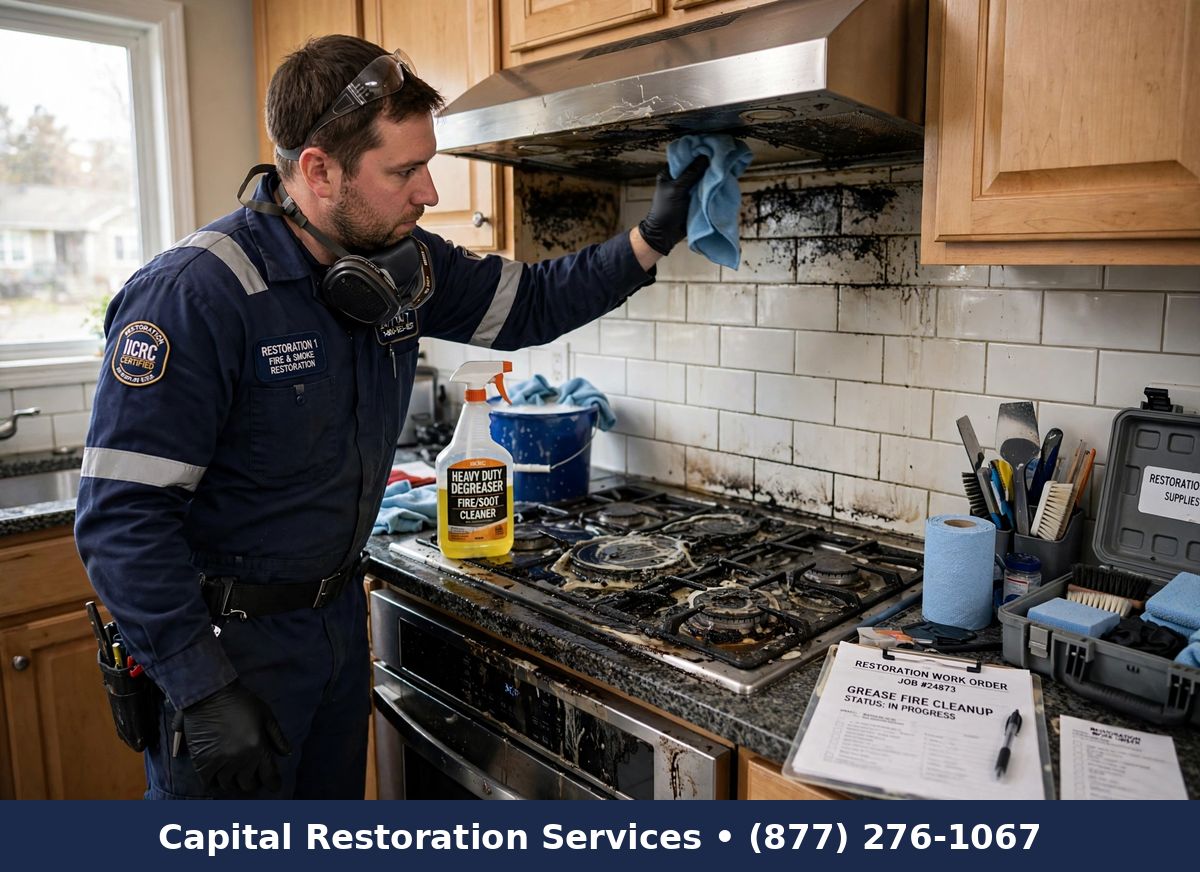
The work begins with an assessment of how far the residue spread. Grease smoke travels on air currents, so we check rooms and vents well beyond the kitchen. Then dry cleaning sponges and HEPA vacuums lift the loose, sticky soot without spreading it. Water comes later, never first, because water alone smears grease.
Next we apply alkaline-based degreasers and enzyme cleaners that break down the oily film through saponification, the same chemistry that turns fat into soap. Cabinets, walls, and hard surfaces are washed and rinsed in sections, with spot testing on delicate finishes first. Appliances are detailed inside and out, and soft goods go through enzyme-detergent washing or professional textile cleaning.
Finally, we address the odor. Surfaces that absorbed the smell may need sealing with an odor-blocking primer, and the air gets treated with thermal fogging or hydroxyl generators to neutralize what clings to hidden surfaces. The job is done when the residue is gone and the kitchen smells like a kitchen again.
What Affects the Cost of Grease Fire Cleanup
The biggest factor is how far the residue traveled. A small stovetop flare-up contained to one wall is a very different job from a fire that filled the house with smoke and ran through the ductwork. The type of surfaces matters too, since sealed tile and stainless steel clean up faster than unfinished wood or textured drywall.
Soft goods add work. Drapes, upholstery, and clothing each need their own cleaning pass. Odor treatment is its own step, and heavy contamination may need more than one round. Timing also plays a role, because residue gets harder to remove the longer it sits.
How Capital Restoration Services Serves Your Area
Capital Restoration Services helps homeowners recover from kitchen fires, from small stovetop incidents to fires that filled the whole house. We also work with restaurants, cafes, and small food businesses where a grease fire can shut down the kitchen until the space is clean and odor-free.
Rental properties are a big part of our work. Landlords need a unit back in rentable shape, and tenants need to know the space is truly clean. Wherever food is cooked, grease fires happen, and we are equipped to clean up the aftermath properly.
Features
- Alkaline-based degreasers and enzyme cleaners matched to protein-fire residue
- Dry cleaning sponges and HEPA vacuuming that lift sticky soot without smearing
- Cabinet, range hood, and appliance detailing inside and out
- Soft goods treatment with enzyme detergents and professional textile cleaning
- Odor control with thermal fogging and hydroxyl generation
- Odor-blocking primers that seal in smells on painted and porous surfaces
- Duct and vent checks when the HVAC ran during the fire
Benefits
- Removes the sticky film that soap and water only spread around
- Stops the burned-cooking odor instead of covering it up
- Protects delicate finishes with tested cleaners and spot checks
- Soft furnishings and clothing get their own proper cleaning pass
- Kitchens, cabinets, and appliances look and feel clean again
- Documentation of the cleanup helps with insurance claims
- You can cook in your kitchen again without the constant reminder
Frequently asked questions
How is grease-fire soot different from regular smoke soot?
Wood and paper fires leave dry, powdery soot. Grease and protein fires leave a sticky, nearly invisible film that is oily and acidic. It needs degreasing chemistry, meaning alkaline cleaners and enzymes, rather than standard dry soot cleaning.
Can I just scrub it off myself?
Light surface film sometimes responds to household degreasers, but the sticky residue smears easily and the odor soaks into paint, drywall, and fabrics. If the smell persists after your own cleaning, or the HVAC was running during the fire, professional cleanup is the reliable fix.
Will the burned smell really go away?
Yes, when the residue is fully removed and the remaining odor is treated. We combine thorough degreasing with odor treatments like thermal fogging and odor-blocking primers on porous surfaces. Lingering smell almost always means residue was left behind somewhere.
How much does grease fire cleanup cost?
It depends on how far the residue spread, which surfaces were affected, how much soft goods need cleaning, and whether odor treatment is required. A contained stovetop incident is a very different job from whole-house smoke. Call (877) 276-1067 and we will assess the damage and walk you through the options.
Can I use my kitchen during cleanup?
It depends on the extent. Small, contained jobs may let you keep using part of the kitchen. Larger cleanups usually need the kitchen closed off so residue and odors do not keep spreading. We will tell you up front what to expect.