Hardwood Floor Water Damage Repair Near Me
Starting price: Call for pricing
Hardwood floors soak up water fast, and the damage shows up as cupping, crowning, or boards that lift and buckle. Capital Restoration Services dries hardwood floors the right way, with moisture meters, specialty floor drying mats, and patient monitoring, then sands, repairs, or replaces what water ruined. Call (877) 276-1067 before small warping turns into a full replacement.
What Hardwood Floor Water Damage Repair Covers
This service is about saving your wood floors after water gets to them. We handle the full arc: finding the moisture with professional meters, drying the floor and the subfloor beneath it, and then repairing the damage the water left behind. That repair may mean sanding cupped boards flat and refinishing, or replacing individual planks with matching wood.
What we do not do is rush the drying. A wet wood floor that is sanded too early will cup again as it keeps shrinking, so every step waits on the moisture readings. We also do not guess at replacement. Boards are matched by species, thickness, and finish so the repair blends in with the floor you already have.
Signs Your Hardwood Floor Needs Professional Help
- Edges of boards curling upward, the classic cupping pattern
- Board centers swelling higher than the edges, called crowning
- Boards lifting, buckling, or pulling away from the subfloor
- Dark stains or discoloration that keep spreading
- A musty smell rising from the floor, hinting at mold below
- Loose boards, gaps, or a hollow sound when you walk across them
How We Dry and Repair Water-Damaged Hardwood
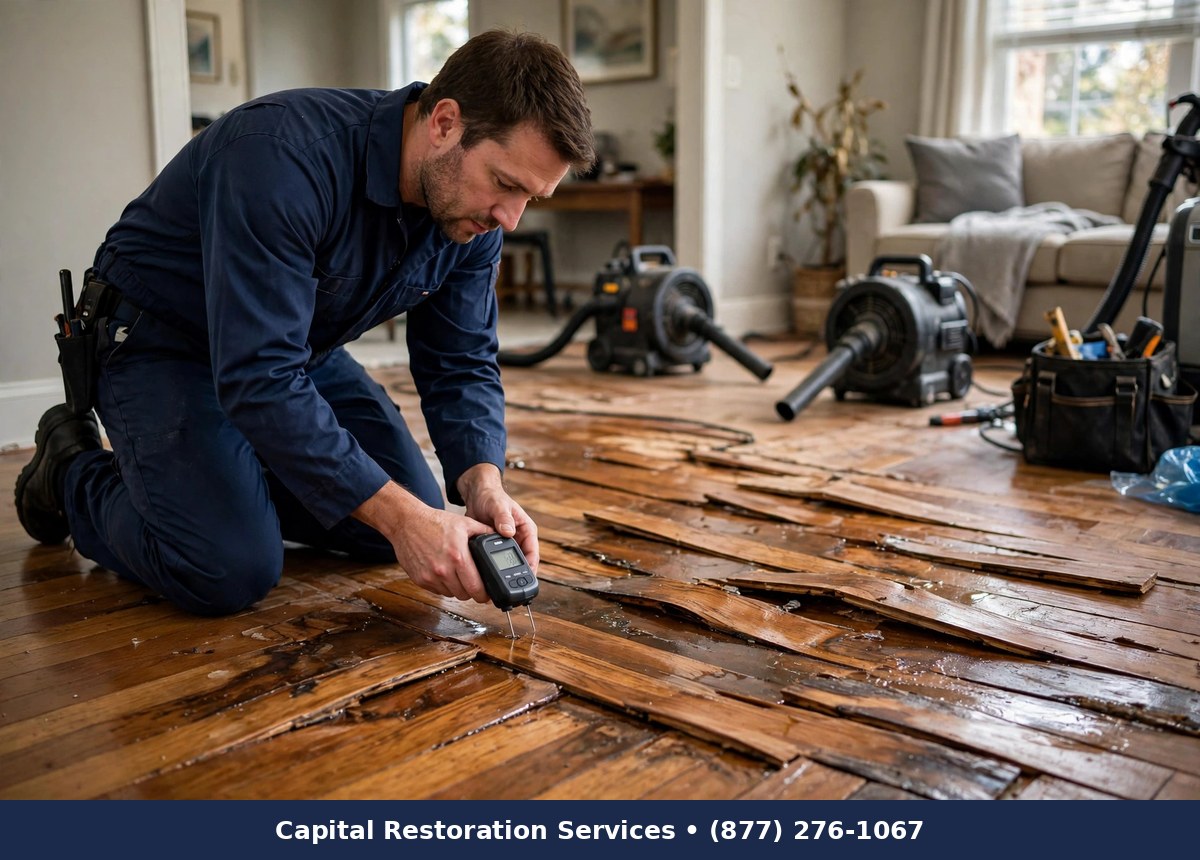
First we map the moisture. Pin and pinless meters tell us how deep the water went and whether the subfloor is wet too, and infrared cameras catch areas your eyes cannot see. Then standing water is extracted and we set up drying equipment: air movers and dehumidifiers for the room, plus specialty floor drying mats that pull moisture up through the boards with concentrated suction.
Drying takes patience. We monitor the moisture content daily and keep the equipment running until the wood reaches its target level. Only then does repair begin. Minor cupping is sanded flat and the floor is refinished to a uniform sheen. Boards that are cracked, rotted, or permanently deformed are replaced with matching species and stained to blend. A final protective finish helps guard against the next spill.
Repair or Replace: How We Decide
Light damage, such as surface staining and minor cupping, can usually be repaired. The floor is dried completely, sanded level, and refinished, and most homeowners cannot tell anything happened. Moderate damage means replacing the worst boards while saving the rest, matching the wood so the patch disappears into the floor.
Full replacement is the honest answer when boards are severely buckled, the subfloor is rotted, or mold has grown underneath. We will show you the moisture readings and the damage itself so you can see exactly why we recommend what we do.
What Affects the Cost of Floor Repair
The area of damaged flooring is the first factor, followed by how deep the water went and how long it sat. Drying a few cupped boards is very different from drying an entire room plus its subfloor. The wood itself matters too, since solid oak, engineered planks, and exotic species each dry and repair differently.
The repair path shapes the rest. Sanding and refinishing takes less labor than replacing and matching boards across a large area. Subfloor replacement, mold treatment underneath, and the number of finish coats all add scope. And as with any restoration work, emergency timing affects scheduling.
How Capital Restoration Services Serves Your Area
Capital Restoration Services helps homeowners protect one of their home's most valuable surfaces. Kitchens, bathrooms, and laundry rooms are the usual trouble spots, but we also dry hardwood in living rooms, hallways, and finished basements hit by leaks or floods. We work with landlords keeping rental units in shape and with small businesses whose wood floors are part of the customer experience.
Every floor gets the same careful approach: measure first, dry completely, and repair only when the wood is ready.
Features
- Pin and pinless moisture meters plus infrared cameras to map hidden water
- Specialty hardwood floor drying mats that pull moisture through the boards
- LGR dehumidifiers and air movers sized for wood-floor drying
- Daily moisture monitoring until the wood reaches its target level
- Sanding and refinishing that levels minor cupping and restores the sheen
- Board replacement matched by species, thickness, and stain color
- Subfloor inspection, drying, and replacement when water reached below
Benefits
- Proper drying gives your floor the best chance of being saved, not replaced
- Moisture readings prove the floor is ready before any sanding begins
- Matched replacement boards blend in instead of standing out
- Subfloor drying prevents mold from growing where you cannot see it
- Refinishing restores the look and adds protection against future spills
- You keep more of your original floor, which keeps the character of your home
Frequently asked questions
Will my cupped floor flatten out on its own?
No. A floor that has cupped, crowned, or warped will not return to flat on its own, even after it dries. Minor cupping can be sanded level once the wood is fully dry, while severe buckling usually means those boards need replacing.
How do you match my existing wood?
We identify the species, board width, and thickness, then source replacement boards to match. The new boards are sanded and stained to blend with the surrounding floor. An exact invisible match is not always possible on aged floors, but a careful match comes very close.
Can sanding fix cupping?
Yes, for mild to moderate cupping, but only after the floor is completely dry. Sanding a wet floor is a classic mistake: the wood keeps shrinking as it dries and cups again. That is why we dry first and verify with moisture readings before any sander touches the floor.
How much does hardwood floor water damage repair cost?
It depends on the damaged area, how deep the water went, the type of wood, and whether the fix is sanding and refinishing or board replacement. Drying-only jobs are the simplest, while full replacement of boards and subfloor is the largest. Call (877) 276-1067 for an on-site assessment and a clear explanation of your options.
Does homeowners insurance cover water-damaged hardwood?
Often, when the cause is sudden, such as a burst pipe or appliance leak. Gradual leaks and long-term moisture are usually excluded. We provide moisture readings and photos that document the damage for your claim. Your agent can confirm what your policy covers.