HVAC Mold Remediation Near Me
Starting price: Call for pricing
Musty smell every time the air kicks on? Your HVAC system may be growing mold on the evaporator coil, in the drain pan, or inside the ductwork, then blowing spores into every room. Capital Restoration Services remediates HVAC mold at the source: full-system cleaning guided by NADCA practices, coil and drain pan treatment, and moisture fixes that keep it from coming back. Call (877) 276-1067 to breathe easier.
Why HVAC Mold Is Its Own Problem
Mold in an HVAC system is different from mold on a wall. Your ductwork connects every room in the house, so a colony growing on a damp evaporator coil or inside a supply duct sends spores through the whole home every time the blower runs. Cleaning one vent register does nothing if the coil behind it is still growing mold.
The system also feeds the problem. Cooling coils produce condensation by design, and if drain pans do not drain properly or ducts stay humid, the moisture never leaves. That is why HVAC mold keeps returning after surface-only cleanups. The source was never fixed.
Signs Mold Is Growing in Your System
- A musty or earthy smell that appears when the heat or AC runs
- Visible mold or dark staining around vent registers
- Standing water or slime in the condensate drain pan
- Clogged condensate drain lines or water stains near the air handler
- Rooms that smell musty only when the system is running
- Dust and debris blowing from vents even after filter changes
How We Remediate an HVAC System
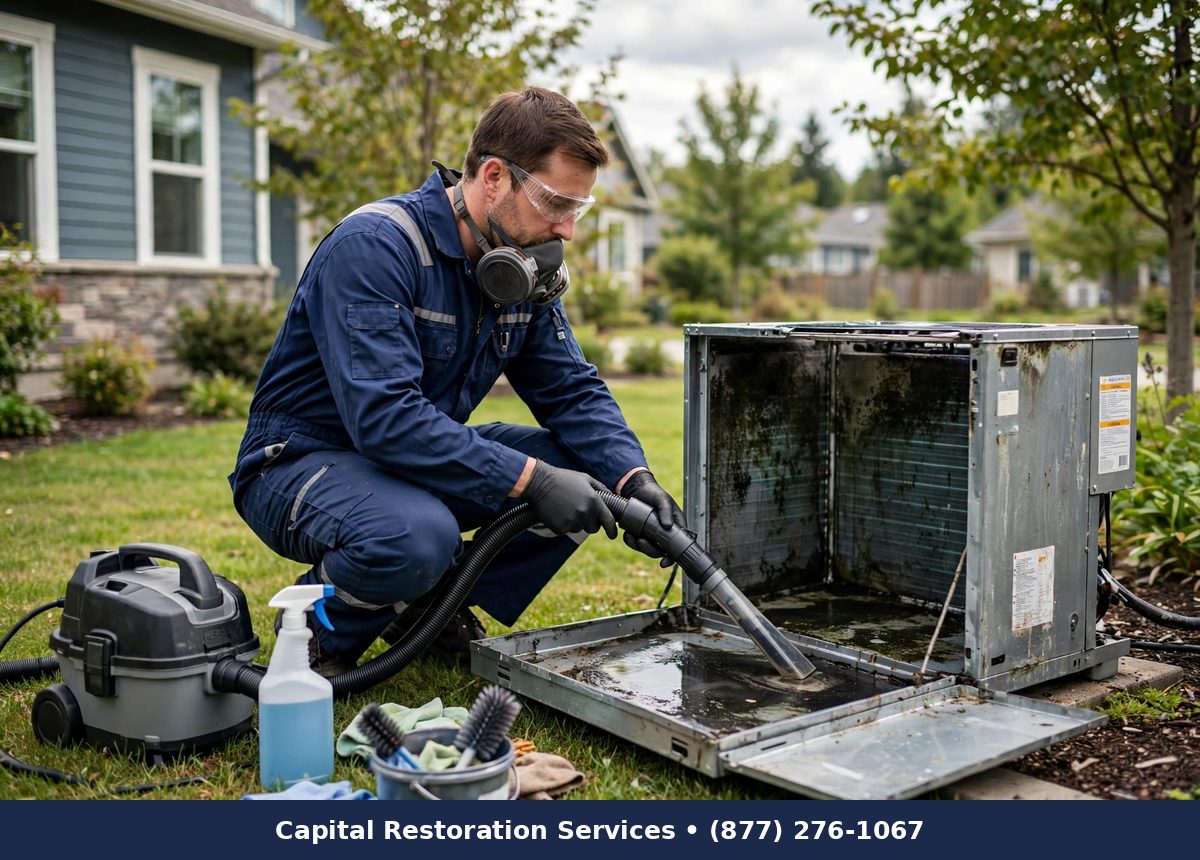
We begin with the system off and a full inspection of the air handler, coils, drain pan, and accessible ductwork. Then the ductwork is placed under HEPA-filtered negative air so everything we dislodge is pulled out of the system, not pushed deeper into it. Agitation tools, meaning brushes and compressed air, loosen debris from duct walls while the vacuum captures it.
The evaporator coil gets its own attention. Light dust comes off with dry methods, while adhered growth calls for wet cleaning with products made for coils, with rinse water captured so it never soaks the surrounding insulation. The condensate drain pan is cleaned, flushed, and checked for proper drainage, and the drain line is cleared. Blowers, housings, and plenums are cleaned the same way.
Porous materials that got wet, like fiberglass insulation inside the ductwork, are removed and replaced rather than cleaned, because you cannot reliably clean mold out of saturated insulation. After cleaning, surfaces are treated with an EPA-registered antimicrobial labeled for HVAC use, and we verify the system is visibly clean before it goes back into service.
What Affects the Cost of HVAC Mold Remediation
System size is the first factor. A single air handler in a small home is a different job from multiple units on a commercial building. How far the contamination spread matters too: a dirty coil and drain pan is one thing, while mold throughout the supply and return ductwork is another.
Coil condition shapes the work. Light dust needs dry cleaning, while impacted or corroded coils may need wet cleaning or, in bad cases, coil replacement. Accessibility counts as well, since tight attics and crawl spaces slow everything down. And fixing the moisture source, like a misdraining pan or poor insulation, is part of doing the job right.
Keeping Mold Out After Remediation
Remediation without moisture control is temporary. We check that the condensate drain flows freely and the pan sits level so water cannot pool. Duct insulation gets inspected for gaps where warm, humid air can condense on cold metal.
On your side, the habits that help most are simple: change filters on schedule, keep indoor humidity in a reasonable range, and have the system serviced regularly so small moisture problems are caught early. A clean system with dry components is one where mold struggles to return.
How Capital Restoration Services Serves Your Area
Capital Restoration Services remediates HVAC mold in homes, rental properties, and small commercial buildings. We handle the systems most homes have, including split systems, package units, and air handlers with standard ductwork, and we work in the attics, basements, and crawl spaces where these systems live.
Property managers call us when tenants report musty odors, and small business owners call us when the shop smells wrong every time the AC cycles. Wherever conditioned air flows, we can clean the system that moves it.
Features
- Whole-system inspection: air handler, coils, drain pan, and ductwork
- HEPA-filtered negative air that pulls dislodged debris out of the system
- Agitation cleaning with brushes and compressed air for duct interiors
- Evaporator coil cleaning, dry methods for dust and wet methods for adhered growth
- Condensate drain pan cleaning, flushing, and drainage verification
- Removal and replacement of wet, moldy porous insulation
- EPA-registered antimicrobial treatment labeled for HVAC use
Benefits
- Removes the mold source instead of just cleaning the vent covers
- Stops spores from being blown into every room the system serves
- Proper drainage fixes cut off the moisture mold needs to return
- Clean coils and blowers move air the way the system was designed to
- Musty odors fade once the growth and its food source are gone
- Documented cleaning gives you a clear record of what was done
Frequently asked questions
Can mold in my ducts make my family sick?
Mold exposure can bother people, especially those sensitive to it, and the EPA recommends fixing mold problems promptly. We are restoration specialists, not doctors, so for health questions talk to your healthcare provider. What we can do is remove the growth and its moisture source so the system stops spreading spores.
Why does my house only smell musty when the AC runs?
That is the classic sign of HVAC mold. When the blower is off, the colony sits quietly. When it runs, air passes over the moldy coil, drain pan, or duct lining and carries the odor, and spores, into your rooms. If the smell tracks the blower, the system is the likely source.
Can you just clean the vents?
Cleaning registers alone is cosmetic. The mold lives deeper, on coils, in drain pans, and inside duct runs. If those are not cleaned and the moisture fixed, the smell and the growth come right back. Real remediation treats the whole system.
Should I replace my ducts instead of cleaning them?
Usually not. Metal ductwork cleans up well and rarely needs replacing. Flexible ducts or duct board with heavy internal growth may be better replaced, and wet fiberglass insulation always is. We will show you what we find and recommend the honest option.
How much does HVAC mold remediation cost?
It depends on the system size, how far the contamination spread, the coil's condition, accessibility, and what moisture fixes are needed. A single dirty coil is far simpler than mold throughout the ductwork of a large home. Call (877) 276-1067 and we will inspect your system and explain your options.