HVAC Smoke and Soot Cleaning Near Me
Starting price: Call for pricing
After a fire, your ductwork often holds more soot than any surface you can see. Capital Restoration Services inspects, shuts down, and professionally cleans your entire HVAC system — ducts, coils, blower, and vents — so the next heating or cooling cycle doesn't push smoke right back through your home. Call (877) 276-1067 before you turn the system back on.
What HVAC smoke and soot cleaning really covers
Your heating and cooling system moves air through every room of the building. During a fire, it does the same job with smoke — pulling soot into the supply and return ducts, the air handler, and every vent in the house. Cleaning only the rooms you can see leaves the biggest soot reservoir untouched. A professional cleaning reaches everywhere the smoke reached: the duct runs, the coils, the blower wheel, the drain pan, the dampers, and the registers themselves.
It does not cover repair of heat-damaged equipment. If the fire or firefighting water ruined the air handler, cracked a heat exchanger, or fried a control board, that part needs repair or replacement by a licensed HVAC technician first. We will tell you straight when cleaning is enough and when something has to be swapped out.
Why the system stays off until the cleaning is done
The moment the air handler cycles on, it becomes a delivery truck for soot. Running the heat or AC after a fire drags settled particles off duct walls and sends them back into clean rooms — sometimes into rooms that never saw a single flame. That is why the first move is always the same: system off, registers sealed, until cleaning is finished. Skip this step and you can undo weeks of room-by-room cleanup in a single afternoon.
Not all soot behaves the same. Dry soot from fast-burning fires wipes up as a powder. Wet soot from smoldering fires is sticky and smeary. Both travel through ductwork, but the oily kind clings much harder to coil fins and blower blades. Knowing which residue we are dealing with decides which cleaning agents and tools will lift it instead of spreading it around.
How the cleaning works, step by step
- Inspection and photos. A camera goes into the ducts to check soot depth, heat damage, and whether the ducts are worth cleaning at all. You get the findings in plain words.
- Shutdown and sealing. The system goes off and every register gets covered so nothing moves while we work.
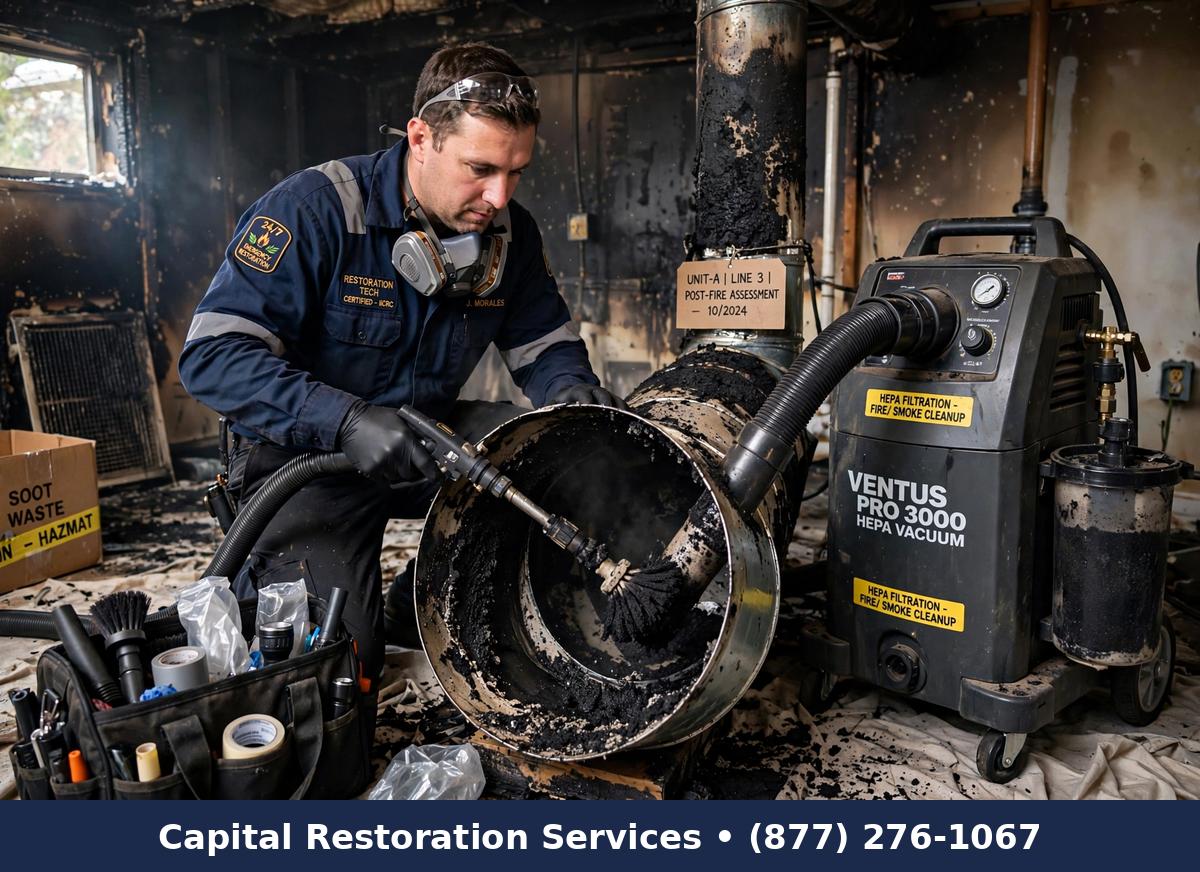
- Agitation with HEPA vacuum. Rotary brushes and air whips knock soot loose while a high-powered vacuum pulls it out. HEPA filtration matters here — a regular shop vacuum would just blow fine soot back into the room.
- Component cleaning. Evaporator and condenser coils, the blower wheel and its housing, the drain pan, dampers, and every register. Coils count double: soot layers act like insulation and kill efficiency.
- Sanitizing and deodorizing. EPA-registered sanitizers on the surfaces, then a deodorizing treatment pushed through the system to reach what brushes cannot.
- New filters and a restart test. Fresh filters go in, then the system runs while we check airflow and confirm no odor or residue comes back through the vents.
The whole job usually takes the better part of a day for an average home. Bigger homes, or ones where the system ran for hours during the fire, take longer.
Parts that often get replaced instead of cleaned
Some things do not clean well enough to keep. Flexible ductwork with melted or soot-saturated liners, disposable filters, and fiberglass duct board soaked with smoke usually cost more to clean than to swap out. Heat-damaged capacitors, wiring, and control boards are not cleaning candidates at all. We show you what is salvageable and what is not, so you never pay to clean something that should have been replaced.
What affects the cost
No two systems cost the same to restore. The biggest drivers are how much of the ductwork is reachable — long attic runs take longer than an open basement layout — how heavy the soot is, whether it is dry or oily, and how many components need replacing instead of cleaning. A system that was running during the fire, spreading contamination through the entire loop, needs more work than one that was off. Night, weekend, and emergency calls add to the time. For a real number, call (877) 276-1067 and we will price it in writing after the inspection.
Serving homes and businesses across the area
Capital Restoration Services handles this for single-family homes, townhouses, apartments, offices, and retail spaces — any property where a fire, a puffback, or wildfire smoke got into the ventilation. The approach is the same whether it is a furnace with ductwork or a rooftop unit over a shop. If your home still smells of smoke every time the air kicks on, that is the system talking. Reach out at (877) 276-1067 and we will take it from there.
Features
- Camera inspection of the ductwork before any work starts
- Full system shutdown with sealed registers to stop re-contamination
- Rotary brush and air-whip agitation with HEPA vacuum extraction
- Evaporator and condenser coil cleaning
- Blower wheel, housing, and drain pan cleaning
- Antimicrobial sanitizing of duct surfaces
- Deodorization run through the whole system with filter replacement and an airflow test after restart
Benefits
- Stops soot from recirculating every time the heat or AC kicks on
- Removes the smoke smell at its source instead of masking it
- Brings back the coil and blower efficiency lost under soot buildup
- Protects finishes, electronics, and metal parts from corrosive acidic soot
- Gives you documented before-and-after proof for your insurance claim
- Clears the one contamination source that can undo the rest of your fire cleanup
Frequently asked questions
Do I really need the ducts cleaned after a small kitchen fire?
If the range hood, furnace, or AC was running, smoke traveled — ductwork is built to move air, so even a small fire sends soot into it. A quick camera inspection tells us for sure, and it only takes a few minutes.
How long does HVAC smoke cleaning take?
Most single-family homes take the better part of a day. Heavy contamination, larger homes, or systems that kept running during the fire take longer, and we'll give you a real time frame after the inspection.
Will this get rid of the smoke smell completely?
Cleaning removes the source of most of the odor, which is the soot itself. Stubborn smells trapped in porous duct liners or insulation may need an extra deodorizing treatment or a section replaced — we'll say so plainly after we look.
Can soot actually damage my furnace or air conditioner?
Yes. Soot is acidic, so it corrodes metal, fouls circuit boards, and coats coils like insulation until they lose efficiency. The longer it sits, the more of that damage becomes permanent.
What does HVAC smoke cleaning cost?
It depends on the size of the system, the duct layout, how heavy the soot is, and what needs replacing versus cleaning. After the inspection we give you a written price. Call (877) 276-1067 to set up the inspection.
Can I just replace the filter instead?
A new filter helps, but it can't touch the soot already coating your ducts, coils, and blower. Filters catch what passes through; cleaning removes what has settled. Do both.