Insurance Claim Assistance for Fire Damage Near Me
Starting price: Call for pricing
A fire claim is never just about the burned area — smoke, soot, odor, and firefighting water spread further than the flames. Capital Restoration Services documents the full extent of the damage, builds the scope of work your adjuster needs, and stays on the claim with you until it is settled. Call (877) 276-1067 and we will start the paper trail today.
One fire, four kinds of damage — and one claim that must capture all of it
Fire claims are the most complicated claims in restoration because a single event creates several different problems. The flames char structure. Smoke and soot coat rooms the fire never reached. Firefighting water soaks floors, drywall, and insulation. And some of the worst of it hides — inside wall cavities, in the HVAC system, under flooring. A claim that only describes the burned room misses most of the real loss.
That is where claims go wrong. An adjuster who sees a scorched kitchen may not know the smoke traveled through the ductwork into every bedroom, or that hundreds of gallons of hose water are sitting in the subfloor. Our job is to make the invisible visible: testing, photographing, and writing down every form of damage so the claim reflects the whole event, not just the obvious part.
What we handle while you deal with the insurer
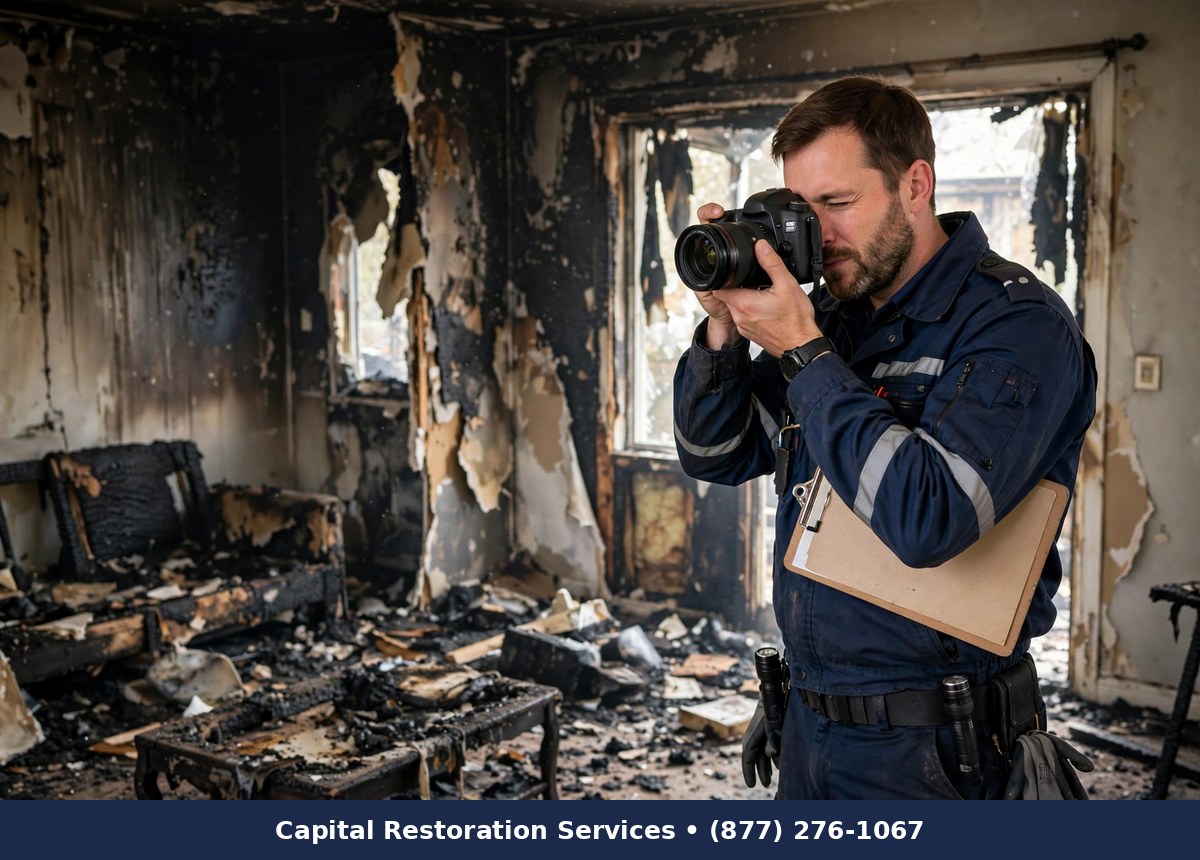
We do not approve or deny claims — that is between you and your carrier. What we do is build the record your claim stands on. From the first visit we photograph and video everything, take moisture readings where firefighting water landed, and list the materials affected. Every emergency step — board-up, roof tarping, water extraction — gets logged with dates, because your policy requires you to stop further damage and the insurer will ask for proof.
Then we write a scope of work: a clear, line-by-line description of what needs cleaning, what needs removing, and what needs rebuilding. Adjusters work from scopes. A detailed, professional one keeps the conversation grounded in facts instead of guesses.
Walking the adjuster through the damage
Be there when the adjuster visits, and bring us along. We walk them through the property, open the areas where hidden damage lives, and explain what each reading means. Smoke inside a wall cavity sounds abstract until someone shows the soot line and the meter reading. That walkthrough routinely changes the scope for the better.
Damage also reveals itself in stages. Demolition exposes charred framing nobody could see; drying exposes water lines in the subfloor. When that happens we submit supplemental documentation — new photos, new readings, a revised scope — so the claim grows with the real damage instead of freezing at the first estimate.
The coverage buckets that matter in a fire claim
Most homeowners policies break a fire loss into a few buckets, and it helps to know them. Dwelling coverage handles the structure: walls, roof, built-in fixtures. Personal property coverage handles your belongings — furniture, electronics, clothing — and this is where a careful inventory pays off, with descriptions, ages, and receipts where you have them. Additional living expenses cover temporary housing and meals while the home is unlivable, so keep every receipt.
Your deductible applies before any of this. Knowing your buckets and limits before the adjuster arrives means you can ask sharper questions and spot a shortfall early.
What affects your out-of-pocket cost
Nobody can quote a fire claim in advance — every loss is different — but the factors that shape what you pay are consistent. The deductible comes off the top. Damage above your coverage limits is yours. Contents are often settled at depreciated value unless your policy includes replacement cost, which can leave a real gap on older items. And some things simply fall outside the policy, no matter how legitimate they feel.
What keeps costs down is a complete, honest scope from the start. Supplements filed late, undocumented damage, and rework from a sloppy first estimate all stretch the timeline — and stretched timelines cost money. Call (877) 276-1067 and we will tell you plainly where your claim stands.
Serving homeowners across the area
Capital Restoration Services guides fire claims for single-family homes, townhouses, condos, and rental properties — and for the commercial buildings that sit on this service page's sister pages. The paperwork is the same discipline whether the loss is one scorched kitchen or a whole structure. If the adjuster has already been out and something feels off, or if the fire just happened and nobody has documented anything yet, reach out at (877) 276-1067. The earlier the record starts, the stronger the claim.
Features
- Same-day emergency documentation with photos and video before cleanup begins
- A written scope of work the adjuster can review line by line
- Moisture readings and material lists for firefighting water damage
- Board-up and tarp records proving you met your mitigation duty
- Contents inventory support for the personal property part of the claim
- Direct coordination with your adjuster, with your permission
- Supplemental documentation when hidden damage turns up mid-project
Benefits
- Nothing gets missed — heat, smoke, soot, odor, and firefighting water all end up on the record
- Claims move faster when documentation is complete from day one
- A written scope of work that lines up with what the adjuster approves
- Proof you stopped further damage, which your policy requires
- One team documenting and restoring, so nothing falls between the cracks
- You talk to us instead of chasing paperwork at the worst possible time
Frequently asked questions
Can you file the insurance claim for me?
We cannot file it or approve it — only you and your insurance company do that. But we prepare nearly everything the insurer asks for: photos, moisture readings, inventories, and a written scope of work, and we answer the adjuster's technical questions.
What if the adjuster missed some of the damage?
It happens a lot, especially with smoke and hidden water damage. When we find more damage during cleanup — soot inside wall cavities, water under flooring — we submit supplemental documentation so the scope reflects reality, not just the first walkthrough.
Will insurance cover smoke damage in rooms that didn't burn?
Usually, yes. When smoke and odor come from the same covered fire, cleaning them is part of the claim — even in rooms the flames never touched. Your policy terms decide the final answer, but we document exactly how far the smoke traveled so the spread is on the record.
How long does a fire damage claim usually take?
Straightforward claims often settle in weeks; complex ones with reconstruction take months. The biggest avoidable delay is incomplete documentation at the start. A complete file on day one keeps things moving.
What will I have to pay out of pocket?
Your deductible comes first, then anything above your coverage limits or outside your policy terms. Depreciation on older contents can also leave a gap. We flag the likely gaps early so there are no surprises, and point you to (877) 276-1067 any time you have questions.
Do you work with my insurance company?
Yes. We coordinate with adjusters from any carrier — meeting them on site, walking them through the damage, and supplying the documentation they request. Call (877) 276-1067 to get the process started.