Insurance Claim Assistance for Water Damage Near Me
Starting price: Call for pricing
Water claims turn on two things: proving the loss was sudden, and proving you acted fast. Capital Restoration Services documents the damage before cleanup, maps the moisture with meters and thermal imaging, and walks your adjuster through the file. Call (877) 276-1067 the moment you find water — the first hours shape the whole claim.
The two questions every water claim must answer
Adjusters evaluate water claims around two questions, and everything we do is built to answer them. First: was this loss sudden and accidental, or gradual? A burst supply line is covered; a faucet that dripped for a year is not. Second: did the homeowner act fast to limit the damage? Policies require mitigation, and insurers notice when it starts late.
The first hours decide both answers. Water documented before cleanup proves what happened and when. Extraction started the same day proves you took the loss seriously. Wait a week to call anyone, and both answers get harder.
Document first, then mitigate, then report
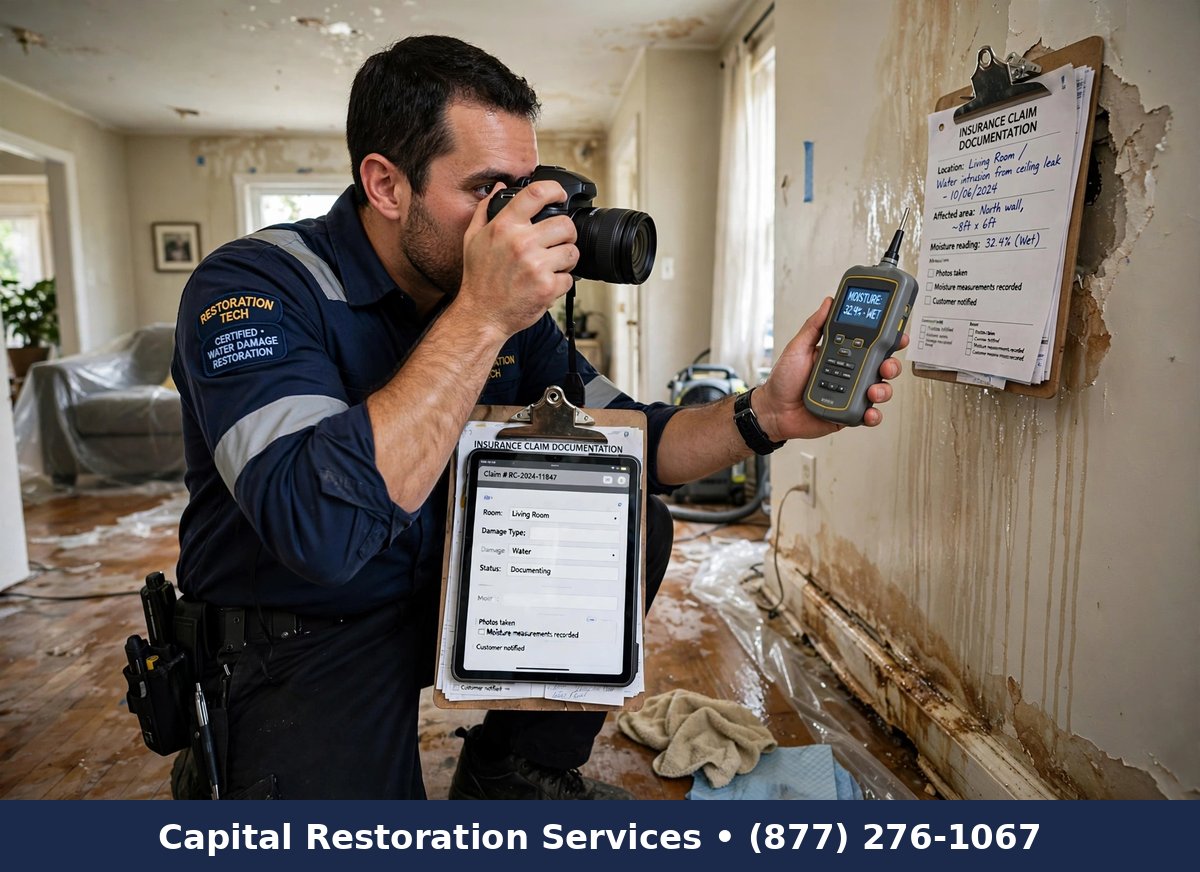
The order matters. Before a single piece of carpet comes up, we photograph and video everything — the standing water, the water lines on walls, the source if it is visible, every damaged belonging. Timestamped images are the most trusted evidence in a claim file.
Then mitigation begins: stopping the source where safe, extracting water, and placing drying equipment. This is not just restoration — it is your contractual duty under the policy, and we log every step with dates so the insurer sees it happened promptly. Only then does the formal claim paperwork go in, backed by a file that is already complete.
Why the moisture map changes the claim
Water does not respect room boundaries. It wicks up drywall, runs under flooring, and pools in wall cavities and subfloors — places no photo can show. A moisture map, built from thermal imaging scans confirmed with pin and pinless meters, draws the true boundary of the loss.
This matters for the claim because adjusters approve what they can verify. A reading that shows elevated moisture inside a wall cavity turns an invisible problem into a documented one. Those same readings become the drying baseline: equipment stays until the numbers return to the dry standard, and the daily log proves the job was finished properly, not just declared finished.
Meeting the adjuster on site
Be present when the adjuster walks the property, and let us be there too. We open the suspect areas, show the moisture map, and explain what each reading means. A cold spot on a thermal image becomes a wet wall cavity with a number attached — much harder to overlook or undervalue.
Bring your questions to that meeting. Ask how the carrier classifies the loss, what the coverage limits are, and how contents will be valued. The answers shape your expectations, and we help you ask them in the right terms.
What affects your out-of-pocket cost
No one can price a water claim sight unseen, but the variables are consistent: your deductible, the true extent of the damage (which the moisture map defines), and how the policy treats what we find. Damage ruled gradual rather than sudden falls outside coverage. Materials may settle at depreciated value. Endorsements you do or do not carry — like sewer backup coverage — change the picture.
What keeps your cost predictable is a complete file and a drying plan written before work begins. Call (877) 276-1067 and we will lay out what your claim is likely to look like, honestly and in plain terms.
Serving homeowners across the area
Capital Restoration Services documents and dries water losses for single-family homes, townhouses, condos, and rental properties — from burst pipes and appliance failures to storm intrusion and the water left behind after a fire. The discipline is the same every time: document first, mitigate fast, and give the adjuster a file that answers their questions before they ask them. If you are standing in water right now, call (877) 276-1067. The clock on your claim has already started.
Features
- Emergency response with photo and video documentation before cleanup
- Moisture mapping with pin meters, pinless meters, and thermal imaging
- Written drying plan with daily moisture readings as the job progresses
- Contents inventory support with descriptions and condition notes
- Extraction and drying logs proving your mitigation duty
- Direct adjuster coordination, including the on-site walkthrough
- Supplemental documentation when hidden moisture is found during drying
Benefits
- Documentation captured before cleanup changes anything, which is what insurers trust most
- A moisture map that shows the adjuster exactly how far the water traveled
- Proof of mitigation that satisfies your policy's requirements
- An inventory of damaged belongings organized for the contents claim
- One point of contact for the adjuster, the paperwork, and the drying
- Fewer delays, because the file is complete the first time it's reviewed
Frequently asked questions
What water damage does homeowners insurance cover?
Sudden and accidental water damage — burst pipes, appliance failures, water from fighting a fire — is typically covered. Gradual leaks, long-term seepage, floodwater, and sewer backup without a special endorsement are typically not. The policy language on sudden versus gradual decides most claims.
What should I do first after discovering water damage?
Photograph and video everything before any cleanup, including the water source. Then stop the source if you can do it safely, and start mitigation — extraction and drying — right away. Call your insurer promptly. Document first, then mitigate, then report.
Can I throw away ruined carpet and furniture?
Don't. Adjusters often want to see damaged items in person, and discarding them can weaken the contents portion of your claim. Move items out of the water if you must, but keep them until the inspection is done.
Do moisture readings really help the insurance claim?
Yes — and it matters. Moisture readings taken at the start show the adjuster how far water traveled behind walls and under floors, including damage nobody can see. That data becomes the baseline for the drying plan and the claim file alike.
What will I pay out of pocket?
It usually comes down to your deductible plus anything the policy excludes or caps — for example, damage classified as gradual rather than sudden. We flag the likely gaps after our inspection so the numbers don't surprise you. Call (877) 276-1067 to talk through your situation.
How long does a water damage claim take?
Simple claims often settle in a few weeks; complex ones with structural drying or coverage questions take longer. The avoidable delays come from incomplete documentation and slow mitigation — both things we handle from day one.