Moisture Detection and Mapping Near Me
Starting price: Call for pricing
Water travels further than it looks — wicking up drywall, pooling under floors, hiding in wall cavities. Capital Restoration Services finds it with thermal imaging, confirms it with moisture meters, and builds a room-by-room moisture map that guides the entire drying plan. Call (877) 276-1067 if you suspect hidden water.
The water you can't see is the water that causes the real damage
The puddle on the floor is the easy part. The expensive part is where that water went: wicking up inside drywall, running under the flooring, soaking into insulation and framing. Left alone, hidden moisture warps floors, feeds mold, and rots structure — weeks after the visible mess is gone.
Moisture detection and mapping exists to draw the true boundary of a water event. Not a guess, not "it looks dry now," but a measured, documented picture of where water is and how wet everything is. Every drying decision after that — what equipment goes where, what gets removed, when the job is done — flows from the map.
How the mapping actually works
We start with a thermal imaging scan. An infrared camera sweeps walls, ceilings, and floors looking for temperature patterns — damp areas typically run cooler because evaporating water pulls heat away. It is fast, non-invasive, and covers large areas in minutes. But a cold spot is a suspect, not a verdict.
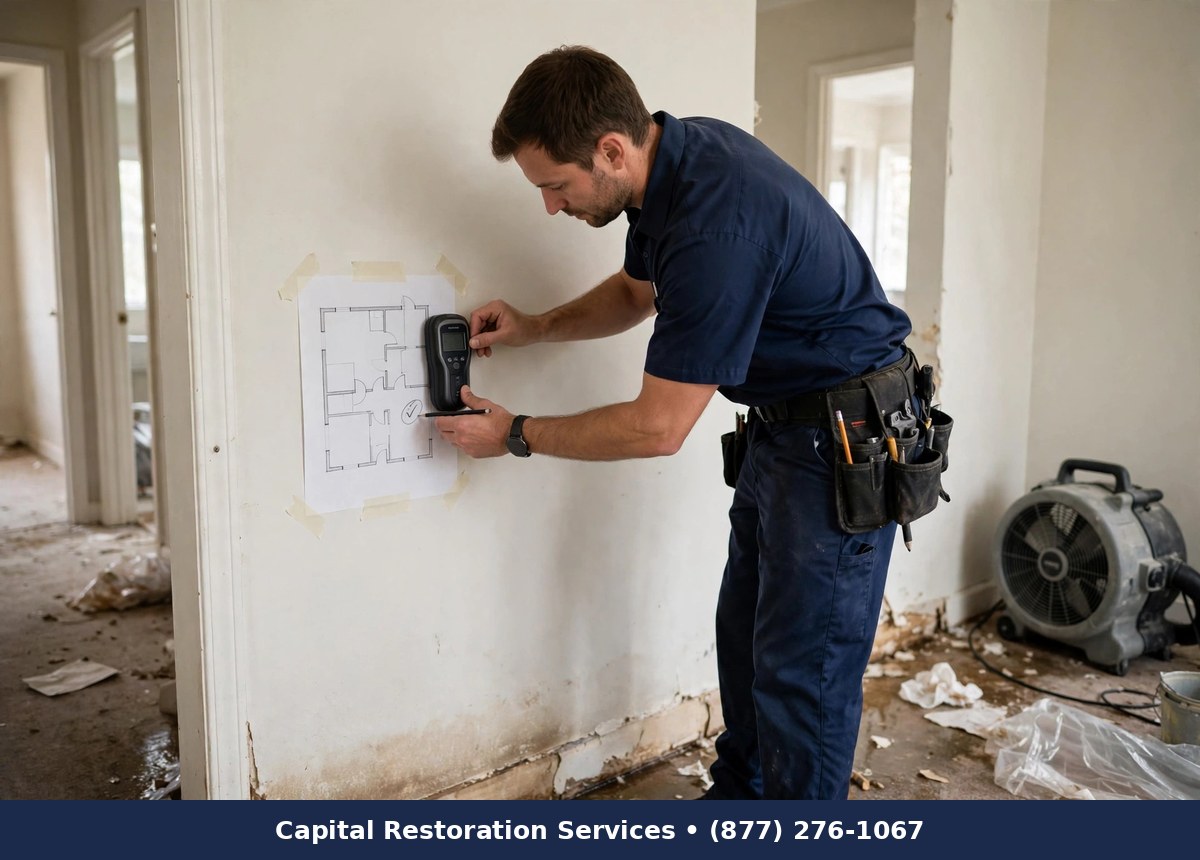
Every suspect area gets confirmed with moisture meters. Pinless meters scan broad sections without marking surfaces; pin meters probe the exact moisture content at a precise point and depth. Thermo-hygrometers add the air side of the picture — temperature and humidity readings that show whether the environment is actually drying or just pushing damp air around.
All of it goes onto the moisture map: a room-by-room record of readings, materials, and affected areas. That map becomes the baseline for the drying plan and the proof, later, that the structure returned to dry.
The dry standard: how we know when it's done
"Dry" is not a feeling — it is a number. We establish it by testing unaffected areas made of the same materials: a dry wall in another room, an untouched section of flooring. That dry standard accounts for normal moisture levels, which vary by climate and material.
Drying equipment stays until the affected areas match the standard, verified by repeat scans during the process. This is what separates professional drying from opening windows and hoping. Without a target number, nobody can honestly say the job is finished.
When mapping matters most
After any significant leak, flood, or firefighting water — where the volume guarantees water went somewhere unseen. When buying a home with a water-damage history, to confirm the previous fix actually worked. When a musty smell or buckling floor hints at a leak nobody can find. And when an insurer needs proof of the damage's extent before approving a scope of work.
It also matters before repairs. Drywall, flooring, and paint installed over still-damp structure trap moisture inside the assembly — practically an invitation to mold. Verification scanning before the rebuild closes that risk.
What affects the cost
The main variables are the size of the property and the number of areas that need scanning. A single bathroom with a suspected leak is a short visit; a whole house after a supply-line break takes considerably longer. Access matters too — finished basements, tile walls, and built-ins slow the work. Call (877) 276-1067 and we will tell you what your situation calls for.
Serving homes and businesses across the area
Capital Restoration Services maps moisture for homeowners, landlords, property managers, and buyers who need to know the truth about water in a building. Whether it is a slow leak behind a shower, a burst pipe two floors up, or verification after someone else's drying job, the method is the same: scan, confirm, document. If something smells damp or your water bill jumped for no reason, call (877) 276-1067 — hidden water only gets more expensive with time.
Features
- Thermal imaging scans of walls, ceilings, and floors
- Pinless meter sweeps for fast, non-invasive coverage
- Pin meter confirmation at every suspect location
- Thermo-hygrometer readings tracking air temperature and humidity
- Room-by-room moisture map with documented readings
- Dry-standard baselines from unaffected areas
- Post-drying verification scans proving the job is done
Benefits
- Finds water hiding behind walls, under floors, and inside cavities
- Defines exactly how far the drying equipment needs to reach
- Prevents mold growth from moisture that was never addressed
- Gives your insurer documented proof of the damage's true extent
- Confirms the structure is actually dry before repairs begin
- Avoids tearing open walls blindly to chase a leak
Frequently asked questions
Does a thermal camera actually see water?
No. A thermal camera detects temperature differences, and wet areas usually run cooler because of evaporation. A cold spot still has to be confirmed with a moisture meter — it could be a draft, missing insulation, or plumbing. We use both, every time.
What's the difference between pin and pinless moisture meters?
Pin meters use two small probes to test moisture inside a material at a precise spot. Pinless meters scan about an inch deep without leaving marks, which is faster for covering large areas. We sweep with pinless first, then confirm with pins.
How do you know when something is dry enough?
By testing unaffected areas made of the same material — your dry standard. Normal moisture varies by region and material, so comparing wet areas to a known-dry reference is how we know when something is truly dry again.
Where does hidden moisture usually end up?
Wall cavities, subfloors, insulation, and framing — the places water reaches that eyes can't. Moisture wicking upward behind drywall and water trapped between flooring layers are the two most common hidden finds.
What does moisture mapping cost?
It depends on the property's size and how many areas need mapping. A single-room scan is quick; a whole house after a major leak takes longer. Call (877) 276-1067 and we'll give you a straight answer for your situation.
Can you find a leak I can't see at all?
Yes — it often finds what visual checks miss, especially slow leaks behind tile or under slabs. Many of our mapping calls start with exactly that: a high water bill and no visible damage.