Mold Air Quality Testing Near Me
Starting price: Call for pricing
You can smell it but you can't find it — that musty odor with no visible source. Capital Restoration Services tests your indoor air with professional spore-trap sampling, compares it to an outdoor baseline, and has an accredited lab count exactly what's floating around. Call (877) 276-1067 to find out what you're really breathing.
What mold air testing actually tells you
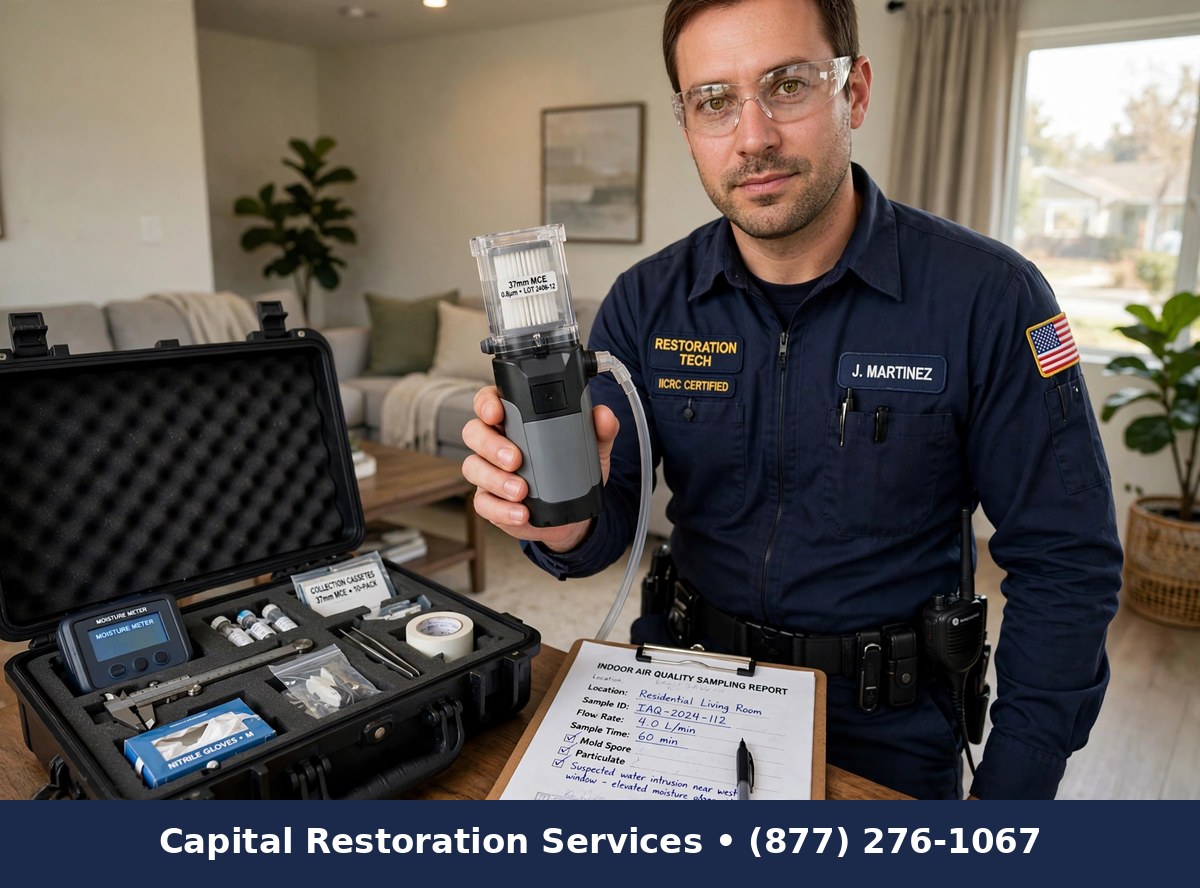
Air sampling answers one question: what is floating in your air right now? A calibrated pump draws a measured volume of air through a spore-trap cassette, and an accredited lab counts the captured spores by type — Aspergillus, Penicillium, Cladosporium, Stachybotrys, and the rest. The result is a concentration, not a guess.
The key to reading it is the outdoor control sample. Mold spores are everywhere outdoors, so indoor air always contains some. What matters is the comparison: indoor counts running clearly higher than the same-day outdoor baseline — or indoor types that don't appear outside at all — point to an active source inside the building.
When testing is worth it — and when it isn't
Testing earns its keep in specific situations. A musty smell with no visible growth. Symptoms that ease when you leave the house. Buying a property with a water-damage history. Needing documentation for a landlord, an insurer, or a sale. And after remediation, to verify the air is back to normal before containment comes down.
It is not always necessary. A small visible patch with an obvious, already-fixed cause usually just needs proper cleaning — testing would tell you what you already know. An honest inspector says so instead of selling samples. We would rather talk you out of testing than into it.
What air sampling can and can't do
Air sampling is a snapshot. Spore levels shift with foot traffic, HVAC cycles, weather, and whether anyone just disturbed a dusty corner. That is why no reputable professional treats one sample as a final verdict — the outdoor control, the visual inspection, and the moisture investigation around it are what make the result meaningful.
It also can't do what many people hope: diagnose health effects or declare a home "safe." There are no established health-based standards for indoor mold levels, and short-term samples can't be read as a health risk score. What testing can do — reliably — is reveal hidden mold, measure the scale of a problem, and prove whether a cleanup worked.
The methods behind the results
Spore-trap cassettes are the workhorse: fast, standardized, and good at capturing what's currently airborne. Where growth is visible, a surface swab or tape lift confirms exactly what that patch is. When we suspect mold inside a wall cavity, a small port lets us draw air from behind the drywall without opening it up.
Some situations call for deeper analysis — DNA-based dust testing that screens for specific water-damage indicator species, for example. We recommend it only when the situation genuinely warrants it, and we explain what the extra data would change about your decisions.
What affects the cost
The variables are straightforward: how many rooms need sampling, whether wall-cavity or surface samples are added, and how much inspection time the property requires. Every indoor round needs its outdoor control, so sample counts add up honestly rather than arbitrarily. Call (877) 276-1067 and we will scope your situation and tell you exactly what we'd recommend — and what we'd skip.
Serving homes and buyers across the area
Capital Restoration Services performs mold air quality testing for homeowners chasing a smell, buyers checking a property's history, landlords settling disputes with documentation, and anyone who wants proof a remediation worked. The approach never changes: inspect first, sample with purpose, and explain the results in words you can actually use. If something in your home smells wrong and you can't find the source, call (877) 276-1067. The air usually knows before your eyes do.
Features
- Calibrated spore-trap air sampling by a trained inspector
- Outdoor control sample for every indoor comparison
- Surface swabs and tape lifts where growth is visible
- Wall-cavity air sampling for suspected hidden mold
- Accredited laboratory analysis with spore counts by type
- Written report comparing indoor results to the outdoor baseline
- Clear explanation of what the numbers mean for your home
Benefits
- Measures what you are actually breathing right now, not last month
- Catches hidden mold behind walls and inside ductwork
- Compares your indoor air to an outdoor baseline for real context
- Documents conditions for landlords, buyers, and insurers
- Verifies a remediation actually worked before containment comes down
- Gives you lab results you can read, explained in plain language
Frequently asked questions
How does mold air testing actually work?
A pump draws air through a cassette for several minutes, trapping spores on a slide. The lab counts the spores by type and reports concentrations, and we compare your indoor numbers to an outdoor control sample taken the same day.
Do I need testing, or should I just clean the mold?
Usually, yes — but not always. Skip the lab work when you can see a small patch and already know what caused it; proper cleaning is the answer. Book testing when the source is hidden, when symptoms follow you from room to room, when you're buying a home, or when you need documentation for a landlord or insurer.
What do the results mean — is any mold in the air bad?
Not necessarily. Spores drift in from outdoors constantly, so a low indoor reading that mirrors the outdoor sample is just normal background. The report gets interesting when the indoor mix looks different from what's outside — that's the sign of something growing inside the building.
How accurate is a single air sample?
Think of it as a weather report, not a climate record. Spore levels move with foot traffic, HVAC cycles, and the weather outside, so one sample describes that moment only. We pair it with an outdoor control and a visual inspection — context is what keeps a single number honest.
What's the difference between air testing and surface testing?
Surface sampling — a swab or tape lift — confirms what a specific visible patch is. Air sampling measures what's circulating, which is how hidden mold gets found. We often use both: air for the big picture, surface for the specific spot.
What does mold air testing cost?
It depends on how many rooms and samples the job needs. Most visits combine an inspection with a few samples — indoor rooms plus the outdoor control. Call (877) 276-1067 and we'll scope it for your situation.