Mold Inspection and Testing Near Me
Starting price: Call for pricing
Testing tells you mold is present. An inspection tells you why it's there, where it reaches, and what to do about it. Capital Restoration Services performs full mold inspections — visual assessment, moisture readings, thermal imaging, targeted sampling, and a written report with a remediation plan. Call (877) 276-1067 to schedule yours.
Testing is a tool. The inspection is the service.
A mold test produces numbers: which genera are present, at what concentrations. Useful — but incomplete. Those numbers can't tell you where the moisture is coming from, how far the problem reaches behind the walls, or what should actually be done. That is what an inspection does.
Think of it this way: testing is a blood test, and the inspection is the doctor's visit. One gives data; the other gives a diagnosis and a treatment plan. Every inspection we perform can include testing, but no testing we perform stands alone without the inspection around it.
What a real inspection covers
It starts with a systematic visual walkthrough — every accessible room, plus the attic, basement, and crawlspace where most mold stories begin. We're looking for visible growth, water staining, warped materials, and the subtle signs of past moisture: efflorescence on foundation walls, rust on fasteners, peeling paint.
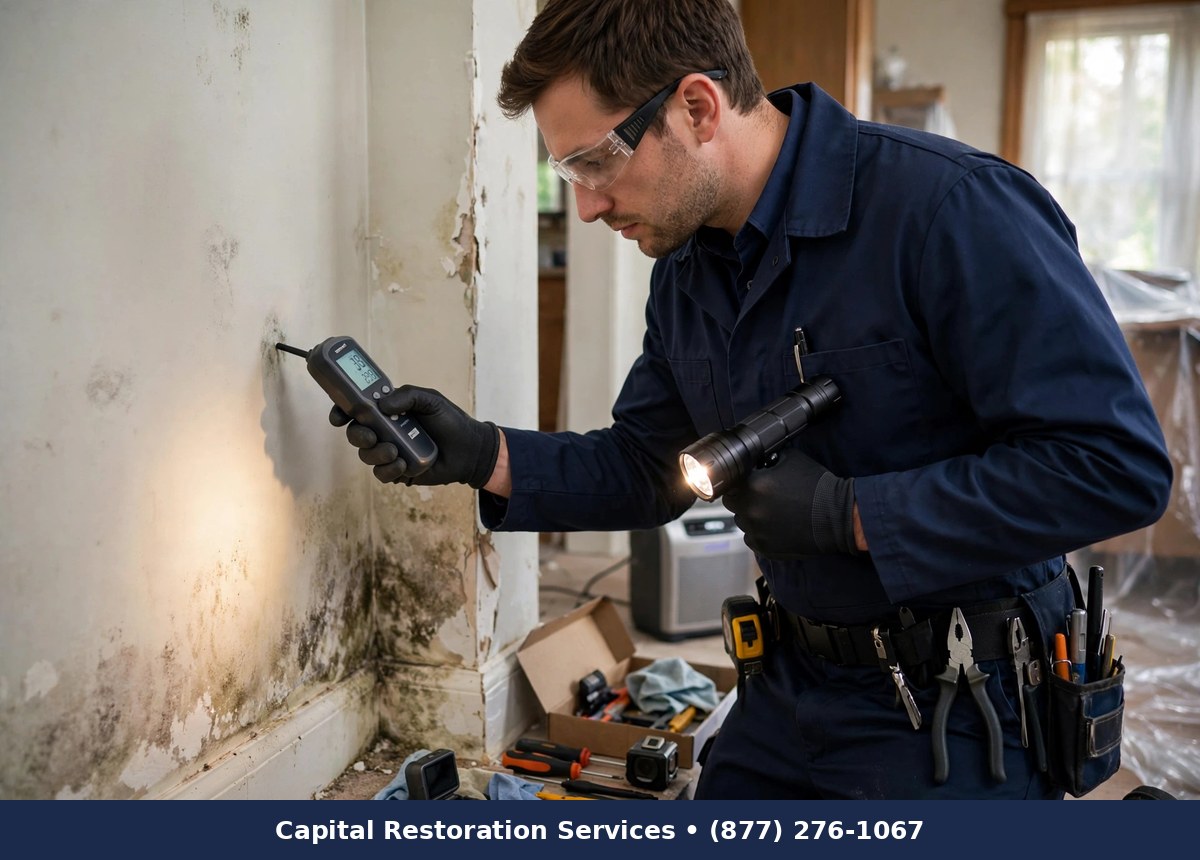
Then the instruments come out. Calibrated moisture meters test walls, floors, and ceilings for elevated readings. A thermal imaging camera sweeps for the cool signatures of hidden moisture. Where the evidence points, we sample — air cassettes with an outdoor control, surface swabs or tape lifts on visible growth, sometimes a wall-cavity draw when we suspect what's behind the drywall.
The thread running through all of it is the moisture source. Mold is a symptom; water is the disease. A leaking supply line, a roof intrusion, condensation from poor ventilation, a bath fan venting into the attic — the inspection names the source, because remediation without that answer is just a pause before the mold returns.
The report: what you actually take home
Everything lands in a written report: visual findings with photos, moisture readings, lab results compared to the outdoor baseline, the identified moisture source, and — most valuable — a remediation protocol. That protocol is the blueprint: the affected areas, the containment the job needs, the materials to remove versus clean, and the standard the finished work must meet.
This document does real work for you. Insurers want it. Landlords and tenants settle disputes with it. Buyers use it to negotiate. And remediation crews — ours or anyone's — price accurately from it instead of guessing.
When an inspection is the right call
A musty odor with no visible source. Health complaints that ease when you leave the house. A recent leak, flood, or roof repair you want verified. Buying a property with any water history. A tenant-landlord disagreement about conditions. Or simply the peace of mind that comes from knowing what's actually in your walls.
And sometimes the right call is no remediation at all. A small, contained patch with a fixed cause doesn't need a containment zone and a five-figure protocol — it needs cleaning and a watchful eye. An honest inspection says that too.
What affects the cost
Property size and whether sampling is included are the main variables. A condo inspection with a few air samples is a different job from a large house with attic, basement, and crawlspace plus wall-cavity sampling. Lab fees apply per sample, so we recommend only the samples that will change a decision. Call (877) 276-1067 for a straight quote.
Serving homeowners, buyers, and landlords across the area
Capital Restoration Services inspects single-family homes, condos, townhouses, and rental properties — for owners chasing a smell, buyers doing diligence, and landlords who need an independent record. Every inspection ends the same way: with you knowing what's there, why it's there, and exactly what to do next. If something in your property doesn't smell or look right, call (877) 276-1067. Answers beat anxiety every time.
Features
- Full visual assessment of all accessible areas
- Calibrated moisture meter readings on walls, floors, and ceilings
- Thermal imaging scan for hidden moisture behind surfaces
- Targeted air sampling with an outdoor control sample
- Surface swabs and tape lifts where growth is visible
- Moisture source identification — the leak or condition behind it
- Written report with photos, lab results, and a remediation protocol
Benefits
- Finds the moisture source feeding the mold, not just the mold itself
- Maps how far the problem reaches beyond what's visible
- Gives you a written remediation protocol — the blueprint for the fix
- Documents conditions for insurance, landlords, buyers, and tenants
- Tells you honestly when you don't need remediation at all
- Puts lab data in context instead of leaving you with raw numbers
Frequently asked questions
What's the difference between mold testing and a mold inspection?
Testing collects samples and produces lab data. An inspection is the complete professional service around that data — the visual assessment, moisture investigation, sampling strategy, interpretation, and written report with a remediation protocol. Numbers without an inspection can't be professionally interpreted.
How long does a mold inspection take?
Plan on one to two hours for a typical home. Larger properties, attics, and crawlspaces add time. If samples are taken, lab results usually follow within a couple of days, and the written report comes after.
Are home mold test kits reliable?
They help, but they're limited. Do-it-yourself kits almost always grow something because spores are everywhere — what they can't do is compare indoor to outdoor levels, find the moisture source, or tell you what the result means for your home. A professional inspection answers all three.
Should I get a mold inspection before buying a house?
Yes — that's one of the best reasons to get one. An inspection documents current conditions, past water damage, and any active moisture, so you're not buying someone else's hidden problem.
What if the inspection finds nothing serious?
Sometimes, and a good inspector will say so. A small patch with an obvious fixed cause may just need cleaning. The inspection earns its value by preventing unnecessary remediation as much as by finding necessary work.
What does a mold inspection cost?
It depends on the property's size and whether sampling is included. Most inspections combine a fixed inspection scope with per-sample lab work. Call (877) 276-1067 and we'll quote your situation plainly.