
Mold Odor Removal Near Me
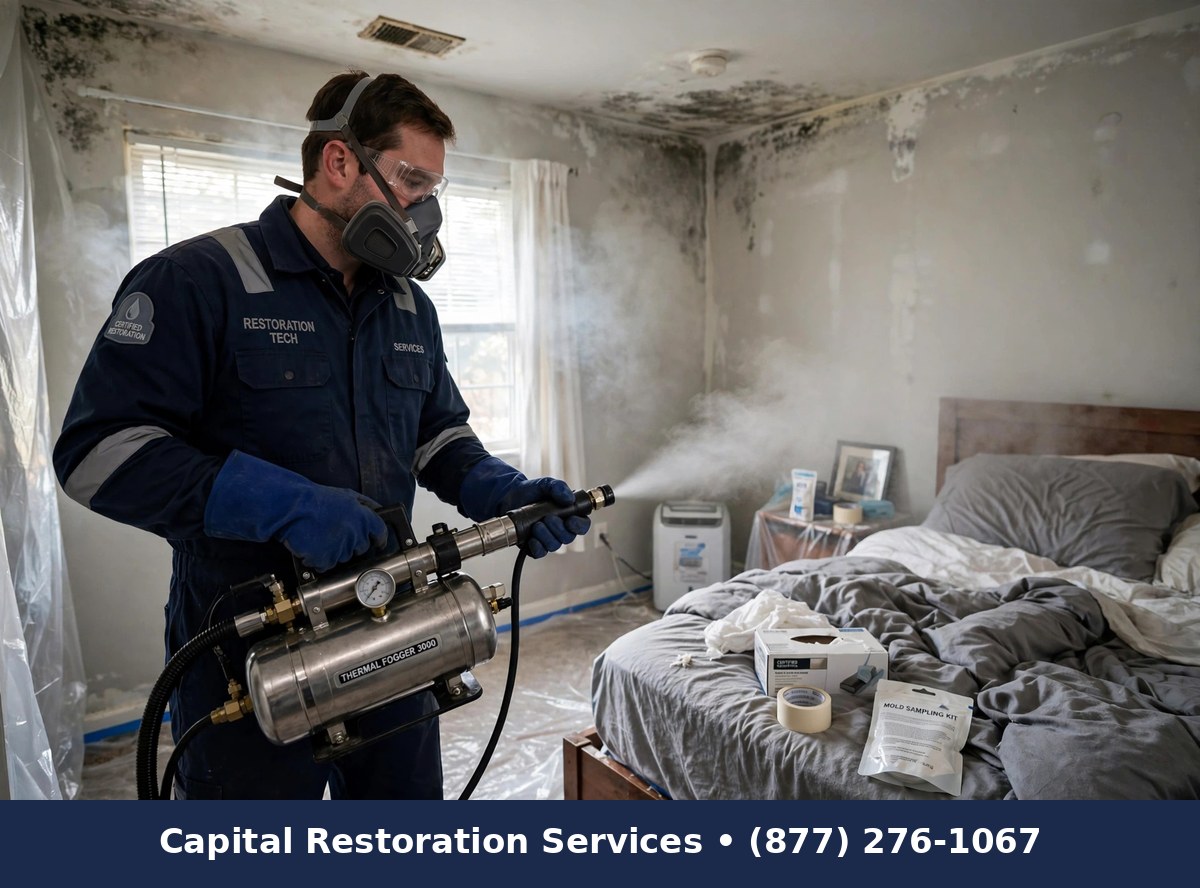
Starting price: Call for pricing
That musty smell isn't dirt — it's chemistry. As mold grows, it releases gases called MVOCs that your nose detects long before your eyes find the growth. Capital Restoration Services tracks the odor to its hidden source, removes it, and neutralizes what lingers. Call (877) 276-1067 if your home smells wrong.
Your nose finds mold before your eyes do
The musty smell in a damp house has a specific chemical source. As mold grows and digests organic material, it releases gases called microbial volatile organic compounds (MVOCs). Your nose detects those compounds at remarkably low levels, which is why a house can smell musty in a room where nobody can find a single visible spot of mold.
MVOCs travel. They move through air gaps, wall cavities, and HVAC ducts, far from whatever is producing them. So the room that smells worst is often not the room with the problem — it's just where the air currents deliver the evidence.
Why masking the smell always fails
This deserves an honest explanation, because it's the reason people spend months frustrated. Scented candles, sprays, and plug-ins work by adding a stronger smell on top of the odor — or by slightly numbing your sense of smell. They don't touch the source. Meanwhile the mold keeps producing MVOCs the entire time, which is why the mustiness always returns, usually within hours and often stronger than before.
The fix runs the other way: locate what's producing the gases, get it out of the building, then break down the odor compounds left behind. With the producer gone, the smell has no way back.
Reading the smell like a diagnostic
Odor patterns tell a trained inspector where to look. A musty smell that's stronger after rain points to water intrusion feeding something hidden. One that intensifies when the AC runs suggests the HVAC system — a contaminated coil, drain pan, or ductwork. A smell confined to one room or closet usually means a localized moisture source nearby: a slow plumbing leak, a wet wall cavity, a forgotten spill under flooring.
A smell that got noticeably worse after a leak or flood, and it's been more than a day or two, means mold may already be starting — growth can begin within 24 to 48 hours of water exposure. Each pattern narrows the search before a single wall gets opened.
How we eliminate it, step by step
- Investigate. Moisture meters, thermal imaging, and cavity checks locate the reservoir — the growth actually producing the MVOCs. Sometimes it's visible; often it's behind drywall, under a tub, or inside ductwork.
- Remove the source. The moldy material comes out under containment: drywall sections, insulation, carpet, whatever the reservoir is living in. Cleaning the air without removing the source is decoration.
- Treat what stays. Exposed framing and surfaces get cleaned and treated with antimicrobial solutions.
- Scrub the air. HEPA air scrubbers run during the work to capture airborne spores and particles stirred up by the removal.
- Neutralize the rest. Hydroxyl generators and targeted deodorization break down residual odor compounds in the air and on surfaces — at the molecular level, not a cover scent.
- Verify. The nose test matters, but so does confirmation: moisture readings back to normal, no visible growth, and the space smelling like nothing at all.
What affects the cost
The hidden-ness of the source is the main variable. Odor from a surface issue in one room is a small job; odor traced to inside wall cavities, subflooring, or ductwork involves investigation, material removal, and sometimes access work. The size of the affected area and the deodorization method round out the picture. Call (877) 276-1067 and we'll tell you what your smell is likely to involve.
Serving homes across the area
Capital Restoration Services tracks down and eliminates mold odors in single-family homes, condos, townhouses, and rentals — the houses that smell fine to visitors for ten minutes and musty to the people who live there. If you've tried the candles and the sprays and the smell keeps winning, that's your sign the source is still in the building. Call (877) 276-1067. We'll find it.
Features
- Odor-pattern analysis to narrow down hidden sources
- Moisture meter and thermal imaging investigation
- Wall-cavity and HVAC inspection for concealed growth
- Removal of the mold reservoir producing the odor
- HEPA air scrubbing during and after the work
- Hydroxyl and targeted deodorization treatments
- Post-treatment verification that the odor is gone
Benefits
- Pinpoints hidden mold you'd never find by looking
- Eliminates the odor at its source instead of covering it
- Stops the musty smell from returning every humid day
- Improves the air your family actually breathes
- Catches moisture problems while they're still small
- Leaves the home smelling like nothing — which is the goal
Frequently asked questions
I cleaned the visible mold — why does the smell remain?
Usually it means the source is still there — often hidden. Visible mold gets cleaned while growth inside a wall cavity, under flooring, or in the HVAC system keeps producing odor. Persistent smell after cleanup is the classic sign of a missed reservoir.
What do different musty smells tell you?
Musty or earthy almost always means mold or mildew. A smell that's stronger after rain or when the AC runs points to humidity feeding something hidden. A smell in one room or closet usually means a localized moisture source nearby. The pattern is a diagnostic tool.
Why don't air fresheners fix a musty house?
They add a stronger scent on top or slightly numb your sense of smell — either way, the mold keeps producing odor compounds the whole time. That's why the smell always returns, often stronger. Masking is temporary by design; source removal is permanent.
What actually causes the musty smell?
It's the gases mold releases as it digests material — microbial volatile organic compounds, or MVOCs. They travel through air gaps, wall cavities, and ductwork, which is why a house can smell musty in a room with no visible mold at all.
What does mold odor removal cost?
It depends on how hidden the source is — a surface issue is quick, while odor from inside wall cavities or ductwork takes investigation and sometimes material removal. Call (877) 276-1067 and we'll assess your situation honestly.
Can the smell come from my air conditioner?
Yes. The HVAC system is a common odor highway — a dirty evaporator coil, a contaminated drain pan, or growth inside ductwork can perfume the whole house every time the system runs. We check it as part of every odor investigation.