Mold Remediation After Flooding Near Me
Starting price: Call for pricing
Floodwater isn't just water — it's Category 3 contamination carrying silt, sewage, and chemicals into every porous surface it touches. Capital Restoration Services remediates mold after flooding with the full protocol: contaminated material removal, structural drying, and mold cleanup done to standard. Call (877) 276-1067 if your home took on water.
Floodwater plays by different rules
A burst pipe is clean water. A flood is not. Rising water picks up sewage, soil, chemicals, fuel, and debris on its way into your home — which is why the restoration industry classifies floodwater as Category 3: grossly contaminated. That classification changes everything about how the cleanup works.
Porous materials that survive clean water often can't survive a flood. Drywall, insulation, carpet and pad, upholstered furniture, and particleboard absorb not just water but everything in it. Cleaning the surface leaves contamination inside the material. That's why flood remediation removes far more than it cleans.
The 24-hour clock starts when the water arrives
Mold doesn't wait for the flood response to get organized. Growth can begin within 24 hours of water exposure, and a flooded home offers ideal conditions: soaked organic materials, warm temperatures, and stagnant air. Every day a flooded house sits wet, the remediation scope grows.
This is why the sequence matters so much. Water extraction first, then mud and debris removal, then demolition of unsalvageable materials — all before mold gets a real foothold. Speed here isn't about convenience; it's about how much of your home survives.
Flood cuts: why drywall comes out above the water line
Water wicks upward through drywall and insulation, carrying contamination higher than the visible stain. That's why professionals make flood cuts — removing drywall (and the insulation behind it) to a foot or more above the highest water mark. It looks aggressive. It's actually precise: everything below that line absorbed Category 3 water and has to go.
What remains — studs, subfloor, concrete, brick — gets cleaned, disinfected with EPA-registered products, and dried. Hard surfaces can be saved. Porous ones can't. Knowing the difference is what keeps a flood job honest.
Drying a flooded structure takes weeks, not days
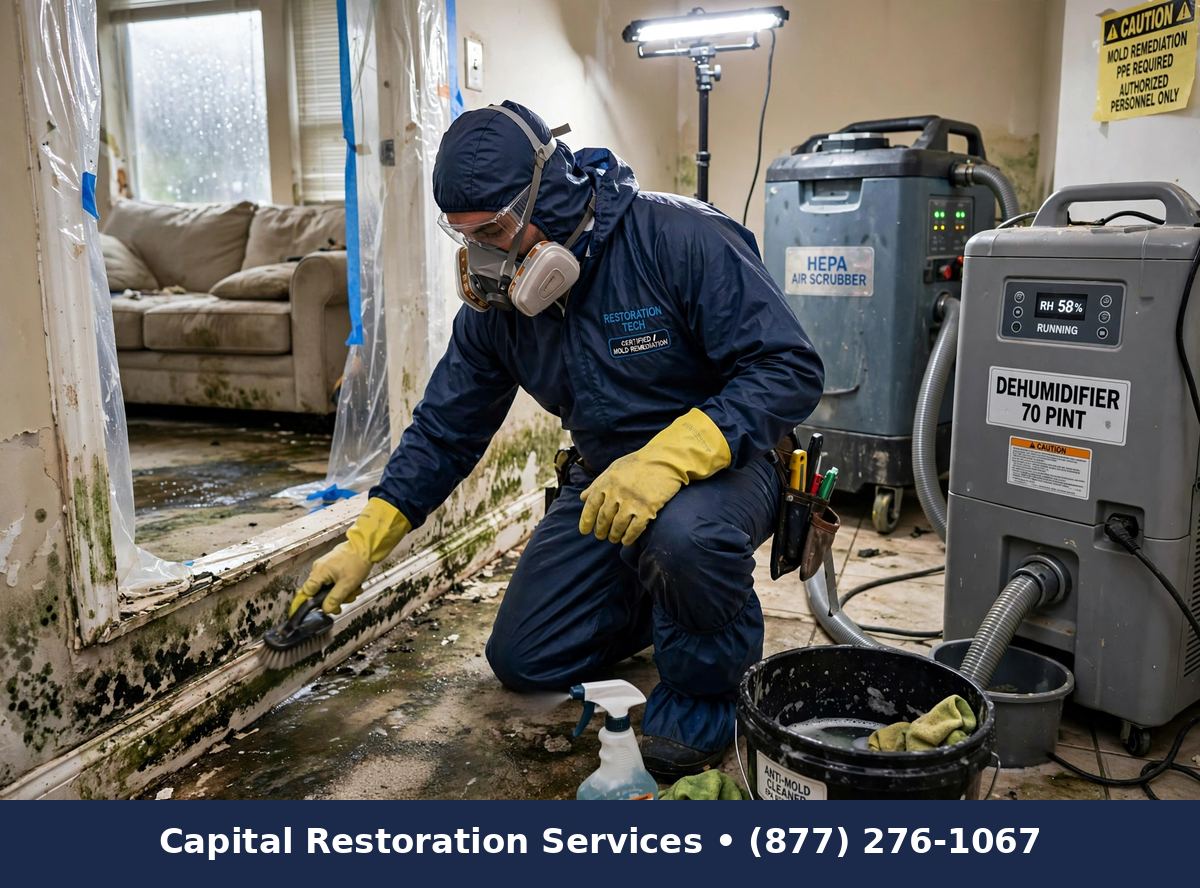
A flooded home holds far more moisture than a leak ever could — water saturates framing, wicks into wall cavities, and pools in subfloors and crawlspaces. Industrial dehumidifiers and air movers run for an extended period, with moisture readings tracked daily against dry standards.
Rushing this stage is the most expensive mistake in flood recovery. Drywall and flooring installed over a still-damp structure trap moisture inside the wall assembly, and the mold returns behind brand-new finishes. Verification — meter readings at target, not a calendar date — is what says the structure is ready to rebuild.
What affects the cost
Flood remediation is among the most variable work in restoration. The depth of the water, how long the home stayed wet, the square footage affected, how much material must be removed, and the drying time all stack up. Homes that sat in water for days need far more than homes pumped out the same afternoon. Call (877) 276-1067 for an on-site assessment — flood jobs can't be scoped by phone.
Serving flood-affected homes across the area
Capital Restoration Services handles the full arc of flood recovery: extraction, mud-out, contaminated material removal, disinfection, structural drying, and mold remediation — with documentation built for insurance from the first visit. If your home took on water, don't wait to see if mold shows up. It will. Call (877) 276-1067 now, while the scope is still as small as it will ever be.
Features
- Emergency water extraction and mud/debris removal
- Flood cuts removing drywall above the contamination line
- Removal and disposal of flood-soaked porous materials
- EPA-registered disinfection of remaining structure
- Industrial drying with daily moisture monitoring
- HEPA air scrubbing throughout the remediation
- Post-remediation verification before rebuild begins
Benefits
- Removes mold growing in flood-soaked materials throughout the home
- Eliminates the contamination floodwater carried in with it
- Dries the structure fully so mold can't return after repairs
- Documents the damage for flood and homeowners insurance claims
- Makes the home safe to reoccupy without lingering health concerns
- Coordinates the whole recovery — mud-out, drying, remediation, rebuild
Frequently asked questions
Does mold always follow a flood?
Yes — and aggressively. Mold can start growing within 24 hours of a flood, feeding on soaked drywall, insulation, carpet, and wood. The longer a flooded home sits wet, the more extensive the remediation becomes.
What is a flood cut, and why do you make one?
Flood cuts. We remove drywall and insulation to a foot or more above the visible water line, because wicking carries contamination higher than the stain shows. Porous materials below the line — carpet, pad, drywall, insulation — generally can't be saved after Category 3 water.
What can be saved after a flood, and what can't?
Concrete, brick, glass, metal, and solid sealed wood can usually be cleaned, disinfected, and dried. Anything porous that absorbed floodwater — drywall, insulation, carpet, upholstery, particleboard — typically gets removed.
Can I clean up flood damage myself?
Not safely. Floodwater is classified as grossly contaminated — it can carry sewage, chemicals, fuel, and bacteria. Cleanup requires protective equipment, proper disposal, and disinfection that goes well beyond household cleaning.
What does mold remediation after a flood cost?
It depends on how much of the home flooded, how long it stayed wet, and how much material must be removed. Flood jobs are among the most variable in restoration. Call (877) 276-1067 for an on-site assessment and a written scope.
Will insurance cover mold after a flood?
Sometimes partially. Standard homeowners policies typically exclude floodwater itself — that needs separate flood insurance — but may cover resulting mold under certain conditions. Documentation from day one is what makes any claim viable.