Mold Remediation After Sewage Backup Near Me
Starting price: Call for pricing
Sewage is Category 3 black water — grossly contaminated — and the nutrient-rich moisture it leaves behind grows mold within a day or two. Capital Restoration Services handles both halves of the problem: professional sewage decontamination and the mold remediation that follows it. Call (877) 276-1067 immediately — this is not a wait-and-see situation.
Two contaminations, one cleanup
A sewage backup creates two problems layered on top of each other. The first is the sewage itself — Category 3 black water, grossly contaminated with bacteria, viruses, and parasites. The second arrives a day or two later: mold, colonizing the nutrient-rich moisture the sewage leaves behind. Spores can establish within 24 to 48 hours.
Treating only one half leaves you exposed to the other. Disinfect without addressing the mold, and growth continues inside walls and under floors. Remediate mold without proper sewage decontamination, and pathogens remain in the structure. The job has to handle both, in the right order.
Why sewage is never a DIY cleanup
This point can't be softened: any water that has contacted sewage is Category 3, regardless of appearance. Household bleach and rubber gloves don't touch this level of contamination. Porous materials — carpet and pad, drywall, insulation, upholstery — absorb black water deep into their structure and can't be disinfected reliably. They get removed and disposed of as contaminated waste.
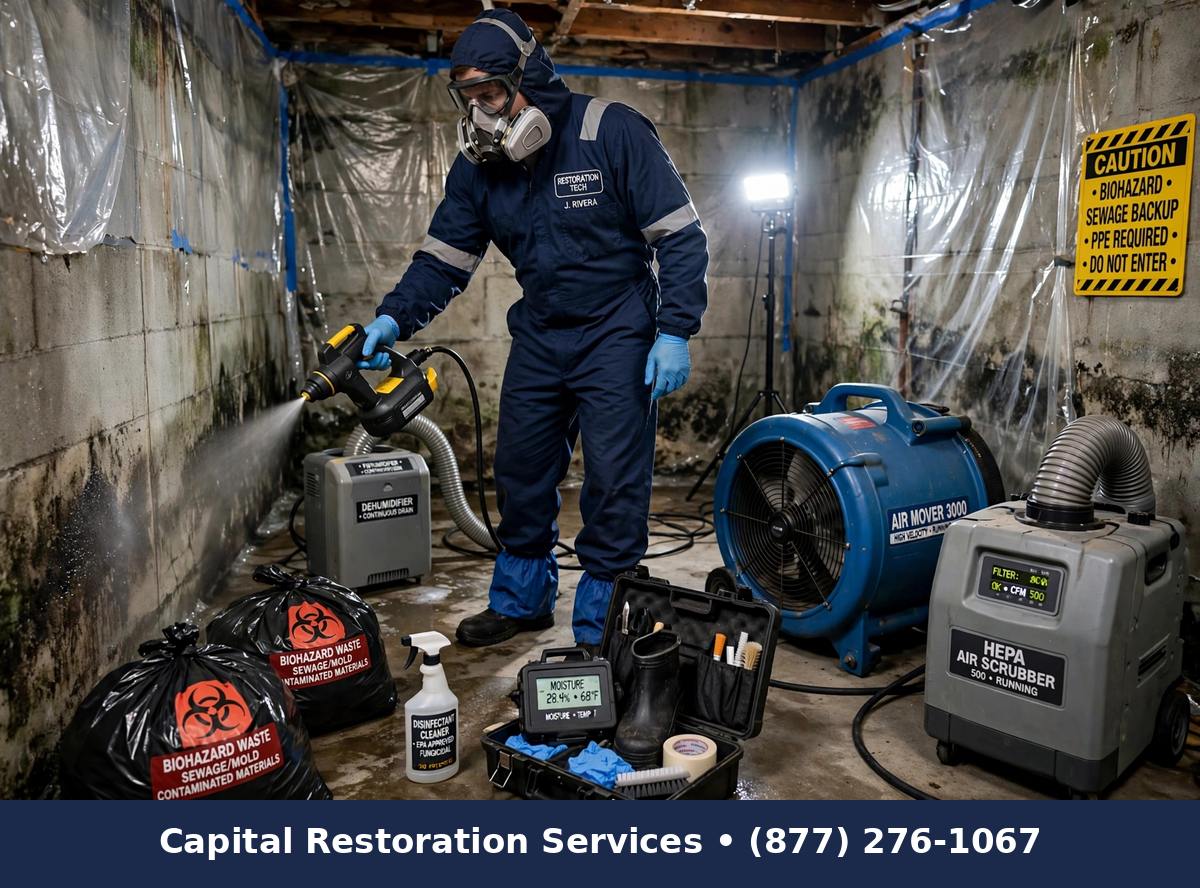
Our crews work in full protective equipment with contained work zones under negative air, because the contamination is airborne as well as on surfaces. Extraction equipment pulls the standing waste; then every remaining surface gets professional-grade antimicrobial disinfection. This is the part of restoration where shortcuts genuinely endanger health.
Where the mold comes in
Even after thorough sewage cleanup, the moisture timeline matters. If the backup sat undiscovered — a basement no one visits, a crawlspace, a vacation home — mold may already be established when we arrive. Damp drywall, wet insulation, and soaked framing are ideal colonization sites, and sewage residue is practically fertilizer.
That's why structural drying starts immediately and mold inspection runs alongside it. Where growth has taken hold, full remediation follows: containment, removal of colonized materials, HEPA filtration, and treatment of remaining structure. The drying readings get tracked daily until everything hits its dry standard — because any moisture left behind restarts the whole cycle.
What gets removed versus what gets saved
The rule is straightforward: porous materials that absorbed sewage go. Drywall, insulation, carpet and padding, particleboard, upholstered items — removed, bagged in containment, disposed of properly. Non-porous materials — concrete, tile, glass, metal, sealed wood — can be cleaned, disinfected, and dried.
Framing lumber sits in the middle: structurally sound studs and joists usually stay, but they get disinfected, dried, and treated. Every decision gets documented with photos, which matters for the insurance file as much as for your peace of mind.
What affects the cost
Category 3 work costs more than clean-water work for honest reasons: full protective equipment, contained work zones, biohazard-compliant disposal, professional disinfection, and longer drying times. The extent of the backup — one bathroom versus a flooded basement — and how long it sat before discovery are the biggest variables. Call (877) 276-1067 and we'll assess it in person.
Serving homes across the area
Capital Restoration Services responds to sewage backups in single-family homes, townhouses, condos, and rentals — extraction, decontamination, drying, and mold remediation as one coordinated job, not four separate contractors. If sewage has entered your home, don't wait and don't try to handle it yourself. Call (877) 276-1067 now. Every hour the contamination sits, it spreads deeper and the mold gets a head start.
Features
- Emergency extraction of standing sewage
- Contained work zones with HEPA negative air
- Removal and biohazard-compliant disposal of porous materials
- EPA-registered antimicrobial disinfection of all surfaces
- Full structural drying with daily moisture readings
- Mold remediation of any growth that established
- Clearance verification before the space is reoccupied
Benefits
- Eliminates both sewage pathogens and the mold that follows
- Removes contaminated porous materials instead of spreading them
- Disinfects the structure with professional-grade biocides
- Dries everything fully so mold can't colonize afterward
- Documents a Category 3 loss properly for insurance
- Returns the home to a genuinely safe, sanitary condition
Frequently asked questions
Is all sewage backup considered hazardous?
Any water that has contacted sewage is classified as Category 3 black water — grossly contaminated with pathogens — regardless of how it looks or how quickly it's addressed. There's no 'minor' sewage backup from a contamination standpoint.
Can I clean up a small sewage backup myself?
Strongly discouraged, even for small spills. Household cleaners aren't formulated for sewage-level pathogens, and porous materials that look fine can be contaminated beneath the surface. This is genuinely a job for full protective equipment and professional disinfection.
Why does mold follow sewage so quickly?
Because sewage is nutrient-rich water — essentially fertilizer for fungi. Spores can establish within 24 to 48 hours in the damp conditions a backup leaves behind, especially in warm weather. Fast extraction and drying are the only prevention.
Can we stay in the home during cleanup?
Usually not during active cleanup — Category 3 contamination puts pathogens in the air and on surfaces. It's safest to stay elsewhere until the space is decontaminated, dried, and verified. We'll tell you honestly when it's clear.
Does homeowners insurance cover sewage backup?
Usually not without a separate sewer backup endorsement, which most standard policies don't include by default. Check your declarations page. Either way, document everything from the start — photos before cleanup, our reports after.
What does sewage mold remediation cost?
It depends on the extent of the backup, how far it spread, and how much material must be removed and disinfected. Category 3 work involves more protection, more disposal, and more disinfection than clean-water jobs. Call (877) 276-1067 for an assessment.