Mold Remediation for Condos and Apartments Near Me
Starting price: Call for pricing
Mold in a condo or apartment rarely stays in one unit — it travels through shared walls, floor cavities, and HVAC chases. Capital Restoration Services remediates multi-unit buildings with contained work zones, source tracing across unit lines, and documentation HOAs and managers can use. Call (877) 276-1067 for an assessment.
Mold doesn't respect property lines
In a single-family home, the mold and its cause live under one roof and one owner's control. In a condo or apartment building, neither is guaranteed. The leak feeding your mold may be in the unit above, in a common pipe inside a shared wall, or in building envelope failure the HOA maintains. And the mold itself travels — through wall cavities, plumbing chases, electrical outlets, and shared HVAC pathways — into units that never had a leak at all.
This changes the job fundamentally. Remediation here isn't just cleaning; it's investigation across boundaries, containment that protects neighbors, and documentation that multiple parties can rely on.
Finding the source when it isn't in your unit
The classic case: mold on your bathroom ceiling, fed by a slow leak from the unit above — a toilet seal, a shower pan, an AC condensate line. Or growth inside a shared wall, fed by a common-area pipe nobody owns individually. Our inspection traces moisture pathways wherever they lead, using meters and thermal imaging to follow the water through assemblies.
This matters because treating your side while the source next door keeps flowing guarantees the mold returns. The source has to be identified, documented, and fixed — even when fixing it means coordinating with a neighbor, a manager, or the HOA.
The responsibility question, handled with facts
Who pays usually comes down to where the mold originated and who maintains that component — and your building's governing documents draw those lines. A fixture inside a neighbor's unit points one way; a pipe in a common wall points another. We're not lawyers, and we don't decide it. What we provide is objective documentation: where the moisture came from, how far the mold reaches, and what the remediation requires.
That report is what boards, managers, insurers, and — when necessary — attorneys work from. Facts de-escalate disputes faster than anything else.
Working in occupied buildings
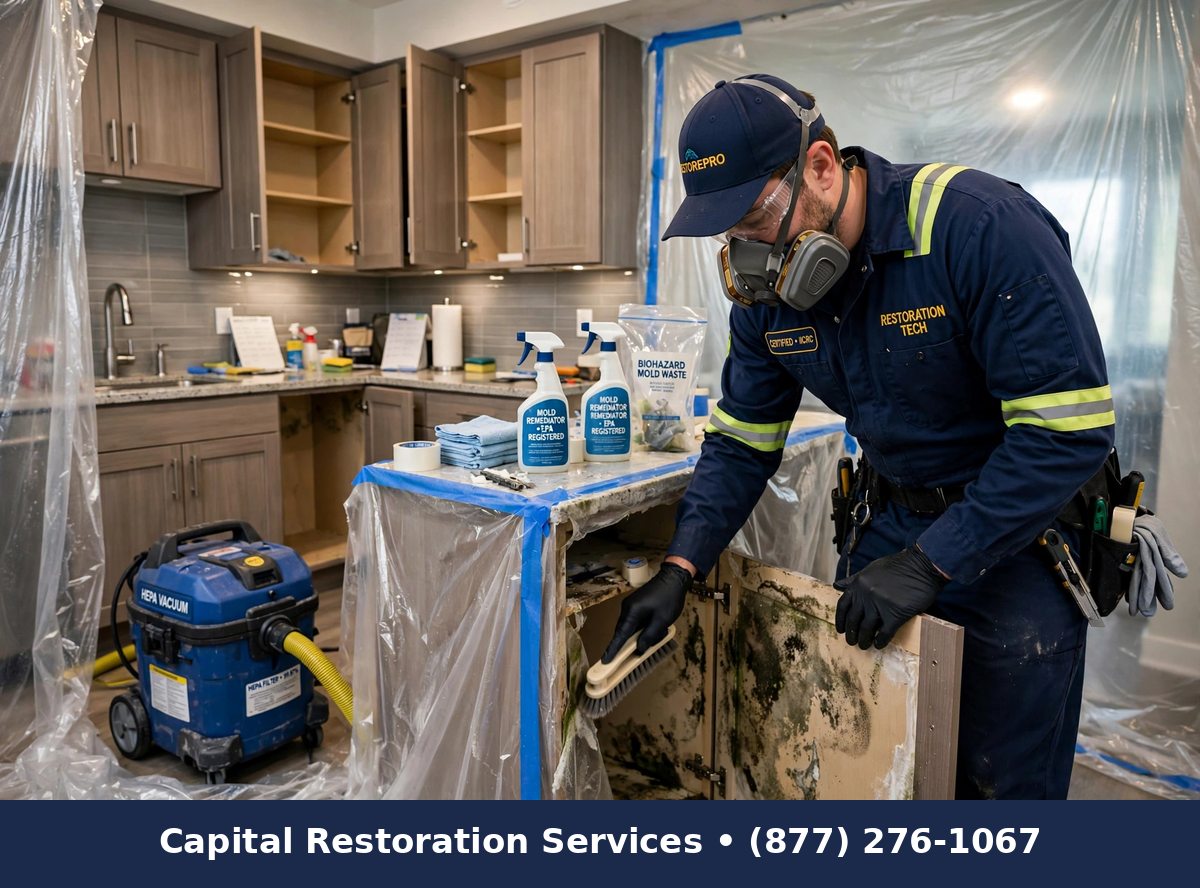
Multi-unit remediation happens while people live around it. Containment with negative air pressure seals the work zone so adjacent units stay clean. We schedule disruptive phases considerately, protect common hallways and elevators on our access routes, and communicate the plan to affected neighbors through the manager or board.
For HOAs dealing with building-wide issues — envelope leaks affecting multiple units, for example — we phase the work logically and document each unit separately, so the board has a clear record of what was done where.
What affects the cost
The variables multiply in multi-unit work: how many units are affected, whether the source is in a unit or a common area, access constraints (occupied units, limited parking, elevator scheduling), and the extent of hidden growth in shared assemblies. An honest scope requires an on-site assessment. Call Capital Restoration Services at (877) 276-1067 and we'll map it out.
Serving condos, apartments, and HOAs across the area
Capital Restoration Services remediates mold in condominiums, apartment buildings, and townhouse communities — for individual owners, property managers, and HOA boards. Whether it's one unit with a neighbor's leak overhead or a building-wide moisture problem, the approach is the same: find the real source, contain the work, and document everything. If mold has crossed a property line in your building, call (877) 276-1067. We'll sort out what's actually happening in there.
Features
- Source tracing across unit boundaries and shared walls
- Contained work zones with negative air protecting adjacent units
- Moisture mapping of affected and neighboring areas
- Inspection reports written for HOA boards and managers
- Coordination with building maintenance on common-area repairs
- HEPA air scrubbing throughout the project
- Clearance documentation for every completed unit
Benefits
- Traces the moisture to its real source — even in the unit next door
- Contains the work so neighboring units stay clean and livable
- Documentation your HOA or board can act on
- Remediation planned around occupied units and shared spaces
- One contractor both sides of a dispute can trust
- A clear report that settles who-pays-what questions faster
Frequently asked questions
Who pays for mold remediation in a condo — me or the HOA?
It usually comes down to where the mold started and who maintains that area — a neighbor's fixture versus a common pipe in the wall, for example. Your governing documents (CC&Rs) define the boundaries. We document the source objectively so the responsibility question has facts behind it.
Can mold in my unit come from my upstairs neighbor?
Very often, yes. A leak from the unit above is one of the most common causes of mold in condos — water travels down through floor assemblies and grows inside your ceiling. We trace it upward and document the pathway.
Can mold spread from a neighboring unit into mine?
It can, through shared wall cavities, plumbing chases, and HVAC pathways. That's why we investigate beyond your unit's walls when the pattern suggests it — treating only your side while the source next door keeps feeding it guarantees a repeat.
Will remediation disrupt my neighbors?
Yes — that's standard for multi-unit work. Containment with negative air keeps the work zone sealed, and we schedule noisy or disruptive phases considerately. Neighboring units stay clean and livable throughout.
What does condo mold remediation cost?
It depends on the extent, the number of units involved, and access constraints. Multi-unit jobs vary widely, which is why we assess in person. Call (877) 276-1067 and we'll scope it honestly.
Do you work with property managers and HOAs directly?
Absolutely. Property managers and HOAs are some of our most frequent clients — we provide the inspection reports, scopes, and clearance documentation boards need to make decisions and communicate with residents.