Mold Remediation for Rental Properties Near Me
Starting price: Call for pricing
Mold in a rental is a legal and business problem as well as a building problem. Capital Restoration Services remediates rental properties with the documentation landlords need — source determination, written scope, clearance reports — and the speed tenants expect. Call (877) 276-1067 to protect your property and your people.
In rentals, mold is a business problem too
A mold complaint in a rental carries weight that a homeowner's mold problem doesn't. There are habitability obligations, tenant relationships, vacancy costs, and a paper trail that either protects you or doesn't. How a landlord responds in the first days after a report often determines whether the situation resolves quietly or becomes a dispute.
The good news: most rental mold situations are straightforward to resolve when handled promptly and documented properly. The expensive ones are the ones that get ignored, painted over, or argued about for months.
Responsibility follows the moisture, not the mold
This is the principle that settles most disputes: whoever owns the moisture problem owns the mold. A roof leak, a plumbing failure, a broken exhaust fan, a structural defect letting water in — those are building issues, and the landlord's to fix. Damage from tenant misuse or neglect sits on the other side of the line.
Our inspection determines the source objectively — the leak, the ventilation failure, the intrusion point — and documents it with readings and photos. That determination is the factual basis everyone works from: landlord, tenant, manager, and insurer alike.
What proper remediation looks like (and what doesn't)
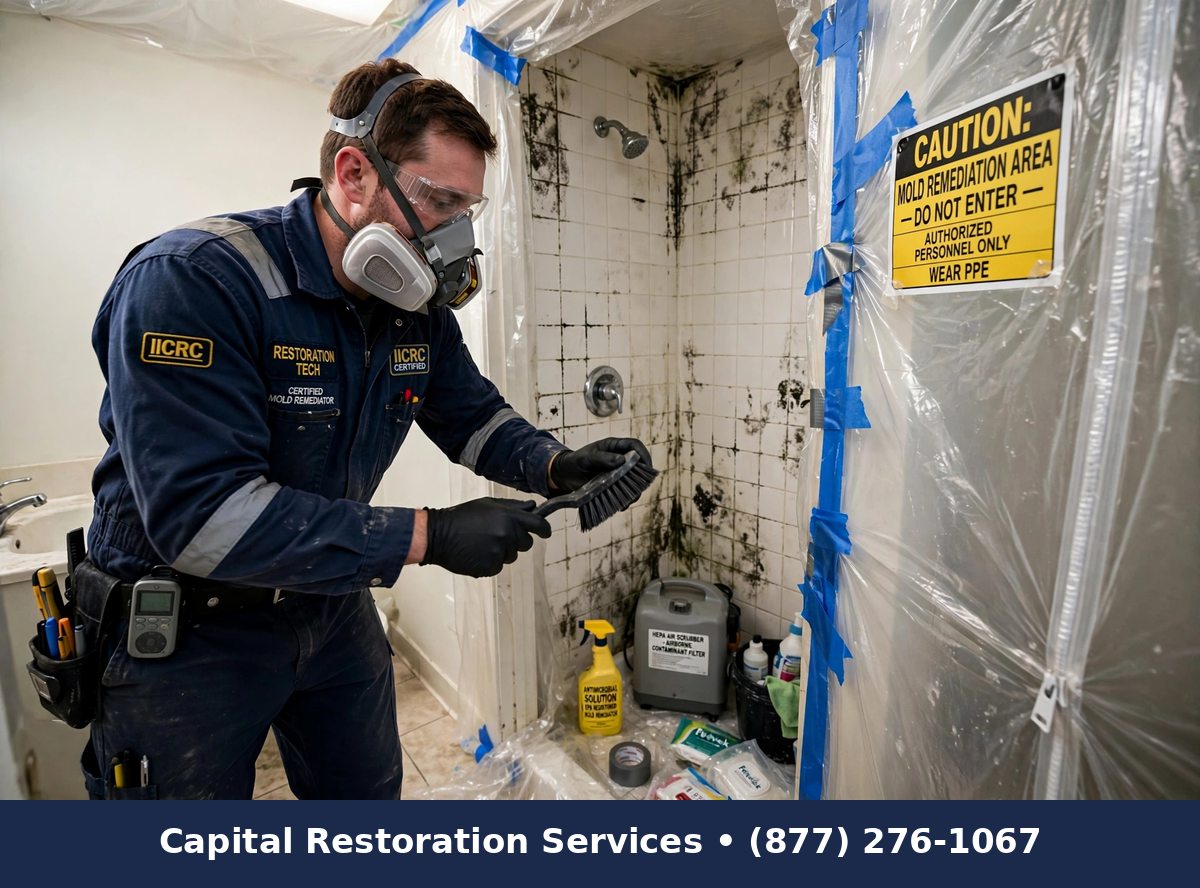
Tenants are entitled to real remediation, and landlords should insist on it — cosmetic fixes fail and create liability. The standard is the same as any professional job: fix the moisture source first, contain the work area under negative air, remove contaminated porous materials rather than painting over them, HEPA-vacuum and treat what stays, dry to standard, and verify with clearance checks.
A landlord who can produce that chain — complaint, inspection, scope, remediation record, clearance report — has the strongest possible position in any disagreement. Documentation isn't bureaucracy here; it's the asset.
Working around tenants and turnovers
Most rental remediation happens in occupied units, and it's designed for that: contained work zones, scheduled phases, clear communication about what to expect. For larger jobs, temporary relocation during the active work is sometimes the practical and humane answer — we help you plan for it.
The ideal window, though, is turnover. Between tenants there's full access, zero disruption, and the chance to inspect every unit after any water event — not just the ones someone complained about. Managers who build moisture checks into turnover catch problems when they're small and cheap.
Prevention beats remediation on every metric
For portfolio owners, the math is simple: working exhaust fans, prompt leak repair, and seasonal moisture checks prevent the overwhelming majority of rental mold claims. A small maintenance program costs a fraction of one disputed remediation — in money, in vacancy time, and in tenant trust.
We help managers set up exactly that: periodic inspections of high-risk areas, moisture baselines for each property, and a response protocol so the next report gets handled in hours, not weeks. Call (877) 276-1067 to talk about your portfolio.
Serving landlords and managers across the area
Capital Restoration Services works with individual landlords, property management companies, and portfolio owners — single units or dozens of doors. Whether it's an urgent tenant complaint, a turnover inspection, or a planned maintenance program, you get the same thing: fast response, honest source determination, proper remediation, and documentation that holds up. If mold has been reported in one of your units, call (877) 276-1067 today. The first week decides how this goes.
Features
- Rapid response scaled to severity across your portfolio
- Independent source determination — whose moisture, whose responsibility
- Contained remediation safe for occupied units
- Written scope of work and photo documentation
- Post-remediation clearance reporting
- Turnover inspections between tenants
- Direct coordination with property managers and owners
Benefits
- Fast response that limits vacancy time and tenant disruption
- Documentation that protects landlords and informs tenants
- Clear determination of the moisture source behind the growth
- Remediation done to standard — not a cosmetic cover-up
- Turnover-ready units between tenants, verified clean
- One contractor for your whole portfolio's mold issues
Frequently asked questions
Who is responsible for mold in a rental — landlord or tenant?
Generally, the party responsible for the moisture problem is responsible for the mold. Landlords typically own structural issues — roof leaks, plumbing failures, ventilation defects — while tenants own damage from misuse or neglect. The inspection's source determination is what settles it.
How should mold be reported in a rental?
In writing, immediately, with photos and dates. Written notice starts the clock and creates the record. Keep copies of everything. As the landlord or manager, respond in writing too — silence reads as indifference if the situation ever escalates.
Can you just paint over mold in a rental unit?
No. Painting over mold without removing it and fixing the moisture source is not remediation — it's a cover-up that fails within weeks and looks terrible in any dispute. Proper remediation removes contaminated materials and corrects the cause.
Can remediation happen while tenants are living there?
With proper notice and coordination, yes. We schedule around tenants, contain the work zone so the rest of the unit stays livable, and communicate the plan clearly. For larger jobs, temporary relocation during active remediation is sometimes the practical answer.
Should I remediate between tenants even if no one complained?
It's one of the smartest uses of the service. Between tenants is the ideal window — full access, no disruption, and a verified-clean unit with documentation for the next lease. Many managers build it into their turnover checklist after any water event.
What does rental mold remediation cost? Do you work with property managers?
It depends on the extent, the unit count, and access. Portfolio clients often get streamlined scheduling across properties. Call (877) 276-1067 and we'll discuss your properties and how we work with managers.