Mold Remediation for Schools and Daycares Near Me
Starting price: Call for pricing
Children's developing systems are more sensitive to mold exposure, which is why schools and daycares hold remediation to a higher standard. Capital Restoration Services remediates educational and childcare facilities on off-hours schedules, with contained work zones and verified clearance before any room reopens. Call (877) 276-1067 to discuss your building.
Children change the stakes
Schools get held to a higher standard for a simple reason: young lungs and still-developing immune systems react more strongly to what's in the air. In a classroom or daycare room, mold exposure lands harder — particularly for children with asthma or allergies. EPA guidance treats school indoor air quality as a priority for exactly this reason.
This doesn't mean panic. It means a higher standard: faster response, more rigorous containment, and verification before anyone declares the job done. Parents trust schools with their children's days; the building should earn that trust.
Where school mold hides
Schools are big, complex buildings with plenty of places for moisture to linger unnoticed. Roof leaks over classrooms, plumbing failures in restrooms and locker rooms, condensation from aging HVAC systems, damp janitor closets and kitchen areas, portable classrooms with envelope issues — the patterns repeat across districts.
Summer is the danger season. Buildings sit with reduced occupancy and less oversight while heat and humidity do their work, and the growth discovered in August started in June. That's why beginning-of-year inspections catch so many problems — and why a proactive moisture plan beats a reactive one every time.
How the work fits around school life
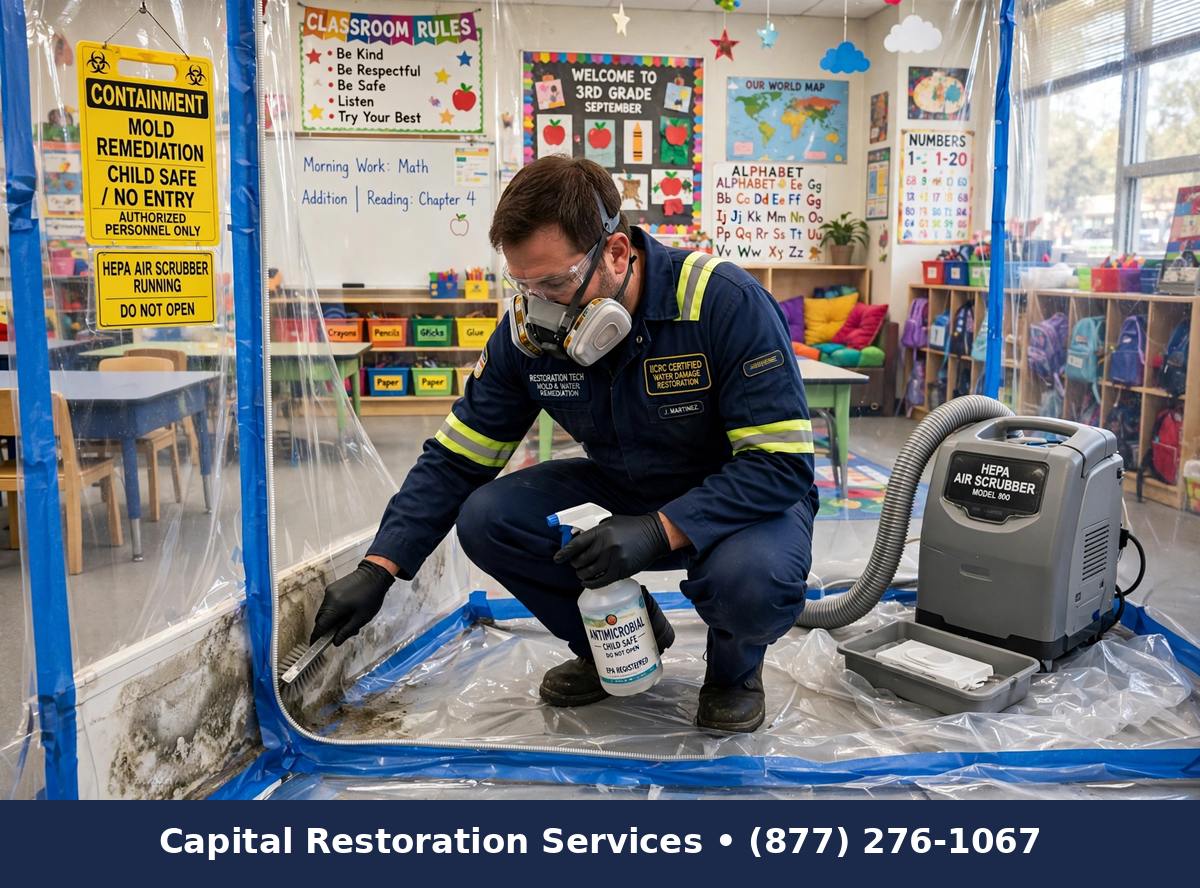
Active remediation happens on the building's schedule, not ours: nights, weekends, holidays, and summer breaks. When work must overlap with occupancy, containment does the heavy lifting — sealed zones under negative air pressure, HVAC vents in the work area sealed off, HEPA scrubbers running, and controlled access so students never enter an active work zone.
No room reopens on assumption. Clearance verification — visual inspection, moisture readings at target, and air or surface checks confirming the remediation worked — comes before barriers come down. That verification is also what administrators show parents: proof, not promises.
The EPA framework we follow
EPA's mold remediation guidance for schools and commercial buildings sets the professional standard: how to size containment to the extent of contamination, what worker protection each level requires, which materials get cleaned versus removed, and what "done" looks like. We work within that framework and document against it.
Just as important is the prevention side of the same guidance: keep indoor humidity in the 30 to 50 percent range, maintain HVAC equipment and drain pans, fix leaks promptly, and ventilate damp areas. Most school mold problems trace back to a maintenance gap, not a mystery.
Communicating with parents and staff
Mold in a school generates anxiety fast, and silence makes it worse. We equip administrators with plain-language summaries — what was found, where, what the plan is, and what verification showed afterward. Facts shared early prevent the rumor cycle that turns a contained maintenance issue into a crisis of confidence.
We're also straightforward about timelines. A single classroom with a contained issue is a short, scheduled job. A building-wide moisture problem discovered over summer break needs a phased plan. Either way, the school gets honest dates, not optimistic ones.
What affects the cost
The extent of contamination, the number of rooms involved, and schedule constraints are the main drivers — off-hours and break-period work carries different logistics than open-access jobs. Older buildings with deferred maintenance often need the moisture repairs alongside the remediation. Call (877) 276-1067 and we'll walk your building and build the plan around your calendar and budget process.
Serving schools and childcare facilities across the area
Capital Restoration Services remediates mold in K-12 schools, daycare centers, preschools, and after-school facilities — working with administrators, facility managers, and district staff. Whether it's a musty classroom, a summer-break discovery, or a proactive building assessment before the school year, you get the same standard: contained, verified, documented, and scheduled around the children. If something in your building doesn't smell right, call (877) 276-1067. The students can't choose their air; we can make sure it's clean.
Features
- Off-hours scheduling: nights, weekends, and school breaks
- Full containment with negative air and sealed HVAC zones
- Inspection and moisture mapping across the building
- EPA-aligned remediation protocols for educational facilities
- HEPA air scrubbing throughout active work
- Independent clearance verification before rooms reopen
- Administrator-ready reports for staff and parent communication
Benefits
- Protects children, who are more sensitive to airborne contaminants
- Work scheduled around classes — nights, weekends, and breaks
- Clear communication materials for administrators and parents
- Remediation following EPA school and commercial building guidance
- Documented clearance results administrators can show parents
- A healthier building that supports attendance and learning
Frequently asked questions
Why does mold in schools get special attention?
Because exposure lands harder on children. Kids spend hours a day in the same classrooms, and their bodies are still developing — so schools warrant a faster response and stricter verification than a typical building.
Can remediation happen while school is in session?
Yes — that's standard practice for educational facilities. We schedule active remediation for nights, weekends, holidays, and summer breaks, with contained zones sealed and under negative air whenever work overlaps with occupancy.
What standards apply to school mold remediation?
EPA publishes mold remediation guidance specifically for schools and commercial buildings, covering containment levels, worker protection, and cleanup standards by material type. We follow that guidance and document accordingly.
What protects students during the work?
Containment with negative air pressure, HEPA filtration, sealing of HVAC vents in the work zone, and clearance verification before barriers come down. No room reopens on assumption — only on verified results.
How do we communicate this to parents?
Transparency defuses concern. We provide administrators with plain-language summaries of the findings, the scope, and the verification results — material they can share with staff and parents. Rumors fill silence; facts don't need to.
What does school mold remediation cost?
Every building is different, so we price from a walkthrough — the affected areas, the moisture repairs needed alongside, and how the work fits your calendar. Call (877) 276-1067 and we'll assess your building.