Mold Remediation in Wall Cavities Near Me
Starting price: Call for pricing
Mold loves the dark, damp space behind your drywall, growing on studs, insulation, and the paper backing of wallboard after a leak or flood. Capital Restoration Services locates every wet cavity with moisture meters and infrared imaging, opens the wall under sealed containment, removes what can't be saved, and treats and dries the framing. If a wall smells musty or paint is bubbling for no clear reason, call (877) 276-1067 and we'll take a look inside.
What Mold Inside Wall Cavities Actually Is
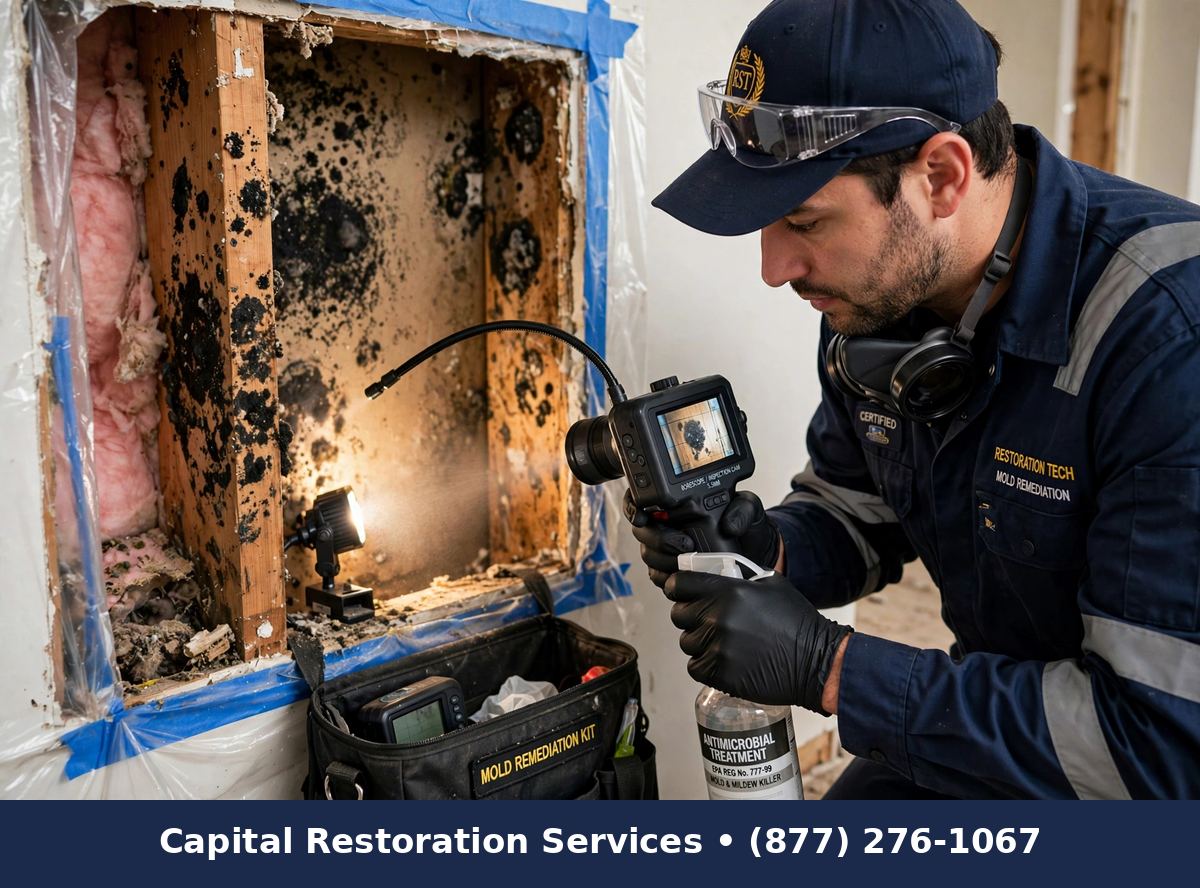
The space between your drywall and the exterior sheathing is a perfect hiding spot for mold. It's dark, it stays warm, and once water gets in from a plumbing leak, a roof drip, or a flood, the paper facing on drywall and the cellulose in wood framing give mold everything it needs to grow. You might see nothing on the room side for weeks while a colony spreads across several stud bays.
This service is for mold growing inside that hidden space. It covers opening affected walls, removing contaminated drywall and insulation, cleaning and treating the framing, and drying the cavity before it's closed. It does not cover surface mildew that wipes off a painted wall with a damp cloth, or mold inside the HVAC system itself — those are different jobs with different methods.
Signs Your Walls Are Hiding Mold
Most wall-cavity mold announces itself indirectly. Watch for these clues:
- A musty or earthy smell near a particular wall, especially after rain or on humid days
- Paint that bubbles, peels, or discolors in patches with no obvious cause
- Dark staining creeping up from baseboards or spreading across a ceiling corner
- Drywall that feels soft, warped, or cool to the touch in one area
- A recent leak, burst pipe, or flood anywhere near that wall
- Allergy or sinus symptoms that get worse indoors and ease up when you leave
One or two of these signs together is a strong reason to have the wall checked. Mold in cavities rarely stays in one stud bay, so early investigation keeps the repair area small.
How We Remediate a Wall Cavity, Step by Step
Every job begins with mapping, not cutting. We run pin and pinless moisture meters across the suspect wall and scan it with an infrared camera to see the full wet footprint, including bays that look fine from the outside. Small inspection holes or a borescope confirm what's growing before we commit to opening the wall.
Next we build containment. A mini chamber of 6-mil polyethylene sheeting goes up around the work area, sealed to the floor and ceiling, with a HEPA-filtered air scrubber pulling negative pressure. This keeps spores released during demolition from drifting into clean rooms. Vents and returns in the zone get sealed too.
Then the wall comes open. Contaminated drywall is cut out, usually a foot or two past the visible damage line, and wet insulation is pulled and bagged. Everything leaves the house in sealed bags the same day. Studs, plates, and sheathing get HEPA-vacuumed, then wire-brushed or sanded where growth is embedded in the wood. Porous drywall and insulation are never "treated and left" — if they're contaminated, they're removed.
After the cavity is clean, we apply an EPA-registered antimicrobial to the framing and cavity interior as a finishing step, never as a substitute for removal. Then drying equipment runs until moisture readings hit verified targets in wood and remaining materials. Only then does new insulation and drywall go back in, and we hand you the readings and photos.
What Affects the Cost of Wall Cavity Work
Cost follows scope, access, and materials. A single ground-floor cavity behind drywall is a far smaller job than mold running through multiple bays on a second floor or behind tile in a bathroom. Plaster walls take more labor to open and patch than standard drywall.
The type of insulation matters too — wet fiberglass batts pull out fast, while saturated blown-in or spray foam in a tight cavity takes longer to clear. If the moisture source still needs fixing, like a leaking supply line or failed flashing, that repair is part of the honest scope. Emergency calls with containment running overnight also cost more than scheduled daytime work. Call (877) 276-1067 for a written quote after we map the wall — every number is based on your actual layout, never a guess.
Homes and Buildings We Serve in the Area
Capital Restoration Services handles wall-cavity mold in single-family homes, townhouses, condos, and apartment buildings, as well as offices and retail spaces with interior partition walls. Older homes with plaster walls and newer builds with tight insulation both show up in our work, and each gets the same careful mapping before anything is opened. Property managers dealing with a tenant complaint about a musty wall can get documentation that holds up. Wherever the damp wall is in the area, we'll find out what's behind it and fix it properly.
Features
- Pin and pinless moisture meters plus infrared cameras to map wet cavities before any drywall is cut
- Mini containment chambers built around each opened wall so spores never reach clean rooms
- Selective removal of mold-damaged drywall, insulation, baseboards, and trim
- HEPA vacuuming of studs, sill plates, and sheathing to capture fine spore dust
- Wire-brushing or sanding of framing where growth is embedded in the wood surface
- EPA-registered antimicrobial treatment applied to cleaned framing and cavity interiors
- Moisture readings logged and verified at dry targets before the wall is closed back up
Benefits
- Finds mold you can't see, instead of only treating the stains on the surface
- Keeps the rest of your home clean and livable while walls are opened
- Removes the water-damaged material that feeds regrowth, not just the visible colony
- Leaves framing documented-dry and ready for safe rebuilding
- Lowers the odds of the same wall growing mold again next season
- Written findings and photos you can keep for your records or share with your insurer
- One crew handles detection, removal, treatment, and drying from first visit to close-up
Frequently asked questions
Can you tell if there's mold inside my walls without tearing them open?
Usually, yes. Moisture meters and infrared cameras show us where water is hiding behind the surface, and a small borescope hole can confirm growth visually. We only open walls where the evidence points, so exploratory demolition stays minimal.
Do you have to remove all the drywall, or can you just treat the mold?
Mold-damaged drywall and insulation must be removed — the paper facing is mold food, and no spray reaches deep enough to fix it. Framing and other solid wood, though, can usually be cleaned, treated, and kept.
Is mold inside wall cavities dangerous for my family?
It can affect indoor air quality, since spores and musty-smelling microbial compounds drift out through outlets, gaps, and the HVAC system. People with allergies, asthma, or weakened immune systems tend to notice it first. Removing the source is the reliable fix.
How long does wall cavity remediation take?
A single affected wall often takes two to four days including drying time. Jobs spanning several rooms or involving a still-active leak take longer, and we'll give you a realistic timeline after the initial mapping.
How much does it cost to fix mold inside walls?
It depends on how many wall sections are affected, what the wall is made of, how the cavity is insulated, and whether the water source needs repair. After we map the damage, call (877) 276-1067 and we'll put the full scope in writing so you know exactly what you're paying for.