Odor-Sealing Primer Application After Fire Near Me
Starting price: Call for pricing
After a fire, smoke odor soaks into framing, subfloor, and sheathing — and plain paint just lets it bleed back through. Capital Restoration Services applies professional odor-sealing primers, including shellac-based sealers, to lock smoke odor and staining inside cleaned structural surfaces for good. When your fire-damaged home is clean but still smells, call (877) 276-1067.
Why Sealing Is Part of Real Fire Restoration
Here's a hard truth about fire restoration: you can clean a stud until it looks perfect, and it can still smell like smoke when summer humidity hits. Wood is porous. Smoke drives deep into framing, subfloor, and roof sheathing during a fire, and surface cleaning — even excellent surface cleaning — can't pull every odor molecule back out of those pores.
That's where odor-sealing primers come in. These aren't regular primers. Shellac-based sealers like the industry-standard B-I-N type products form an impermeable film that traps residual odor and staining inside the wood permanently. Applied after proper cleaning, sealing is the step that makes the difference between a home that smells fine in winter and one that smells fine all year.
What Gets Sealed — and What Doesn't
Sealing is for cleaned structural surfaces that will be hidden behind new finishes:
- Wall and ceiling framing — studs, plates, joists, and rafters
- Subfloor and roof sheathing with smoke penetration
- The backs and tops of framing members, not just the visible faces
- Masonry and concrete with absorbed smoke odor, using appropriate sealers
- Attic decking and rafters after a roof or attic fire
What doesn't get sealed: surfaces that haven't been properly cleaned first — sealer over soot just locks the problem in with the dirt. And finished living surfaces get regular paint after sealing, never sealer as the final coat. There's a well-known cautionary tale in the trade about a house that smelled every time it rained because the tops of the rafters were never sealed. We seal the parts nobody sees, because those are the parts that cause comebacks.
How Professional Sealer Application Works
Preparation is most of the job. Every surface gets HEPA-vacuumed and cleaned to remove loose soot and residue first. Sealer applied over dirty wood doesn't bond properly and doesn't perform. We also verify the structure is dry — sealing wet wood traps moisture and creates a new problem.
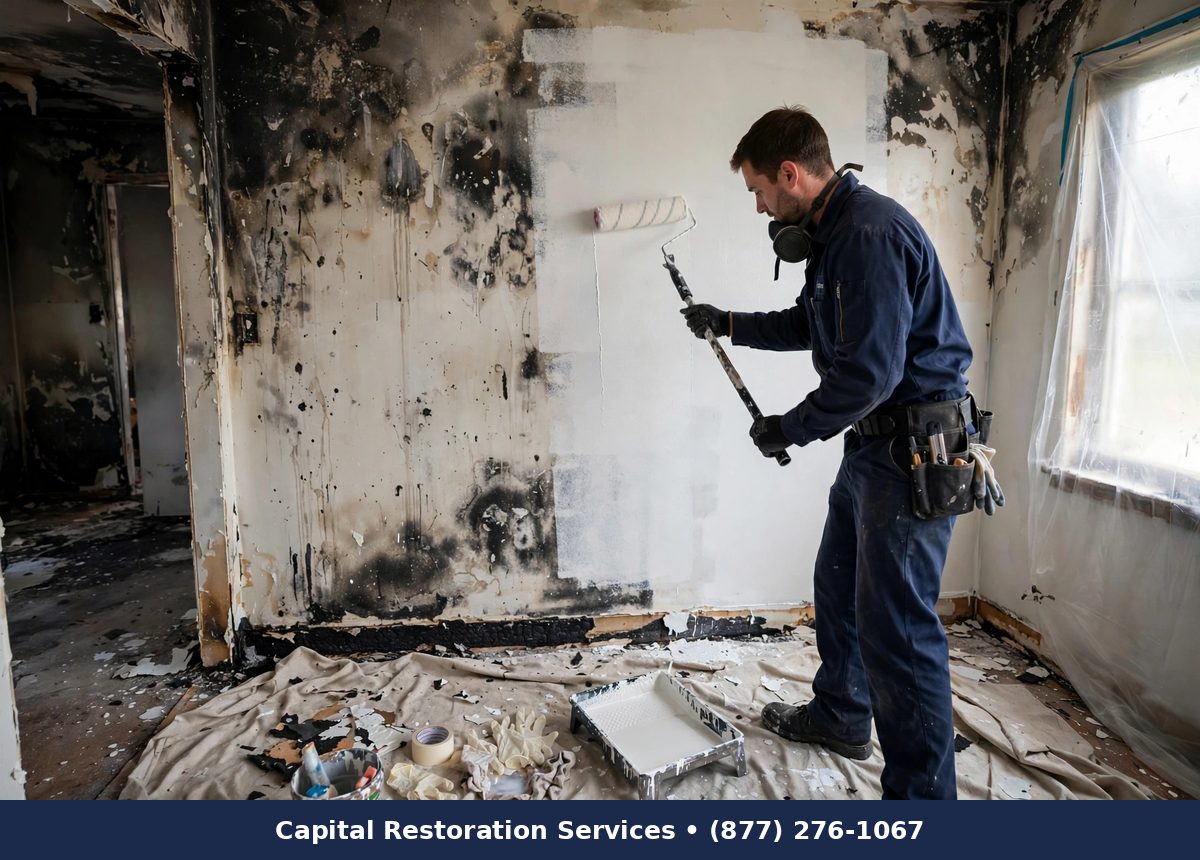
Then we apply the right sealer for each surface. Shellac-based primers go on smoke-penetrated framing; they're the gold standard for odor blocking because shellac forms a hard, impermeable barrier that odor molecules can't migrate through. Where the wood's appearance must be preserved, clear de-waxed shellac does the same job invisibly. Application is by brush, roller, or spray depending on the surface, with full coverage on all faces of each member — tops, ends, and backs included.
Because shellac-based products are solvent-based, we ventilate the space properly and follow all safety practices during application. Once cured, the sealed structure is ready for insulation, drywall, and finishes — and the odor stays locked away permanently.
What Affects the Cost of Odor Sealing
The main factor is surface area: how many linear feet of framing, how much subfloor and sheathing needs coating. An attic-only job is very different from sealing the entire structural shell of a fire-damaged home. The condition of the surfaces matters too — heavily textured char-adjacent wood takes more product and more labor than lightly affected framing.
Product choice plays a role: shellac-based sealers cost more than standard primers, but they're specified because they work where standard primers fail. Access is another factor — sealing a tall attic or a tight crawlspace is slower work than an open framed room. For an exact figure on your structure, call (877) 276-1067 and we'll assess the framing and put it in writing.
Fire Restoration Support Across the Area
Capital Restoration Services provides odor-sealing primer application as part of fire restoration projects in homes, apartments, and commercial buildings throughout the area. We work as part of the full restoration sequence — after cleaning and drying, before insulation and drywall — and we coordinate with your general contractor or our own rebuild team so the timing is right. Whether it's a kitchen fire that affected one wall or a whole-house fire that touched every stud, the sealing gets the same thorough, all-faces coverage. Clean structure deserves a permanent seal, and that's what we deliver.
Features
- Thorough cleaning and HEPA vacuuming of every surface before any sealer is applied
- Shellac-based odor-blocking primers for the toughest smoke penetration in framing
- Clear de-waxed shellac sealers where the natural wood look must be preserved
- Full coverage of joists, studs, rafters, and subfloor — including tops and hidden faces
- Stain-blocking application that stops soot and smoke stains from bleeding through paint
- Proper ventilation and safety practices during application of solvent-based sealers
- Coordination with your rebuild so sealing happens in the right sequence, before finishes
Benefits
- Locks smoke odor inside the structure instead of letting it return with humidity
- Stops yellow-brown smoke stains from bleeding through fresh paint months later
- Protects the investment you're making in new drywall, paint, and finishes
- Reaches the porous wood surfaces that cleaning alone can't fully deodorize
- Gives the rebuilt home a genuinely fresh beginning, not a covered-up smell
- Done once and done right — no repeat applications needed
- Documented step your insurer recognizes as part of proper fire restoration
Frequently asked questions
Can't I just paint over the smoke smell with regular paint?
No — regular paint is permeable, and smoke odor molecules migrate right through it. Within months, often when humidity rises, the smell comes back and yellow-brown stains bleed through. Odor-sealing shellac primers create an impermeable barrier that regular paint can't.
Do you seal before or after the cleaning?
Always after. Sealer goes on only after surfaces are HEPA-vacuumed, cleaned, and verified dry. Sealing over soot or moisture locks contaminants in and causes failures — proper sequencing is what makes the seal permanent.
Will the sealer change how my wood looks?
White-pigmented shellac primers cover the wood completely, which is fine for framing that will be hidden behind drywall. Where appearance matters, we use clear de-waxed shellac sealers that block odor without changing the wood's look.
Is the sealing step really necessary, or is it optional?
For light, surface-level smoke, thorough cleaning may be enough. But when smoke has penetrated porous framing — which is most structure fires — sealing is what prevents the odor from returning. We'll tell you honestly which category your job falls into.
How much does odor-sealing primer application cost?
It depends on how much structural surface needs sealing, the condition of the wood, product requirements, and access. After we inspect the framing, call (877) 276-1067 for a written quote specific to your home.