Post-Remediation Mold Verification Testing Near Me
Starting price: Call for pricing
How do you know the mold job is actually done? Post-remediation verification — independent testing after cleanup — is the answer the IICRC S520 standard calls for. Capital Restoration Services performs thorough verification inspections with visual assessment, moisture readings, and air and surface sampling analyzed by an accredited lab. For proof your remediation succeeded, call (877) 276-1067.
What Post-Remediation Verification Is
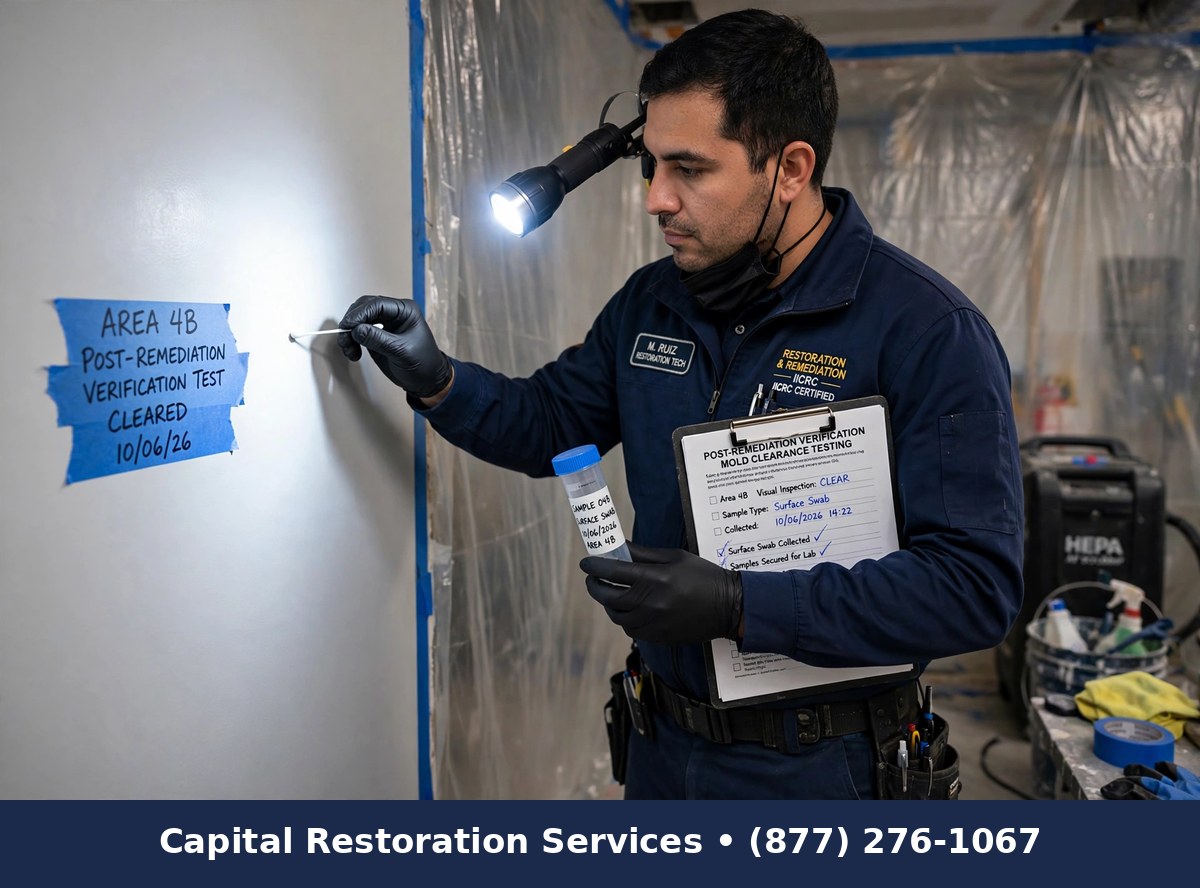
Post-remediation verification, often called PRV or clearance testing, is the final exam for a mold job. After remediation is complete but before containment is taken down, an independent professional inspects the work area, takes moisture readings, and collects air and surface samples. Those samples go to an accredited lab, which reports whether the space has returned to normal fungal ecology.
The IICRC S520 standard — the industry's rulebook for mold remediation — treats verification as a standard final step, not an optional add-on. And the current edition makes an important point explicit: a true verification is done by an independent third party, not by the company that performed the remediation. The logic is simple — nobody should grade their own work when there's money riding on the result.
What Gets Checked During Verification
A proper verification covers four things:
- Visual inspection. Every remediated surface is examined for any remaining visible mold, dust, or debris. The S520 standard calls the passing grade "Condition 1" — surfaces visibly clean with no dust, dirt, or mold growth.
- Moisture assessment. Meters confirm that materials are dry and, critically, that the water source behind the mold has actually been fixed. Remediation without moisture correction is remediation that will fail.
- Air sampling. Samples collected inside the work area are compared against an outdoor control sample. Indoor counts should be at or below outdoor levels, with a similar mix of mold types — that's what "normal fungal ecology" means in practice.
- Surface sampling. Tape lifts or swabs check specific surfaces where the visual inspection raised questions, confirming no residual contamination remains.
If any check fails, the area goes back for additional cleaning or drying, and then it's tested again. That's not a disaster — it's the system working exactly as designed.
How the Verification Process Works
Timing matters: verification happens after remediation is finished and the space has had time to settle, but while containment is still up. Testing inside intact containment gives the most honest reading of what the work area's air actually looks like.
We begin with the visual and moisture inspection, documenting everything with photos and readings. Then we collect air samples using calibrated pumps and cassettes, plus an outdoor control sample for comparison. Surface samples come from any spots that warrant a closer look. Everything is sealed, labeled with chain-of-custody documentation, and sent to an independent AIHA-accredited laboratory.
When lab results come back, we compile the full verification report: what was inspected, the moisture data, the lab findings compared against the outdoor baseline, photos, and a clear pass-or-fail conclusion. You get a document that means something — to you, to a buyer, to a tenant, or to an insurance adjuster.
What Affects the Cost of Verification Testing
The size and complexity of the remediated area is the main factor — a single bathroom needs fewer samples than a whole-house remediation. The number of air and surface samples required follows the scope of the original job and the layout of the containment zones.
Lab analysis fees are part of every verification, since accredited lab work is what makes the results credible. If the first round doesn't pass and re-testing is needed after additional cleaning, that adds a second round. Some clients also want pre-remediation baseline sampling for comparison, which is a separate scope. For a quote on your project, call (877) 276-1067 and tell us about the remediation that was done.
Verification Services Across the Area
Capital Restoration Services provides post-remediation verification for homeowners, landlords, property managers, and real estate transactions throughout the area. We verify our own remediation work through independent lab analysis, and we also serve as the independent check on remediation performed by others — because the standard is clear that the tester and the remediator should be separate. Whether you need clearance documentation for an insurance claim, a property sale, or simply your own peace of mind, we'll give you an honest, data-backed answer about the condition of your space.
Features
- Detailed visual inspection of all remediated areas under the S520 Condition 1 standard
- Moisture meter readings confirming materials are dry and the water source is fixed
- Air sampling inside the work area compared against an outdoor control sample
- Surface sampling where visual clues suggest residual contamination
- Samples analyzed by an independent AIHA-accredited laboratory, not in-house
- Written verification report with findings, lab results, and photos
- Clear pass-or-fail criteria explained in plain language before testing begins
Benefits
- Proves the remediation worked instead of asking you to take someone's word for it
- Catches missed spots or remaining moisture before containment comes down
- Gives you lab-backed documentation for insurance claims and property records
- Protects buyers, tenants, and occupants with verified clean conditions
- Confirms the moisture source was fixed, not just the visible mold
- Provides peace of mind backed by data, not just a visual once-over
- Independent process with no incentive to grade anyone's work favorably
Frequently asked questions
Should the same company that did the remediation do the verification testing?
No — and the IICRC S520 standard says so explicitly. The company that profits from finishing the job has an incentive to declare its own work acceptable. Independent verification by a separate party is the only unbiased way to confirm the work.
What happens if the verification doesn't pass?
The report identifies exactly what failed — a missed spot, remaining moisture, elevated spore counts — and the area goes back for additional cleaning or drying. Then it's re-tested. A failed first round isn't a catastrophe; it's the verification process doing its job.
How long does verification take?
The on-site inspection and sampling usually takes a few hours depending on the size of the area. Lab analysis typically adds a few business days, though rush analysis is often available. We'll give you a timeline when we schedule.
Do I really need lab testing, or is a visual check enough?
A visual check is necessary but not sufficient — it can't see airborne spore levels or confirm the microbial mix matches normal conditions. Lab-analyzed air samples compared against an outdoor control are what make verification meaningful, especially for insurance or real estate purposes.
How much does post-remediation verification cost?
It depends on the size of the remediated area, how many samples are needed, lab fees, and whether re-testing is required. Call (877) 276-1067 with the details of your remediation project for a written quote.