Roof Fire Damage Repair Near Me
Starting price: Call for pricing
A fire doesn't have to burn through your roof to ruin it — heat, smoke, and firefighting water can compromise shingles, sheathing, trusses, and flashing. Capital Restoration Services inspects the full roof assembly after fire damage, repairs or replaces what's compromised, and restores a weather-tight roof that meets code. If your roof took heat or smoke in a fire, call (877) 276-1067 for a thorough assessment.
Why Fire-Damaged Roofs Need a Specialist's Eye
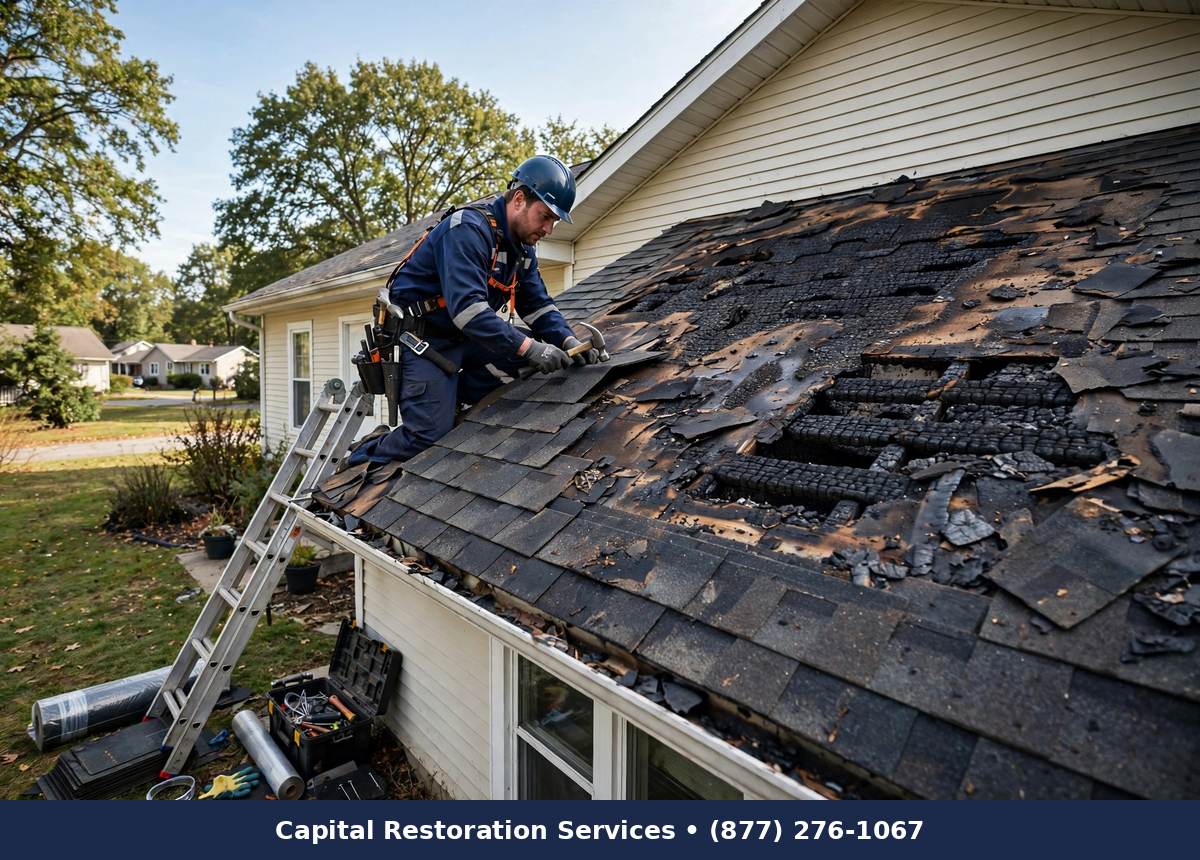
Most people picture roof fire damage as a burned hole. In practice, the damage is often subtler and wider: shingles blistered by radiant heat well beyond the flame area, underlayment dried and cracked, plywood sheathing delaminated by hose water, and trusses weakened by heat they absorbed without ever catching fire. A roof can look intact from the street and still be compromised.
This service covers assessment and repair of roof systems affected by fire — the roofing surface, underlayment, decking, structural framing, flashing, and vents. It covers both direct flame damage and the secondary damage from heat, smoke, and firefighting water. What it doesn't cover is a roof that's simply old: if the fire didn't touch it, that's a roofing contractor's replacement job, not fire repair.
What a Serious Post-Fire Roof Inspection Covers
A proper inspection treats the roof as a layered assembly and checks every layer:
- Roofing surface. Shingles, tile, or membrane checked for blistering, melting, brittleness, and loss of granules from heat exposure
- Underlayment. Felt or synthetic underlayment examined for heat damage that would let future leaks through
- Decking and sheathing. Plywood or OSB panels checked for char, delamination, and water saturation from firefighting
- Trusses and rafters. Structural members inspected for char depth, twisting, cracking, and connection damage
- Flashing, vents, and penetrations. Metal flashing, pipe boots, and vents checked for warped seals and compromised fasteners
- Attic side. The underside of the decking inspected for smoke staining, moisture, and heat effects invisible from above
This is where the repair-versus-replacement decision gets grounded. Localized damage to the surface layers usually means repair. Widespread heat effects, compromised trusses, or a roof already near the end of its service life usually point toward replacement.
How Roof Fire Repair Proceeds
Safety and stabilization come first. If the fire left openings, emergency tarping goes on immediately to keep weather out while the full assessment happens. Nobody walks a fire-weakened roof without knowing what's sound — the inspection often begins from the attic side and with binoculars or a drone before anyone sets foot up there.
Then the damaged layers come off in order: compromised roofing material, failed underlayment, and delaminated or charred sheathing. Structural members that are sound get cleaned of soot and smoke residue; members with char beyond what can be safely cleaned are repaired or replaced — and because roof trusses are engineered systems, significant truss damage gets evaluated with a structural engineer's input, not just a contractor's judgment call.
New sheathing, underlayment, and roofing go on to current code, with flashing and penetrations redone properly. Throughout, we photograph everything: the damage found, the layers removed, and the finished assembly. That documentation is what your adjuster needs to see.
What Affects the Cost of Roof Fire Repair
The extent of structural involvement is the biggest factor. Surface-layer repairs are one scale of job; truss replacement with engineering involvement is a completely different one. Roof size, pitch, and material matter too — tile and steep-slope roofs cost more to work on than simple asphalt shingle roofs.
The roof's age and condition before the fire play a real role. Repairing fire damage on a roof with years of life left is straightforward; when the roof was already near replacement age, the honest recommendation often shifts toward full replacement, which changes the number significantly. Permits, code upgrades, and how much interior work depends on the roof being weather-tight round out the picture. For an exact figure, call (877) 276-1067 after our inspection.
Roof Fire Repair Across the Area
Capital Restoration Services repairs fire-damaged roofs on homes, apartment buildings, and commercial properties throughout the area. We handle the full sequence from emergency tarping through final roofing, and we coordinate with the interior restoration happening below so one trade never undoes another's work. Whether the fire scorched one slope or the heat affected the whole assembly, you'll get an honest assessment of what must be repaired, what should be replaced, and what can stay. Your roof is the shield over everything else we're rebuilding — we make sure it's sound.
Features
- Full-assembly roof inspection: shingles or membrane, underlayment, decking, and flashing
- Structural check of trusses, rafters, and ridge beams for char, warping, or weakened members
- Smoke and soot cleaning of salvageable roof components before repair decisions
- Sheathing and decking replacement where fire or hose water compromised the panels
- Flashing, vent, and penetration resealing to restore weather-tight details
- Coordination with a structural engineer when truss damage needs professional evaluation
- Final documentation with photos for your insurance claim and your records
Benefits
- Treats the roof as a complete system, not just the visibly burned patch
- Catches hidden heat damage in trusses that a ground-level look would miss
- Restores true weather-tightness so the next rain doesn't become a second disaster
- Removes smoke odor trapped in attic sheathing and decking
- Brings repaired sections up to current code requirements
- Protects the interior rebuild happening underneath from water intrusion
- Clear repair-versus-replace reasoning you can show your adjuster
Frequently asked questions
My roof looks fine from the ground after the fire. Could it still be damaged?
Yes. Radiant heat can blister shingles, ruin underlayment, and weaken trusses without leaving visible char. Hose water can delaminate sheathing from underneath. A proper inspection checks every layer, not just what you can see from the driveway.
When does a fire-damaged roof need an engineer involved?
When trusses or major structural members show char, warping, or connection damage. Roof trusses are engineered systems — their load capacity after heat exposure isn't something to eyeball. An engineer specifies the repair so it's genuinely sound.
Can smoke-damaged roof sheathing be cleaned, or must it be replaced?
Sheathing with surface smoke staining can often be cleaned and sealed. Sheathing that's charred, delaminated, or water-saturated from firefighting needs replacement. We test and document each section rather than guessing.
Will my insurance cover the roof repair?
Fire damage to the roof is typically part of the fire claim, including the tarping, assessment, and repair. Where the roof was already worn, the adjuster may separate pre-existing wear from fire damage — our photo documentation helps draw that line accurately.
How much does roof fire damage repair cost?
It varies enormously: surface-layer repairs are modest, while structural truss work with engineering runs much higher. Roof size, pitch, material, and the roof's pre-fire condition all factor in. Call (877) 276-1067 for an inspection and a written estimate.