Sanitization and Disinfection After Water Damage Near Me
Starting price: Call for pricing
Water damage isn't just wet — it's dirty. Floodwater, backups, and long-standing leaks leave bacteria and microbial contamination on every surface they touch. Capital Restoration Services sanitizes and disinfects after water damage using the IICRC S500 two-stage method: thorough cleaning first, then EPA-registered disinfectants. When your water loss needs more than drying, call (877) 276-1067.
Drying Is Only Half the Job
A lot of water damage work stops at dry. The structure hits its moisture targets, the equipment leaves, and everyone moves on. But water — especially anything beyond clean supply-line water — carries bacteria, organic matter, and microbial contamination that doesn't evaporate with the moisture. Dry isn't the same as clean.
This service is the cleaning and disinfection phase of water damage restoration. It covers the decontamination of structural surfaces, cavities, and salvageable materials after water exposure: thorough cleaning followed by EPA-registered disinfectants or antimicrobials. It's the step that makes a water-damaged structure sanitary again, not just dry.
Clean First, Then Disinfect: Why the Order Matters
The IICRC S500 standard — the water damage industry's rulebook — is explicit about this: decontamination is a two-stage process. Detergent cleaning comes first to remove the bioburden — the dirt, organic matter, and microorganisms themselves, plus the food source they'd feed on. Only then does the EPA-registered disinfectant or antimicrobial go on.
Skipping straight to disinfectant is one of the most common shortcuts in the business, and it doesn't work the way people hope. Disinfectants can't reliably do their job through layers of grime and organic matter. The cleaning step isn't optional prep — it's half the decontamination. Any company that fogs or sprays without cleaning first is selling theater, not sanitation.
How the Water Category Shapes the Work
Not all water is equally dirty, and the S500 standard classifies it so the response matches the risk:
- Category 1 — clean water. Supply line breaks and appliance supply failures. Sanitization focuses on preventing microbial growth during drying, with antimicrobial treatment as a safeguard.
- Category 2 — gray water. Washing machine overflows, dishwasher discharges, aquarium water. Contains significant contamination; affected porous materials often must be removed, and remaining surfaces get full cleaning plus disinfection.
- Category 3 — black water. Sewage backups, rising floodwater, and any water that's contacted soil. Grossly contaminated. Porous materials that contacted it are removed and discarded, not cleaned; every remaining structural surface gets the full two-stage decontamination with appropriate PPE and containment throughout.
One more thing the standard recognizes: time changes the category. Clean water left sitting long enough degrades as microbial growth takes hold. That's another reason fast response matters — today's Category 1 becomes tomorrow's bigger problem.
What the Work Looks Like in Practice
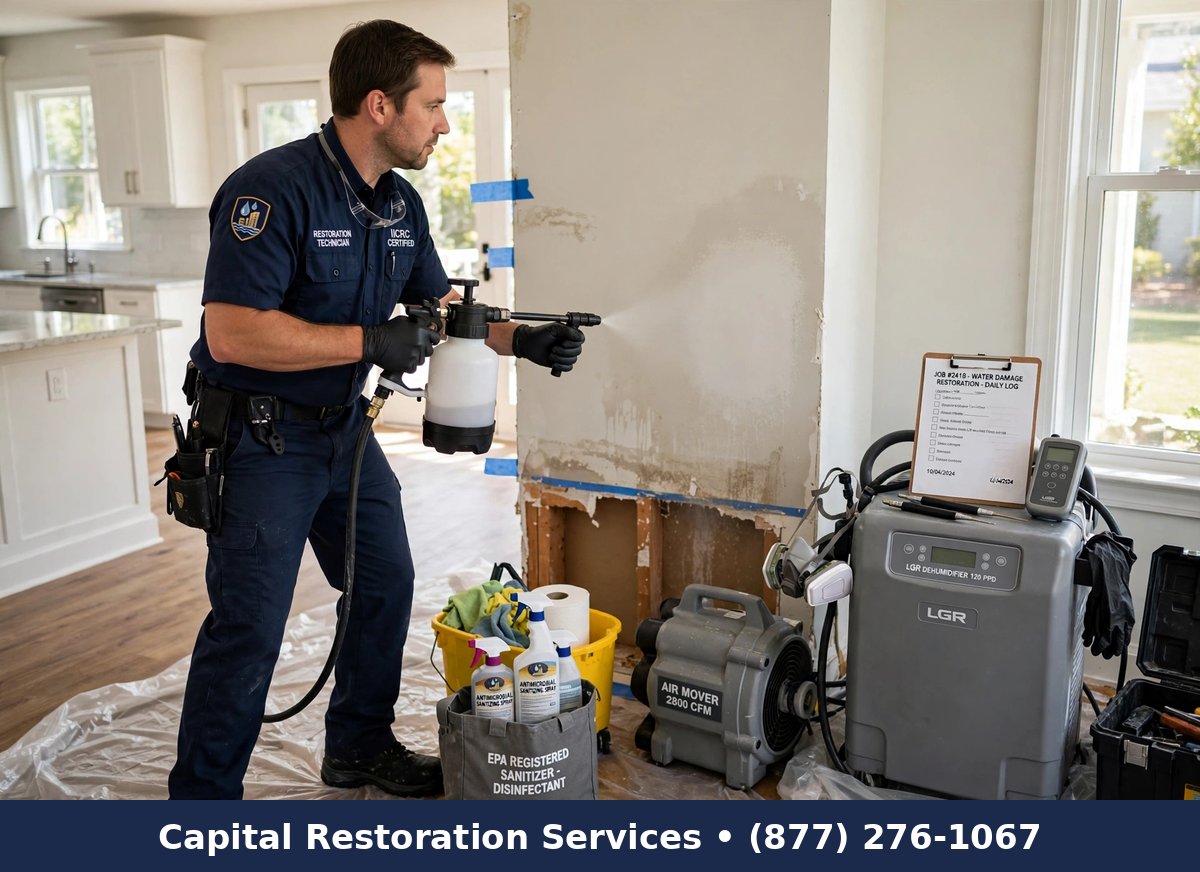
After extraction and any necessary material removal, exposed structural surfaces — framing, subfloor, concrete — get HEPA-vacuumed to remove loose contamination without spreading it. Then comes detergent cleaning: scrubbing and wiping with appropriate cleaners, working from cleaner areas toward more contaminated ones so nothing gets dragged backward.
The EPA-registered disinfectant or antimicrobial follows, applied at proper dwell times — the product needs to stay wet on the surface long enough to work, which is a detail shortcut-takers skip. Wall cavities, the backs of remaining materials, and hidden spaces get treated, not just the visible faces. Throughout Category 2 and 3 work, technicians wear full PPE and the area stays contained. We document every product used and every area treated, because your adjuster and your own records deserve the specifics.
What Affects the Cost of Sanitization and Disinfection
The water category is the primary driver — Category 1 precautionary treatment is a smaller scope than full Category 3 decontamination with containment and PPE. Affected area matters too: sanitizing one room's framing is very different from treating a whole flooded basement's structure.
The condition of the surfaces plays a role. Smooth concrete cleans faster than rough-sawn lumber or intricate framing with lots of surface area. If significant material removal is needed before disinfection can happen, that's part of the overall scope. Emergency scheduling and the products required for the specific contamination round it out. For an exact quote on your water loss, call (877) 276-1067.
Sanitization Services Across the Area
Capital Restoration Services provides sanitization and disinfection after water damage for homes, apartments, rental properties, and commercial buildings throughout the area. We handle it as part of complete water restoration — extraction, drying, decontamination, and rebuild — and we follow the S500 two-stage method on every job, regardless of category. Clean water losses get proper precautionary treatment; sewage and flood losses get the full protocol. When the water's gone but the job isn't done, we make the structure genuinely clean.
Features
- IICRC S500 two-stage protocol: detergent cleaning to remove contaminants, then disinfection
- EPA-registered disinfectants and antimicrobials matched to the water category
- Category-based approach — clean water, gray water, and sewage each get the right procedure
- HEPA vacuuming of surfaces before wet cleaning to remove loose contamination
- Detailed cleaning of framing, subfloor, concrete, and other structural surfaces
- Antimicrobial treatment of wall cavities and hidden spaces after material removal
- Documentation of products used and areas treated for your records and insurer
Benefits
- Removes the bacteria and contaminants drying alone leaves behind
- Follows the industry standard your insurance adjuster expects to see
- Matches the disinfection level to the actual contamination — no overkill, no shortcuts
- Makes salvaged structural materials genuinely safe to build back over
- Reduces the microbial load that causes lingering odors after water jobs
- Protects your family from exposure during and after the restoration
- Written record of exactly what was cleaned, with what, and where
Frequently asked questions
Isn't drying enough? Why do I need disinfection too?
Drying removes moisture, but it doesn't remove bacteria, organic matter, or microbial contamination the water left behind — especially with gray or black water. Sanitization is what makes the structure hygienic again, not just dry.
What's the difference between cleaning and disinfecting?
Cleaning with detergents physically removes dirt, contaminants, and the organic matter microbes feed on. Disinfecting with EPA-registered products then kills remaining microorganisms on the cleaned surface. The IICRC S500 standard requires both, in that order.
Are the disinfectants you use safe for my family and pets?
We use EPA-registered products applied according to their labels, with proper dwell times and ventilation. Treated areas are safe for re-entry once dry and ventilated, and we'll tell you exactly when that is for your job.
My water looked clean. Do I still need this?
If it was truly clean supply-line water addressed quickly, precautionary antimicrobial treatment during drying is usually sufficient. But water that sat for days, came from an appliance drain, or contacted soil or sewage needs the full protocol — and we'll tell you honestly which one applies.
How much does sanitization after water damage cost?
It depends on the water category, the size of the affected area, surface conditions, and whether material removal comes first. Call (877) 276-1067 and we'll assess your water loss and give you a written quote.