Sewage Backup Cleanup Near Me
Starting price: Call for pricing
A sewage backup is the most hazardous kind of water damage — Category 3 black water carrying bacteria, viruses, and contaminants no homeowner should handle alone. Capital Restoration Services responds with full protective gear, containment, extraction, removal of contaminated materials, and EPA-registered disinfection per IICRC S500. If sewage is backing up into your home, keep everyone away and call (877) 276-1067 now.
Why Sewage Is Different From Every Other Water Loss
All water damage is urgent. Sewage is urgent and dangerous. Under the IICRC S500 standard, sewage is Category 3 — black water — defined as grossly contaminated water that can carry pathogens, toxins, and other harmful agents. It's the highest contamination class, and it changes every rule about what gets cleaned versus what gets thrown away.
This service covers the complete professional response to a sewage backup: emergency containment, extraction, removal of contaminated porous materials, two-stage decontamination of the remaining structure, structural drying, and verification. It does not cover fixing the plumbing cause — the blocked line, failed pump, or broken pipe needs a plumber, and we coordinate with yours or help you find one.
What You Should Do Right Now
If sewage is actively backing up:
- Keep people and pets out of the area. No exceptions, especially children and anyone with health vulnerabilities
- Stop using water in the house. Every flush, shower, and laundry load can add to the backup
- Shut off the HVAC if the air handler or returns are near the affected area, so the system doesn't carry contaminants through the house
- Don't run fans on the sewage — airflow spreads bacteria to clean areas
- Photograph everything before anything is moved, for your insurance claim
- Don't try to clean it yourself. Mopping or shop-vacuuming sewage exposes you to pathogens and usually spreads contamination further
Then call (877) 276-1067. The single most useful thing you can do in a sewage backup is get professionals on site quickly.
How Professional Sewage Cleanup Works
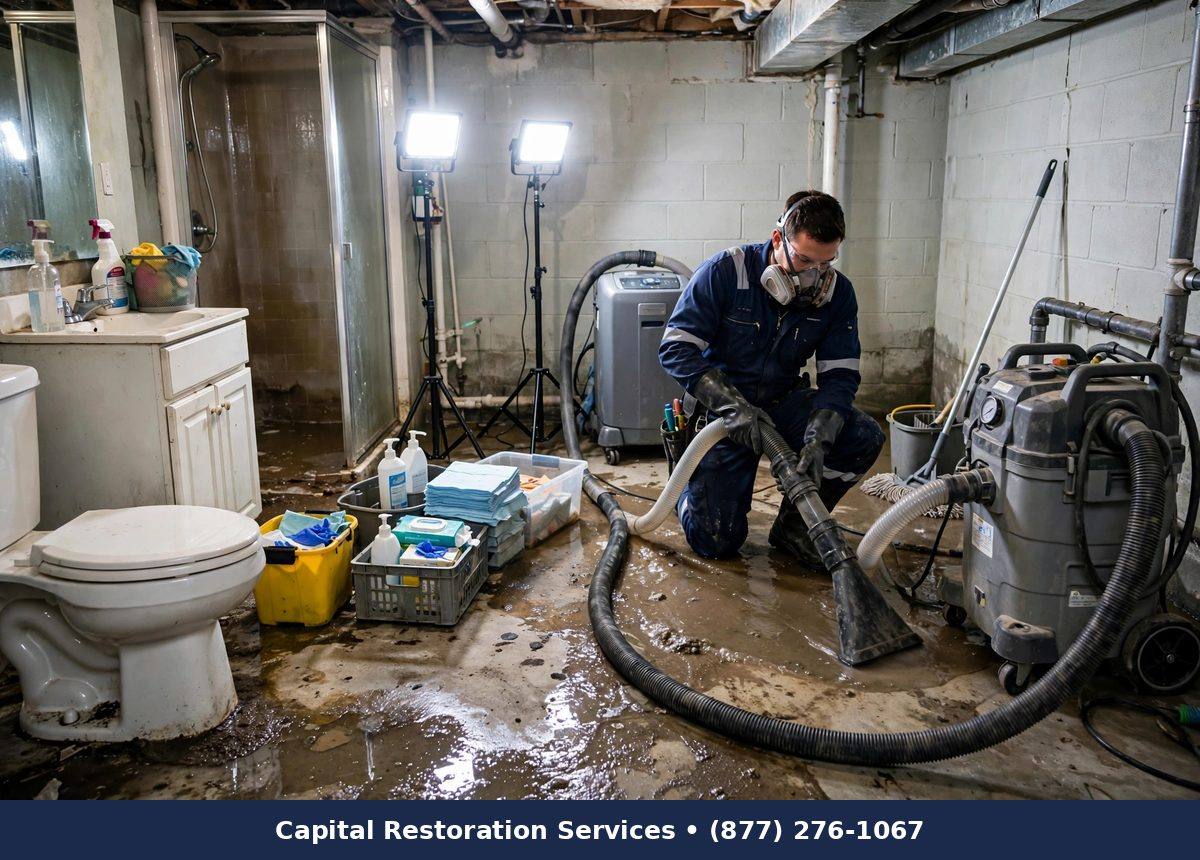
We arrive in full PPE — respirators, disposable suits, goggles, gloves, boots — because Category 3 demands it. Containment goes up first with negative air pressure, sealing the affected zone off from the rest of the building. Then extraction: professional equipment removes the sewage water and waste, which is disposed of properly — wastewater goes to treated sewer systems, never storm drains.
Next comes the part that surprises most homeowners: removal. Per S500, porous materials that contacted black water are removed and discarded, not cleaned. Carpet and pad, drywall below the contamination line (typically cut a foot or two above it), insulation, particleboard cabinets, MDF trim, and upholstered items that absorbed sewage all leave the structure. This isn't being aggressive — it's the standard, and it's what protects you from bacterial and mold problems months later.
What remains — framing, subfloor, concrete, tile — gets the two-stage decontamination: thorough detergent cleaning first, then EPA-registered disinfection. Then structural drying with monitored equipment until readings confirm dry targets. Only when the structure is clean, dry, and verified does rebuilding begin.
What Affects the Cost of Sewage Cleanup
The affected area is the biggest factor — a single bathroom backup is a very different job from a finished basement full of sewage. How long the sewage sat matters too, since contamination spreads and wicks upward into materials over time.
The amount of material requiring removal drives much of the scope: finished spaces with drywall, carpet, and built-ins mean more tear-out than an unfinished concrete basement. HVAC involvement, multi-room spread, and whether the plumbing cause still needs repair all factor in. Emergency response timing plays a role as well. For an honest number on your situation, call (877) 276-1067 — we'll assess and quote the full Category 3 scope in writing.
Sewage Response Across the Area
Capital Restoration Services handles sewage backup cleanup for homes, apartment buildings, and commercial properties throughout the area. We see the classic causes — municipal main blockages during heavy rain, root-intruded clay pipes, failed sump or ejector pumps, and older homes without backflow prevention — and we know how each one plays out. From the first containment plastic to the final verification reading, one team owns the whole hazardous job. Sewage is the one water loss you should never DIY. Let us handle it safely.
Features
- Emergency response with full PPE: respirators, suits, goggles, gloves, and boots
- Containment and negative air pressure to keep contaminants out of clean areas
- Professional extraction of sewage water and solid waste with proper disposal
- Removal and disposal of porous materials that contacted sewage — carpet, pad, drywall, insulation
- Two-stage decontamination of remaining structure: cleaning, then EPA-registered disinfection
- Structural drying with monitored equipment until verified dry targets are reached
- Complete photo and moisture documentation for your insurance claim
Benefits
- Keeps your family away from the serious health hazards of black water
- Follows the IICRC S500 Category 3 protocol your insurer expects
- Removes what can't be saved instead of cleaning what should be discarded
- Disinfects the remaining structure so it's genuinely safe to rebuild on
- Prevents the mold and bacterial problems that follow incomplete sewage jobs
- Handles the disgusting, dangerous work you should never do yourself
- Thorough documentation that supports your claim from the first photo
Frequently asked questions
Can I clean up a small sewage backup myself?
No. Even a small backup is Category 3 black water with real pathogen risk, and household cleaning can't achieve the containment, removal, and disinfection the IICRC S500 standard requires. Keep everyone away and call professionals.
Why do you have to throw away drywall and carpet? Can't it be disinfected?
Porous materials absorb black water deep into their structure, where no surface disinfectant can reliably reach. The S500 standard requires removal and disposal of contaminated porous materials — cleaning them isn't an accepted option, because the health risk stays hidden inside.
How long does sewage cleanup take?
Most residential jobs take several days to a couple of weeks for the full protocol: containment, extraction, removal, decontamination, drying, and verification. Larger losses with finished spaces or HVAC involvement take longer. We'll give you a realistic timeline at the assessment.
Will my homeowner's insurance cover sewage backup?
It depends on your policy — many standard policies exclude sewage backup unless you carry a specific endorsement, while others include limited coverage. Our documentation of the cause, category, and scope gives your adjuster exactly what's needed to evaluate the claim.
How much does sewage backup cleanup cost?
It scales with the affected area, how long the sewage sat, how much porous material must be removed, and whether HVAC or multiple rooms are involved. Call (877) 276-1067 for an on-site assessment and a written quote.