Smoke Damage Encapsulation and Sealing Near Me
Starting price: Call for pricing
Sometimes cleaning isn't enough — when smoke has penetrated deep into porous framing, sealing it in is the professional answer. Capital Restoration Services encapsulates smoke-damaged structural surfaces with specialized sealers after thorough cleaning, locking in residual odor and staining permanently. For framing and structure that cleaning alone can't fully restore, call (877) 276-1067.
When Cleaning Ends and Encapsulation Begins
Every fire restoration reaches a decision point on the framing: is this member clean enough to leave as-is, or does it need to be sealed? Surface cleaning — HEPA vacuuming, dry sponging, washing — does excellent work on soot you can reach. But smoke is a gas, and during a fire it drives into the pores of wood far deeper than any sponge or cloth can follow.
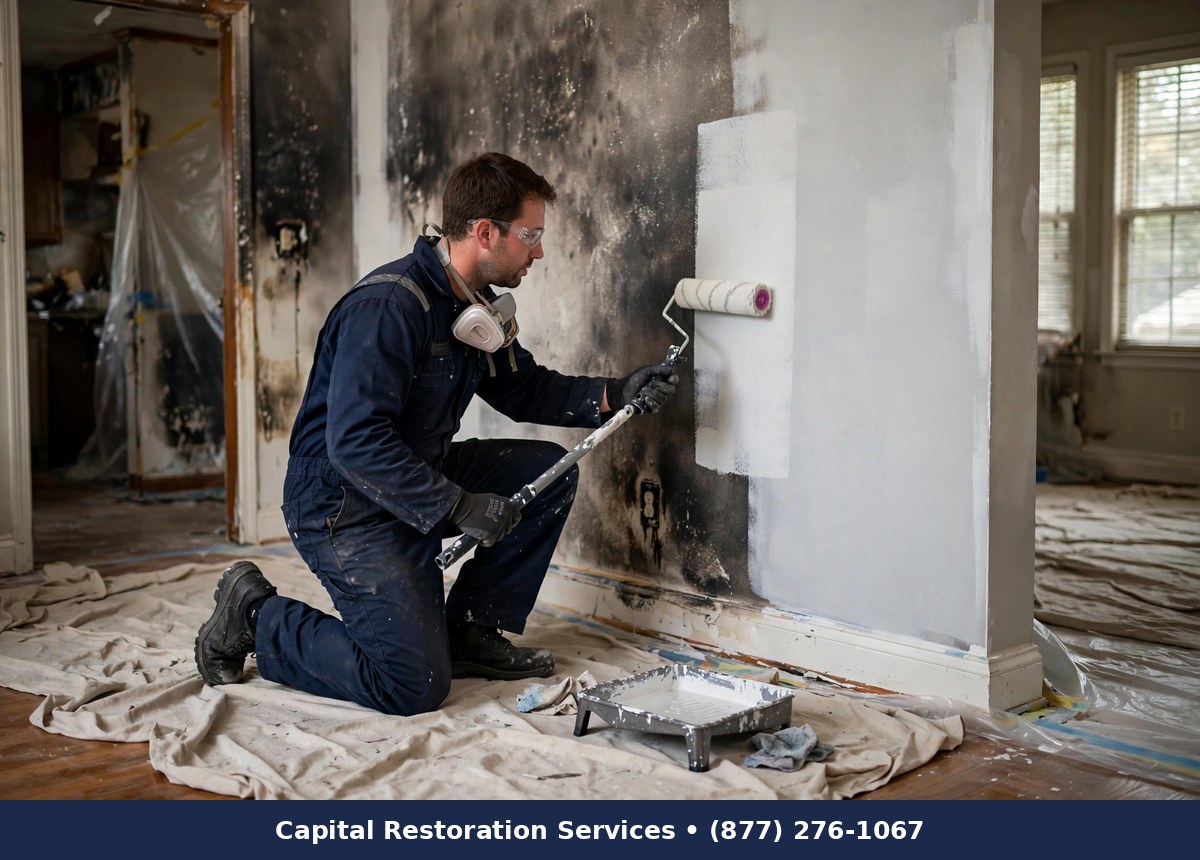
Encapsulation is the professional answer for that gap. After thorough cleaning, specialized sealers are applied to the structural surfaces, forming an impermeable barrier that traps residual odor molecules and staining inside the wood permanently. It's not paint — it's a purpose-built sealer, usually shellac-based, chosen because odor can't migrate through it.
Which Surfaces Get Encapsulated
Encapsulation targets cleaned structural surfaces that will be hidden behind new construction:
- Framing members — studs, joists, rafters, and plates with deep smoke penetration
- Subfloor and roof sheathing — large porous surfaces that hold odor across wide areas
- Attic assemblies — rafters and decking after attic or roof fires, where heat drove smoke deep
- Masonry and concrete — foundation walls and slabs with absorbed smoke odor, using appropriate sealers
- The hidden faces — tops of rafters, backs of studs, ends of joists; the surfaces nobody sees and everybody forgets
That last point deserves emphasis. There's a well-known case in the trade of a rebuilt home that smelled every time it rained — the investigation found the tops of the rafters had never been sealed, even though new roofing sat right above them. The roof had to come back off. We seal every face of every member, because the hidden ones cause the comebacks.
How Encapsulation Fits the Restoration Sequence
Order matters enormously here. Encapsulation happens after cleaning and drying are complete and verified — sealing over soot, moisture, or active contamination locks problems in rather than solving them. Every surface is HEPA-vacuumed and cleaned first, and moisture readings confirm the wood is dry.
The sealer goes on by brush, roller, or spray depending on the surface and access. Shellac-based products are the standard for odor blocking — they cure into a hard, impermeable film. Where the wood must remain visible, clear de-waxed shellac sealers block odor without changing the appearance. Because these are solvent-based products, the space is ventilated properly during application with appropriate safety practices.
Then, and only then, do insulation, drywall, and finishes go in. The sealed structure disappears behind new walls, and the odor stays locked away for the life of the building.
What Affects the Cost of Encapsulation
Surface area is the main driver — linear feet of framing plus square footage of sheathing and subfloor. A single smoke-affected attic is one scale; encapsulating the structural shell of a whole fire-damaged house is another. The depth of penetration matters too: lightly affected members need one thorough coat, while heavily saturated wood may need more product and more careful application.
Access affects labor significantly. Open framed walls are quick; tight attics, low crawlspaces, and intricate roof assemblies are slow. Product selection plays a role — shellac-based sealers cost more than standard primers because they perform where standard primers fail. For your structure's exact number, call (877) 276-1067 after we inspect the framing.
Encapsulation Services Across the Area
Capital Restoration Services provides smoke damage encapsulation and sealing for fire restoration projects in homes, apartments, and commercial buildings throughout the area. We perform it as part of complete fire restoration — cleaning, then sealing, then rebuild — and we also come in to encapsulate after another contractor's cleaning when the odor persists. Whether it's a contained kitchen fire or a whole-house event, the standard is the same: clean first, seal every face, verify the result. The smell stays sealed, permanently.
Features
- Complete HEPA vacuuming and cleaning of all surfaces before any encapsulation
- Assessment of which members need sealing versus which can be left cleaned
- Shellac-based sealers for maximum odor blocking on heavily affected framing
- Clear sealers where the wood's natural appearance must be preserved
- Full-member coverage — faces, ends, tops, and backs of every sealed piece
- Specialized sealers for masonry and concrete with absorbed smoke odor
- Sealing sequenced correctly: after cleaning and drying, before insulation and drywall
Benefits
- Permanently locks in odor that cleaning alone can't remove from porous wood
- Stops smoke staining from bleeding through new paint and finishes
- Costs less than replacing sound structural members that just smell
- Protects your investment in the new finishes going over the sealed structure
- Eliminates the seasonal odor comebacks that plague unsealed fire jobs
- Recognized step in professional fire restoration your insurer understands
- One-and-done application — no maintenance or reapplication needed
Frequently asked questions
What's the difference between encapsulation and just painting over smoke damage?
Regular paint is permeable — odor molecules migrate through it, and stains bleed back within months. Encapsulation uses specialized impermeable sealers, usually shellac-based, that permanently trap odor and staining. Paint goes over the sealer as the finish, never instead of it.
Does every fire job need encapsulation?
No. Light, surface-level smoke often resolves with thorough cleaning alone. Encapsulation is for porous structural materials where smoke penetrated deeper than cleaning can reach. We'll assess your framing honestly and recommend it only where it's actually needed.
Will encapsulation work if the wood wasn't cleaned first?
No — and this is critical. Sealer applied over soot, dirt, or moisture fails: it doesn't bond properly and it locks contaminants in. Proper encapsulation always follows complete HEPA vacuuming, cleaning, and verified drying.
How long does the encapsulation last?
Permanently. Once a proper shellac-based sealer cures on a clean, dry surface, the barrier doesn't wear out or need reapplication. It's a one-time step that lasts the life of the structure.
How much does smoke damage encapsulation cost?
It depends on how much structural surface needs sealing, how deep the smoke penetration is, product requirements, and access to the spaces. Call (877) 276-1067 for a framing inspection and a written quote.