Smoke Damage Restoration Near Me
Starting price: Call for pricing
Smoke damage goes far beyond what you can see — soot on surfaces, odor in wall cavities, residue in ductwork, and contamination on belongings. Capital Restoration Services restores smoke-damaged properties as one connected system per the IICRC S700 standard: assessment, soot removal, deodorization, HVAC cleaning, and verification. When smoke has spread through your property, call (877) 276-1067.
Smoke Damage Is a Whole-Property Problem
After a fire, the instinct is to clean what's visibly dirty. But smoke doesn't respect room boundaries. It travels on air currents through doorways, into wall cavities, up into attics, and through the HVAC system — depositing soot and odor in places that look perfectly clean. A property where only the charred room was addressed will keep smelling, keep showing soot, and keep disappointing.
This service is complete smoke damage restoration: the systematic process of finding everywhere smoke went, removing soot from surfaces and contents, neutralizing odor at its source, cleaning the HVAC system, and verifying the property is truly restored. It follows the IICRC S700 standard for professional fire and smoke restoration. Emergency board-up, structural repair, and full reconstruction are related services handled alongside when needed.
Not All Soot Is the Same
One of the first things a professional determines is what kind of soot they're dealing with, because each type needs different treatment:
- Dry soot. From fast-burning, high-heat fires. Powdery, easier to remove with dry sponging and HEPA vacuuming — but it spreads readily if handled carelessly.
- Wet soot. From slow, smoldering fires. Thick, sticky, and smeary; needs solvent-based cleaners and careful technique to avoid driving it deeper into surfaces.
- Protein soot. From kitchen fires — burned meat, grease, and food. Nearly invisible but intensely odorous, coating everything in a greasy film that discolors paint and varnish.
- Fuel-oil soot. From furnace puff-backs. Sticky, hard to remove, and prone to recurring if the furnace issue isn't fixed.
Using the wrong method on the wrong soot makes things worse — water on dry soot smears it, and aggressive scrubbing on wet soot drives it into the surface. Matching the method to the residue is where professional training pays off.
The Restoration Process, Step by Step
It begins with assessment and containment. We map where smoke traveled — which rooms, which cavities, whether the HVAC carried it — and seal off clean zones so restoration work doesn't spread contamination further. Contents are evaluated: what can be cleaned on-site, what should go to off-site cleaning, and what can't be saved.
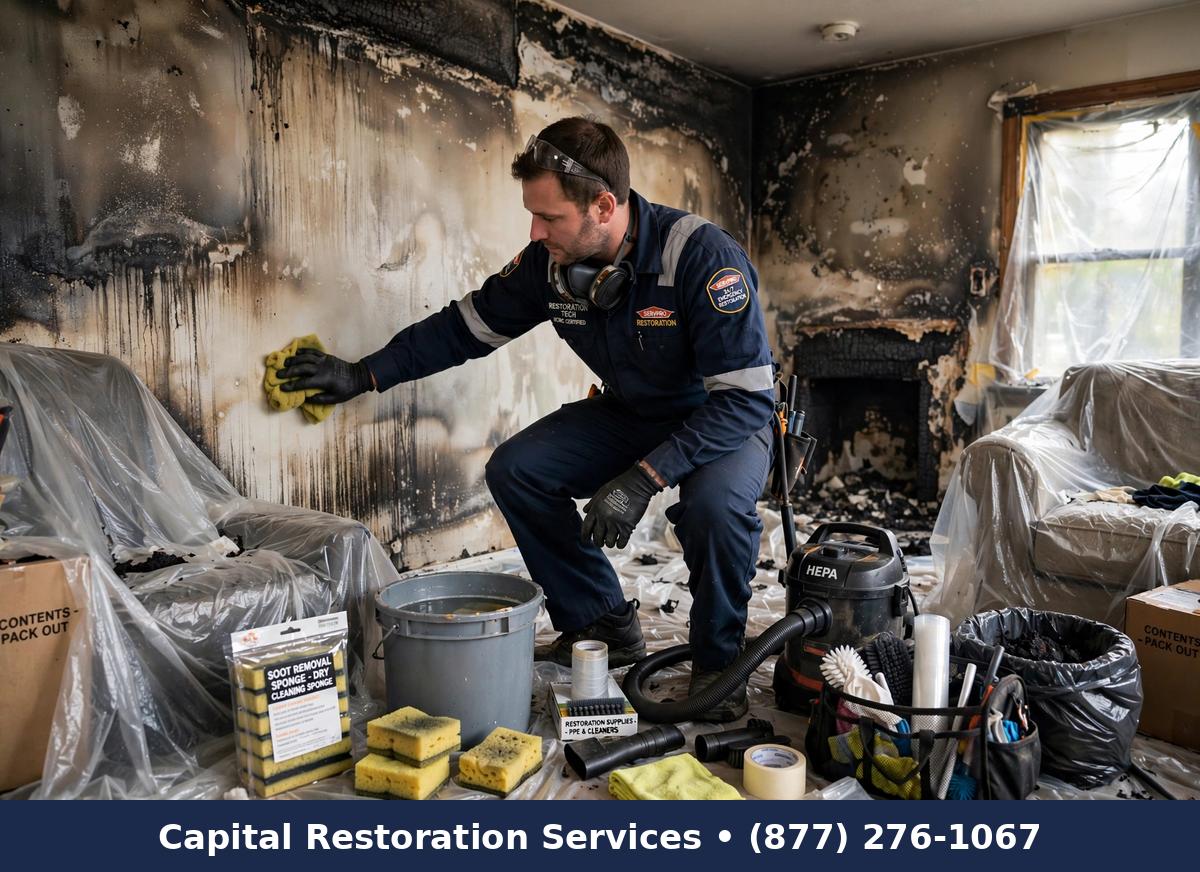
Soot removal comes next, method matched to soot type and surface. Dry chemical sponges lift dry soot without water; HEPA vacuums capture loose particles; solvent-based cleaners cut through wet and protein residues. Every surface gets the approach its material and its soot type call for — walls, ceilings, flooring, cabinetry, and contents each handled appropriately.
Then the HVAC system: filters replaced, ductwork cleaned, coils and air handlers addressed, so the system stops recirculating what we just removed. Deodorization follows, with the technology matched to the situation — thermal fogging for odor trapped in porous materials, ozone for sealed unoccupied spaces, hydroxyl units for occupied areas needing gradual treatment. We finish with verification: odor checks, visual inspection, and confirmation that particle levels are resolved before we call it done.
What Affects the Cost of Smoke Restoration
The extent of smoke travel is the dominant factor. Smoke contained to one room is a contained job; smoke that rode the HVAC through the whole house is a whole-house job. Soot type matters too — protein and fuel-oil residues take more specialized labor than straightforward dry soot.
Contents volume plays a big role. A lightly furnished space cleans faster than a home full of textiles, upholstery, and porous belongings that each need individual attention. HVAC involvement, the deodorization methods required, and whether structural repairs or reconstruction follow all shape the scope. For a real number based on your property, call (877) 276-1067 after our assessment.
Smoke Restoration Across the Area
Capital Restoration Services performs complete smoke damage restoration for homes, apartments, condos, and commercial buildings throughout the area. House fires, kitchen fires, furnace puff-backs, and smoke from a neighboring unit — each gets the full systematic process, not a surface wipe-down. We handle structure and contents together, coordinate with your insurer, and verify the result before we leave. Smoke touched everything it could reach; our restoration reaches everywhere the smoke went.
Features
- IICRC S700-based process covering the whole property as one connected system
- Smoke travel mapping to find every room, cavity, and duct the smoke reached
- Soot removal matched to residue type: dry, wet, protein, and fuel-oil soot
- HEPA air scrubbing running throughout the project to capture airborne particles
- HVAC inspection and cleaning so the system stops recirculating contaminants
- Deodorization matched to the smoke type — fogging, ozone, or hydroxyl as appropriate
- Final verification that odor and particle levels are truly resolved
Benefits
- Treats the entire property, not just the obviously dirty surfaces
- Matches cleaning methods to the actual soot type for real results
- Clears the HVAC system so it stops spreading contamination room to room
- Neutralizes odor at its source instead of masking it
- Handles contents and structure together so nothing gets missed
- Verifies the air is genuinely clean before calling the job done
- Documented process your insurance company recognizes and respects
Frequently asked questions
The fire was in one room. Why does the whole house smell like smoke?
Because smoke travels on air currents — through doorways, into wall cavities, up stairwells, and especially through the HVAC system, which can carry it to every room in minutes. That's why professional restoration maps smoke travel instead of just cleaning the fire room.
Can smoke-damaged clothes, furniture, and belongings be saved?
Often, yes. Textiles and upholstery can go through specialized cleaning, hard contents get cleaned on-site or off-site, and electronics need specific decontamination. We evaluate each category honestly — some porous items with heavy contamination can't be saved, and we'll tell you which.
How long does smoke damage restoration take?
A single room with light smoke might take days; whole-house restoration with heavy soot, contents cleaning, and HVAC work can take weeks. Deodorization methods like hydroxyl treatment add time by design. We give you a realistic schedule after the assessment.
Will the smoke smell come back after you leave?
Not if the job is done completely — which means all soot removed, odor neutralized at the source, HVAC cleaned, and hidden reservoirs like wall cavities addressed. Comebacks happen when steps are skipped. Our verification step exists to catch anything missed before we finish.
How much does smoke damage restoration cost?
It depends on how far the smoke traveled, the soot type, how much contents need cleaning, HVAC involvement, and which deodorization methods are required. Call (877) 276-1067 for an assessment and a written quote.