Soot Removal Services Near Me
Starting price: Call for pricing
Soot is acidic, corrosive, and permanent if handled wrong — wipe it with a wet cloth and you'll smear it into the surface forever. Capital Restoration Services removes soot professionally with HEPA vacuuming, dry chemical sponges, and residue-specific cleaners matched to the soot type. The sooner soot comes off, the less damage it does, so call (877) 276-1067 promptly after any fire.
Why Soot Removal Is a Skill, Not Just Cleaning
Soot looks like dirt, but it behaves nothing like dirt. It's a fine, acidic powder — a byproduct of incomplete combustion — and it begins damaging surfaces the moment it lands. The acids in soot etch glass, corrode metals, yellow plastics, and stain porous materials, and the damage gets worse every hour it sits. Time is genuinely a factor: soot removed today comes off cleanly; soot left for weeks may never fully come off.
Worse, the obvious way to clean it is the wrong way. Wiping soot with a damp cloth or a regular sponge smears the fine particles across the surface and grinds them into pores, turning a removable layer into a permanent stain. That's why professional soot removal is methodical, dry-first, and matched to the specific residue — it's a discipline, not just elbow grease.
The Four Soot Types and Why They Matter
Identifying the soot type determines everything about the approach:
- Dry soot comes from fast, hot fires. It's powdery and lifts well with dry chemical sponges and HEPA vacuuming — but it spreads easily, so containment and careful technique matter.
- Wet soot comes from slow, smoldering, low-heat fires. It's thick, sticky, and smeary, clinging to surfaces in a way dry methods can't handle. Solvent-based cleaners and degreasers break it down.
- Protein soot comes from kitchen fires. It's nearly invisible — a greasy, intensely odorous film rather than black powder — but it discolors paint and varnish and leaves a powerful smell. It needs specialized cleaners, not just wiping.
- Fuel-oil soot comes from furnace puff-backs. It's sticky and persistent, and it recurs if the underlying furnace problem isn't fixed first.
A single fire can produce more than one type in different areas. The technician reads the residue in each zone and adjusts — that's the difference between restoration and a bigger mess.
How Professional Soot Removal Works
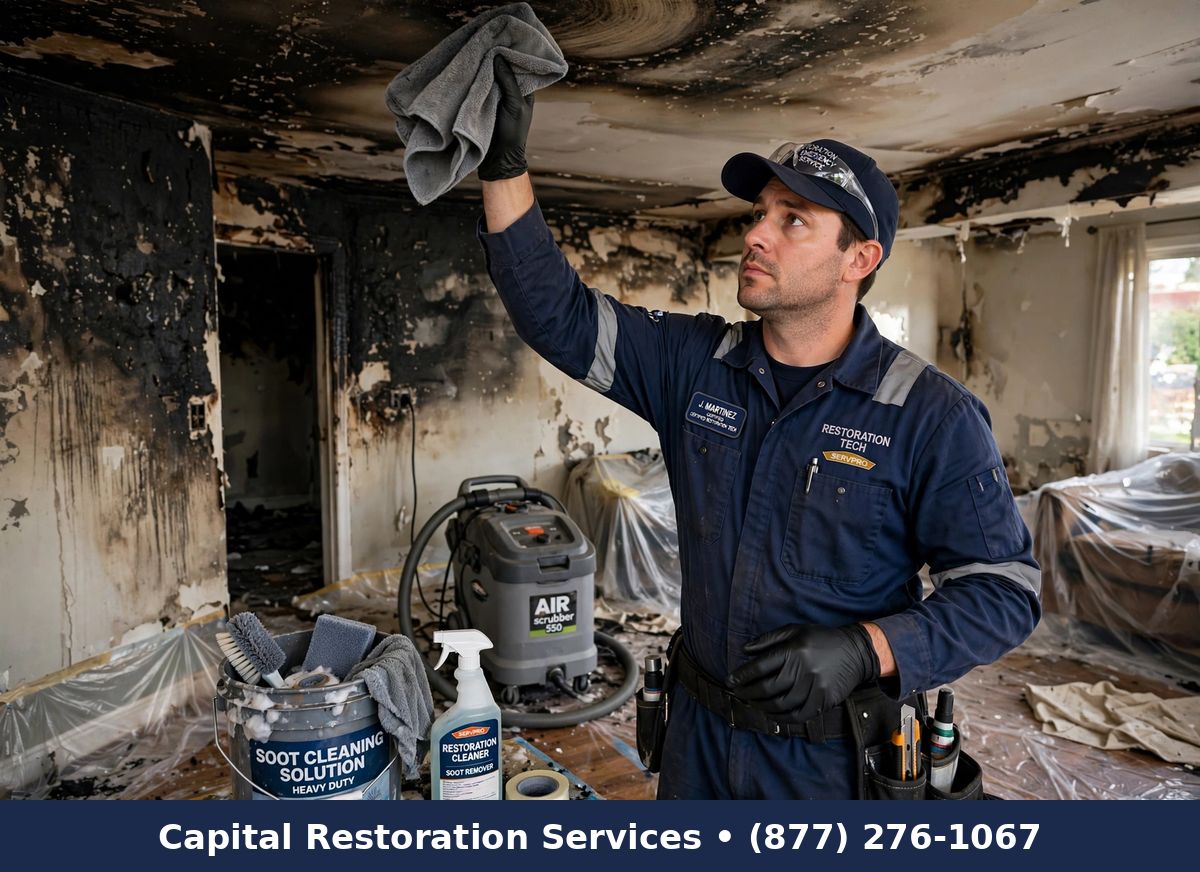
Everything begins dry. Loose soot gets HEPA-vacuumed first, with the nozzle held just above the surface — never pressed on, which would grind particles in. Standard vacuums are forbidden here; without HEPA filtration, they just blow fine soot back into the room.
Then dry chemical sponges — vulcanized rubber sponges made specifically for soot — lift the remaining residue. The technique is press, lift, and rotate to a clean face; never scrub, never wipe in circles. Each sponge face loads up with soot and gets trimmed or replaced, so contamination isn't redeposited. Walls are worked in systematic sections, typically bottom-up, so loosened residue doesn't streak down over cleaned areas.
Wet and protein residues get the solvent treatment: appropriate degreasers and cleaners applied with minimal moisture, worked carefully, and removed before they can drive residue deeper. Delicate surfaces — artwork, electronics, finished wood — each get their own approach. Throughout, the work zone stays contained with HEPA air scrubbing running, because soot removal inevitably puts fine particles in the air.
What Affects the Cost of Soot Removal
Affected surface area is the main factor — how many rooms, how much wall and ceiling footage, and how much contents need individual attention. Soot type matters significantly: straightforward dry soot cleans faster than sticky wet soot or pervasive protein film that coats every surface in the home.
The delay since the fire plays a real role. Fresh soot lifts; aged, bonded soot takes more passes, more product, and more labor — sometimes the difference between cleaning and replacement for the worst-affected finishes. Contents volume, ceiling height, and surface intricacy (crown molding, textured ceilings, built-ins) all add time. For an accurate quote, call (877) 276-1067 — we'll assess the soot type and scope in person.
Soot Removal Across the Area
Capital Restoration Services provides professional soot removal for homes, apartments, and commercial buildings throughout the area after house fires, kitchen fires, furnace puff-backs, and wildfire smoke intrusion. We treat it as the critical first phase it is — because everything downstream, from deodorization to painting, depends on the soot being truly gone first. If your property has soot on its surfaces, the clock is already running on permanent damage. Call us promptly and we'll stop it.
Features
- HEPA-filtered vacuuming to lift loose soot without spreading it or scratching surfaces
- Dry chemical sponges used with proper technique — press and lift, never scrub
- Residue-specific methods for dry, wet, protein, and fuel-oil soot
- Wall and ceiling cleaning in systematic sections, bottom-up to prevent streaking
- Specialized degreasers and solvents for sticky wet-smoke and protein residues
- Careful technique on delicate surfaces: no smearing, no water where it harms
- Coordination with deodorization so odor treatment follows complete soot removal
Benefits
- Removes acidic soot before it etches, stains, or corrodes surfaces permanently
- Uses the right method for your soot type instead of one-size-fits-all wiping
- Prevents the smearing and embedding that ruins DIY cleanup attempts
- Protects metals, glass, and finished surfaces from ongoing corrosive damage
- Prepares surfaces properly for paint, sealing, or further restoration
- Saves belongings and finishes that aggressive wrong-method cleaning would destroy
- Fast response limits the time soot has to bond with your surfaces
Frequently asked questions
Can I just wipe soot off with a damp cloth?
Please don't. Wiping smears fine soot particles across the surface and grinds them into pores, turning removable soot into permanent staining. It also spreads acidic residue to clean areas. Dry, professional methods exist for a reason.
How soon after a fire should soot be removed?
As soon as it's safe to enter. Soot is acidic and corrosive — it etches glass, tarnishes metal, and stains porous materials worse with every passing day. Prompt professional removal is the difference between cleaning and replacing.
My kitchen fire left almost no visible soot, but everything smells. What's going on?
That's protein soot — the nearly invisible, greasy film from burned food. It coats surfaces throughout the home and carries intense odor even when you can't see it. It needs specialized cleaners; standard wiping won't touch it.
Can soot be removed from fabrics and upholstery?
Often, yes, with HEPA vacuuming followed by appropriate professional cleaning methods for the fabric type. Heavily contaminated porous textiles sometimes can't be fully restored, and we'll assess each piece honestly rather than promising what cleaning can't deliver.
How much does professional soot removal cost?
It depends on the affected area, the soot type, how long it's been sitting, and how much contents need individual work. Call (877) 276-1067 for an in-person assessment and a written quote.